“A Complex Sentence is an important book in more than one understanding. It is important in its gather from the range of comprehensions and tentative elusions that comprise Marjorie Welish’s considerable range of work. It is important in that it stands out as seminal in a context of the large number of contemporary poetry book publications. This has come about from the joyful complexity of an artist with visual acuity and constructivist practice in tow with an exact sense of word choice and recurrence. It is a book of poetry that stands out in its range of attentions to different modes of construction and cohesive in its interconnectivity between each construction, between stanzas between different poems between different visual presentations. There is a clarity in the book’s musicality and a disruption of clarity in its sensitive juxtapositions. This is Welish at her best and most powerful moments, at moments of loss and gain, at moments of assuredness and in fleets of frailty.” —Allen Fisher
“A key imperative in Marjorie Welish’s superb new book, A Complex Sentence, is the task of ‘not writing the unsaid,’ which presumably would mean to write the sayable in the folds of a complex sentence that erases it. Literary spirit guides come along to help—Mallarmé, Baudelaire, James, Pound, and critics who read them. There may be a ghostly revision of Pound’s imagism, ‘a complex in an instant of time,’ but instead of le mot juste, we have le mot détourné, diverted as it enters into new semiotic fields and explodes. A Complex Sentence is, in addition, a meditation on the book—its materiality (pages, margins, indexes, parchment, epigraphs, sentences)—and its cultural role as a document. Welish’s sentences are complex, grammatically and narratively; they break the spine, as it were, of the book’s monumentality. In the interstices of writing and saying lies the supplement to meaning, what we read between the lines or what the lines—center margined or flush left—arrange as a new structure of understanding. This is a wild and compelling book.” —Michael Davidson
“In ‘Pervasive Spacing,’ one of several key signature (as in a musical composition and guide to binding pages) poems in A Complex Sentence, Marjorie Welish pauses her restless pencil (instrument of inscription and erasure) to assert this axiomatic one-liner: ‘Scale: she was larger than the room in which she found herself.’ So too Welish, a practitioner of conceptual writing long before the phrase entered the zeitgeist of contemporary American poetry. Her procedural writing, à la Mac Low et al., exceeds normative critical and poetic categories. A Complex Sentence is the latest instantiation of Welish’s relentless pursuit and demonstration of her deliberate, delimited, and far-reaching conceptual imagination. More forcefully than ever before, she subjects found and ‘original’ texts to a panoply of formal constraints. Roaming across the vistas of Western writing—Cicero, Epictetus, Edmund Burke, William Strode, Ezra Pound, Bertolt Brecht, William Carlos Williams, and Nathaniel Mackey all make cameo appearances—Welish cuts and pastes texts into frames of intertextuality, disseminating critical glosses, free-floating quotations, and judgments that, though grounded in a commitment to the primacy of aesthetics, are unafraid of political, social, and cultural affirmations and rebuttals. Welish’s wide-ranging metapoems excavate the generative assumptions underlying the production and translatability of verbal, plastic, and musical languages. A Complex Sentence strips bare the book, canvas, drawing board, and score, jettisoning their accumulated histories in order to resituate them within the domains of languages as denaturalized artifacts. Moreover, media per se is reduced to so many permutations of spacing, rendering temporality and, by implication, aesthetic ‘readability’ as effects, per Derrida, of différance. Encoding her writing as both normative spacing and non-spacing markings (diacritics being a prime example of the latter), Welish treats morphemes as both analog and digital codes mapped onto materials that are anything but neutral. Displacing semantics with syntactics, foregrounding the syntagmatic over the paradigmatic, Welish reminds her readers of the structural, formal, and, above all, cultural values that constrain all meaning-making, artistic or not. For these reasons and more, the title of this book must be read simultaneously as a dialectics—adjective-noun, adjective-verb, noun-verb—without resolution, three dyads orbiting one another in the dance of an intellect with few peers.” —Tyrone Williams
Praise for Marjorie Welish
“[Welish’s] writing is marked by the legacies of multiple modernisms and by sly misprisions and recursions, an obsession with logical forms that flip abruptly into their shadow selves.” —BOMB
“Welish’s poetry, like [Thelonious] Monk’s music, is a montage of moving parts in which you’d be wise to expect the unexpected. . . . Welish is sharp about the muddle that is almost everyone’s daily lot.” —Hyperallergic
“Welish’s poems do for language what great abstract paintings do for paint.” —No: A Journal of the Arts
“Welish’s diction is relentlessly, maddeningly, dazzlingly abstract. . . . The result is a cerebral music that offers, for those willing to spend real time, a commensurate reward.” —Kirkus
“Wrenching, obdurate music. There may be no known correspondences for Marjorie Welish’s mind. The poems neither describe nor situate but compose and construct. The procedures are odd but the materials quite embodied. . . . She’s a little bit scary.” —C. D. Wright
“[Marjorie Welish’s work] has both sensuality and really dazzling conceptual rigor.” —Culture Industry
“For Welish, as with the Alice Notley of Descent of Alette, cordoned off words and phrases imply a poised and thoughtful consciousness, caught in the midst of intellective and amusing animations of things and thought.” —Publishers Weekly
“Ferocious, sometimes hilarious and always provocative. . . . No one has ever written like Marjorie Welish.” —Poetry Project Newsletter
“Welish’s usual practice is ‘not to trust language,’ which makes her work bumpy, real, alive. . . . A poet of ‘the insistent now,’ Welish is sensitive to the chora; let her get wind of a chaoid and she’s off.” —Lana Turner
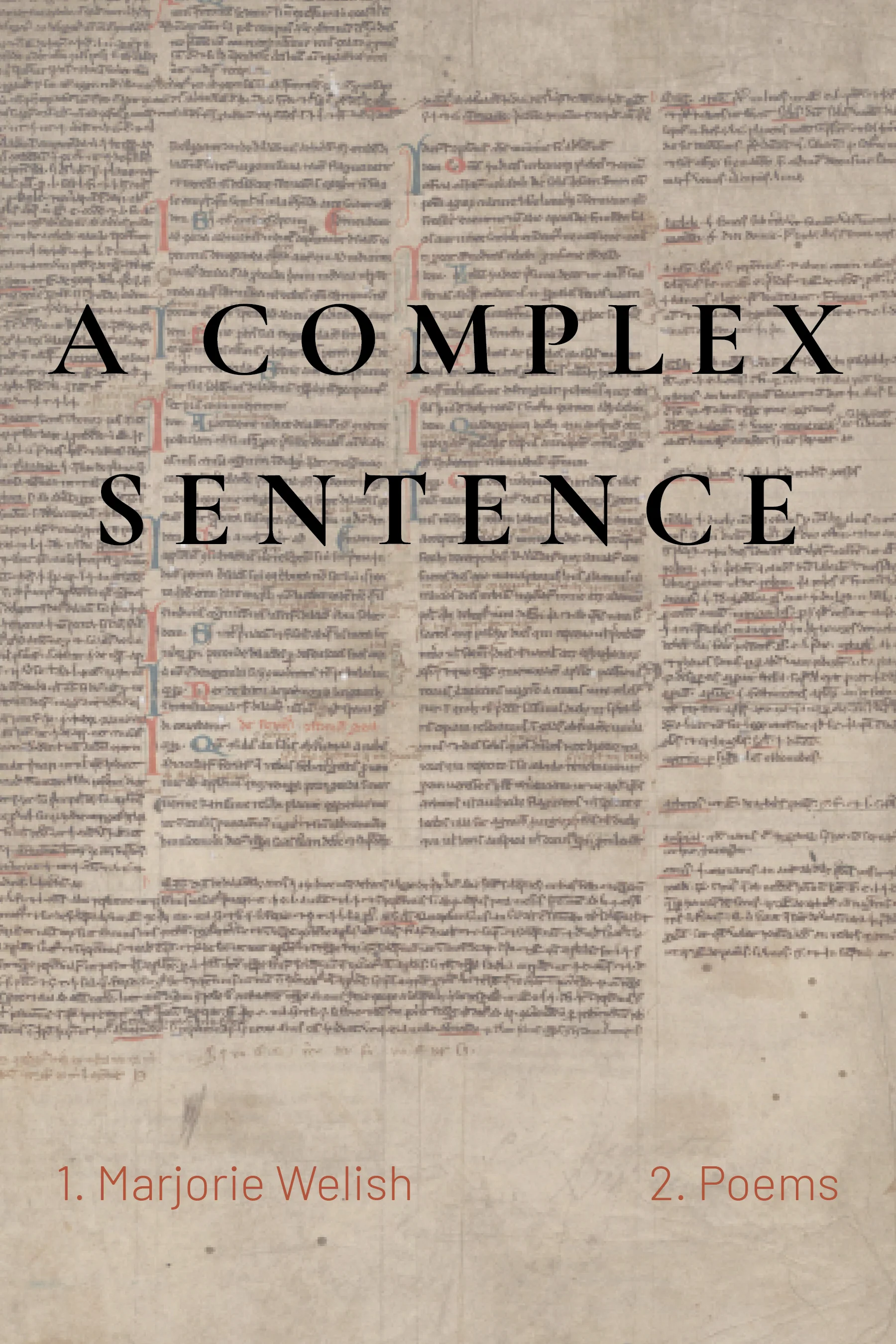
A Complex Sentence
Poetry by Marjorie Welish
May 11, 2021 • 6 x 9 • 128 pages • 978-1-56689-608-5
In A Complex Sentence, Marjorie Welish builds immersive intertextual environments as she questions the canon of modernist poetry and the ways we talk about poetics.
In her sixth collection with Coffee House, Welish continues to explore rhetorical practices such as diagramming, inscription, and quotation, to call our attention to literary acts—from finding the right desk to getting lost at logic gates—yet all the while following the mental circuitry of dismantling and re-assembling a poetic language. Expertly manipulating the space of the page, her poems dissolve the boundaries between visual art and the written word. With her signature precision, musicality, and structural rigor, Welish turns the lyric poem into a critical instrument with which to think about the writer’s calling, through the specifics of language and literature.
About the Author
A Complex Sentence, the sixth book of poems by Marjorie Welish to be published by Coffee House Press, received fellowship support from the John Simon Guggenheim Memorial Foundation and St. Edmund’s College, University of Cambridge. For her arts and critical practice, she has received a Fulbright Senior Scholarship, which has taken her to the University of Frankfurt and to the Edinburgh College of Art. Papers delivered on her arts practices at a conference at the University of Pennsylvania are compiled in Of the Diagram: The Work of Marjorie Welish. Signifying Art: Essays on Art after 1960 is a book of her art criticism. A Work, and . . ., in which she is interviewed by Lilly Wei, is the most extensive catalogue of her art.
Praise for A Complex Sentence
“A Complex Sentence is an important book in more than one understanding. It is important in its gather from the range of comprehensions and tentative elusions that comprise Marjorie Welish’s considerable range of work. It is important in that it stands out as seminal in a context of the large number of contemporary poetry book publications. This has come about from the joyful complexity of an artist with visual acuity and constructivist practice in tow with an exact sense of word choice and recurrence. It is a book of poetry that stands out in its range of attentions to different modes of construction and cohesive in its interconnectivity between each construction, between stanzas between different poems between different visual presentations. There is a clarity in the book’s musicality and a disruption of clarity in its sensitive juxtapositions. This is Welish at her best and most powerful moments, at moments of loss and gain, at moments of assuredness and in fleets of frailty.” —Allen Fisher
“A key imperative in Marjorie Welish’s superb new book, A Complex Sentence, is the task of ‘not writing the unsaid,’ which presumably would mean to write the sayable in the folds of a complex sentence that erases it. Literary spirit guides come along to help—Mallarmé, Baudelaire, James, Pound, and critics who read them. There may be a ghostly revision of Pound’s imagism, ‘a complex in an instant of time,’ but instead of le mot juste, we have le mot détourné, diverted as it enters into new semiotic fields and explodes. A Complex Sentence is, in addition, a meditation on the book—its materiality (pages, margins, indexes, parchment, epigraphs, sentences)—and its cultural role as a document. Welish’s sentences are complex, grammatically and narratively; they break the spine, as it were, of the book’s monumentality. In the interstices of writing and saying lies the supplement to meaning, what we read between the lines or what the lines—center margined or flush left—arrange as a new structure of understanding. This is a wild and compelling book.” —Michael Davidson
“In ‘Pervasive Spacing,’ one of several key signature (as in a musical composition and guide to binding pages) poems in A Complex Sentence, Marjorie Welish pauses her restless pencil (instrument of inscription and erasure) to assert this axiomatic one-liner: ‘Scale: she was larger than the room in which she found herself.’ So too Welish, a practitioner of conceptual writing long before the phrase entered the zeitgeist of contemporary American poetry. Her procedural writing, à la Mac Low et al., exceeds normative critical and poetic categories. A Complex Sentence is the latest instantiation of Welish’s relentless pursuit and demonstration of her deliberate, delimited, and far-reaching conceptual imagination. More forcefully than ever before, she subjects found and ‘original’ texts to a panoply of formal constraints. Roaming across the vistas of Western writing—Cicero, Epictetus, Edmund Burke, William Strode, Ezra Pound, Bertolt Brecht, William Carlos Williams, and Nathaniel Mackey all make cameo appearances—Welish cuts and pastes texts into frames of intertextuality, disseminating critical glosses, free-floating quotations, and judgments that, though grounded in a commitment to the primacy of aesthetics, are unafraid of political, social, and cultural affirmations and rebuttals. Welish’s wide-ranging metapoems excavate the generative assumptions underlying the production and translatability of verbal, plastic, and musical languages. A Complex Sentence strips bare the book, canvas, drawing board, and score, jettisoning their accumulated histories in order to resituate them within the domains of languages as denaturalized artifacts. Moreover, media per se is reduced to so many permutations of spacing, rendering temporality and, by implication, aesthetic ‘readability’ as effects, per Derrida, of différance. Encoding her writing as both normative spacing and non-spacing markings (diacritics being a prime example of the latter), Welish treats morphemes as both analog and digital codes mapped onto materials that are anything but neutral. Displacing semantics with syntactics, foregrounding the syntagmatic over the paradigmatic, Welish reminds her readers of the structural, formal, and, above all, cultural values that constrain all meaning-making, artistic or not. For these reasons and more, the title of this book must be read simultaneously as a dialectics—adjective-noun, adjective-verb, noun-verb—without resolution, three dyads orbiting one another in the dance of an intellect with few peers.” —Tyrone Williams
Praise for Marjorie Welish
“[Welish’s] writing is marked by the legacies of multiple modernisms and by sly misprisions and recursions, an obsession with logical forms that flip abruptly into their shadow selves.” —BOMB
“Welish’s poetry, like [Thelonious] Monk’s music, is a montage of moving parts in which you’d be wise to expect the unexpected. . . . Welish is sharp about the muddle that is almost everyone’s daily lot.” —Hyperallergic
“Welish’s poems do for language what great abstract paintings do for paint.” —No: A Journal of the Arts
“Welish’s diction is relentlessly, maddeningly, dazzlingly abstract. . . . The result is a cerebral music that offers, for those willing to spend real time, a commensurate reward.” —Kirkus
“Wrenching, obdurate music. There may be no known correspondences for Marjorie Welish’s mind. The poems neither describe nor situate but compose and construct. The procedures are odd but the materials quite embodied. . . . She’s a little bit scary.” —C. D. Wright
“[Marjorie Welish’s work] has both sensuality and really dazzling conceptual rigor.” —Culture Industry
“For Welish, as with the Alice Notley of Descent of Alette, cordoned off words and phrases imply a poised and thoughtful consciousness, caught in the midst of intellective and amusing animations of things and thought.” —Publishers Weekly
“Ferocious, sometimes hilarious and always provocative. . . . No one has ever written like Marjorie Welish.” —Poetry Project Newsletter
“Welish’s usual practice is ‘not to trust language,’ which makes her work bumpy, real, alive. . . . A poet of ‘the insistent now,’ Welish is sensitive to the chora; let her get wind of a chaoid and she’s off.” —Lana Turner
Product Information
Product Information
Shipping & Returns
Shipping & Returns
Description
Poetry by Marjorie Welish
May 11, 2021 • 6 x 9 • 128 pages • 978-1-56689-608-5
In A Complex Sentence, Marjorie Welish builds immersive intertextual environments as she questions the canon of modernist poetry and the ways we talk about poetics.
In her sixth collection with Coffee House, Welish continues to explore rhetorical practices such as diagramming, inscription, and quotation, to call our attention to literary acts—from finding the right desk to getting lost at logic gates—yet all the while following the mental circuitry of dismantling and re-assembling a poetic language. Expertly manipulating the space of the page, her poems dissolve the boundaries between visual art and the written word. With her signature precision, musicality, and structural rigor, Welish turns the lyric poem into a critical instrument with which to think about the writer’s calling, through the specifics of language and literature.
About the Author
A Complex Sentence, the sixth book of poems by Marjorie Welish to be published by Coffee House Press, received fellowship support from the John Simon Guggenheim Memorial Foundation and St. Edmund’s College, University of Cambridge. For her arts and critical practice, she has received a Fulbright Senior Scholarship, which has taken her to the University of Frankfurt and to the Edinburgh College of Art. Papers delivered on her arts practices at a conference at the University of Pennsylvania are compiled in Of the Diagram: The Work of Marjorie Welish. Signifying Art: Essays on Art after 1960 is a book of her art criticism. A Work, and . . ., in which she is interviewed by Lilly Wei, is the most extensive catalogue of her art.
Praise for A Complex Sentence
“A Complex Sentence is an important book in more than one understanding. It is important in its gather from the range of comprehensions and tentative elusions that comprise Marjorie Welish’s considerable range of work. It is important in that it stands out as seminal in a context of the large number of contemporary poetry book publications. This has come about from the joyful complexity of an artist with visual acuity and constructivist practice in tow with an exact sense of word choice and recurrence. It is a book of poetry that stands out in its range of attentions to different modes of construction and cohesive in its interconnectivity between each construction, between stanzas between different poems between different visual presentations. There is a clarity in the book’s musicality and a disruption of clarity in its sensitive juxtapositions. This is Welish at her best and most powerful moments, at moments of loss and gain, at moments of assuredness and in fleets of frailty.” —Allen Fisher
“A key imperative in Marjorie Welish’s superb new book, A Complex Sentence, is the task of ‘not writing the unsaid,’ which presumably would mean to write the sayable in the folds of a complex sentence that erases it. Literary spirit guides come along to help—Mallarmé, Baudelaire, James, Pound, and critics who read them. There may be a ghostly revision of Pound’s imagism, ‘a complex in an instant of time,’ but instead of le mot juste, we have le mot détourné, diverted as it enters into new semiotic fields and explodes. A Complex Sentence is, in addition, a meditation on the book—its materiality (pages, margins, indexes, parchment, epigraphs, sentences)—and its cultural role as a document. Welish’s sentences are complex, grammatically and narratively; they break the spine, as it were, of the book’s monumentality. In the interstices of writing and saying lies the supplement to meaning, what we read between the lines or what the lines—center margined or flush left—arrange as a new structure of understanding. This is a wild and compelling book.” —Michael Davidson
“In ‘Pervasive Spacing,’ one of several key signature (as in a musical composition and guide to binding pages) poems in A Complex Sentence, Marjorie Welish pauses her restless pencil (instrument of inscription and erasure) to assert this axiomatic one-liner: ‘Scale: she was larger than the room in which she found herself.’ So too Welish, a practitioner of conceptual writing long before the phrase entered the zeitgeist of contemporary American poetry. Her procedural writing, à la Mac Low et al., exceeds normative critical and poetic categories. A Complex Sentence is the latest instantiation of Welish’s relentless pursuit and demonstration of her deliberate, delimited, and far-reaching conceptual imagination. More forcefully than ever before, she subjects found and ‘original’ texts to a panoply of formal constraints. Roaming across the vistas of Western writing—Cicero, Epictetus, Edmund Burke, William Strode, Ezra Pound, Bertolt Brecht, William Carlos Williams, and Nathaniel Mackey all make cameo appearances—Welish cuts and pastes texts into frames of intertextuality, disseminating critical glosses, free-floating quotations, and judgments that, though grounded in a commitment to the primacy of aesthetics, are unafraid of political, social, and cultural affirmations and rebuttals. Welish’s wide-ranging metapoems excavate the generative assumptions underlying the production and translatability of verbal, plastic, and musical languages. A Complex Sentence strips bare the book, canvas, drawing board, and score, jettisoning their accumulated histories in order to resituate them within the domains of languages as denaturalized artifacts. Moreover, media per se is reduced to so many permutations of spacing, rendering temporality and, by implication, aesthetic ‘readability’ as effects, per Derrida, of différance. Encoding her writing as both normative spacing and non-spacing markings (diacritics being a prime example of the latter), Welish treats morphemes as both analog and digital codes mapped onto materials that are anything but neutral. Displacing semantics with syntactics, foregrounding the syntagmatic over the paradigmatic, Welish reminds her readers of the structural, formal, and, above all, cultural values that constrain all meaning-making, artistic or not. For these reasons and more, the title of this book must be read simultaneously as a dialectics—adjective-noun, adjective-verb, noun-verb—without resolution, three dyads orbiting one another in the dance of an intellect with few peers.” —Tyrone Williams
Praise for Marjorie Welish
“[Welish’s] writing is marked by the legacies of multiple modernisms and by sly misprisions and recursions, an obsession with logical forms that flip abruptly into their shadow selves.” —BOMB
“Welish’s poetry, like [Thelonious] Monk’s music, is a montage of moving parts in which you’d be wise to expect the unexpected. . . . Welish is sharp about the muddle that is almost everyone’s daily lot.” —Hyperallergic
“Welish’s poems do for language what great abstract paintings do for paint.” —No: A Journal of the Arts
“Welish’s diction is relentlessly, maddeningly, dazzlingly abstract. . . . The result is a cerebral music that offers, for those willing to spend real time, a commensurate reward.” —Kirkus
“Wrenching, obdurate music. There may be no known correspondences for Marjorie Welish’s mind. The poems neither describe nor situate but compose and construct. The procedures are odd but the materials quite embodied. . . . She’s a little bit scary.” —C. D. Wright
“[Marjorie Welish’s work] has both sensuality and really dazzling conceptual rigor.” —Culture Industry
“For Welish, as with the Alice Notley of Descent of Alette, cordoned off words and phrases imply a poised and thoughtful consciousness, caught in the midst of intellective and amusing animations of things and thought.” —Publishers Weekly
“Ferocious, sometimes hilarious and always provocative. . . . No one has ever written like Marjorie Welish.” —Poetry Project Newsletter
“Welish’s usual practice is ‘not to trust language,’ which makes her work bumpy, real, alive. . . . A poet of ‘the insistent now,’ Welish is sensitive to the chora; let her get wind of a chaoid and she’s off.” —Lana Turner