Winner of the 2022 Lambda Literary Award in Bisexual Nonfiction
Winner of the 2022 Jean Córdova Prize for Lesbian/Queer Nonfiction
Publishers Weekly, “Featured Travel Books 2021”
The A.V. Club, “Books to Read in November”
Ms. Magazine, “November Reads for the Rest of Us”
Literary Hub, “Indie Booksellers Recommend”
Book Riot, “8 Queer Books that Explore Place, Nature, and the Environment”
“There’s a push and pull to the movement of [Sabatini Sloan’s] ideas that engaged me completely. Structurally, this beautifully fragmented essay creates space for the reader to sit with the thoughts and images which engage Sloan. . . . Rigorous essays shake up memory, history, and what we consider the knowledge we possess.” —Lauren LeBlanc, Observer
“Teems with satisfying complexity. . . . Sloan has that rare ability to convey the astonishment of an insight at the instant of its arrival. . . . Not much happens on this trip. And yet everything happens. The body travels while the mind wanders and the sensation is that of roaming freely—the valorization of landscape as an interior experience.” —Lisa Hsiao Chen, The Rumpus
\"This book-length essay is about Homer, Alaska, and what it’s like to be a queer Black woman in a very white town. It’s about Sloan’s own experience of wilderness, but it’s also about the history of nature writing and the racism inherent in so much of it, being an artist, photography, loneliness, and wildlife. . . . Expansive and spacious.” —Laura Sackton, Book Riot
“Essayist Sabatini Sloan muses on ice, art, and her exes in this lyrical exploration of Homer, Alaska. . . . Throughout, the descriptions are surprising and funny, the musings on race in Alaska poignant, and the prose punchy, vulnerable, and surprising.” —Publishers Weekly
“A meditative journey to Homer, Alaska. . . . No one lands in such a unique setting without a darn good story of how and why. This is stunning. Sloan’s prose is breathtaking as she explores the wilderness.” —Courtney Eathorne, Booklist
“Negotiating between the spaciousness of her environment and the strictures of history and identity, she frames travel as both fraught and illuminating.” —Publishers Weekly
“Borealis is an absolutely beautiful meditation on the cohabitation of linguistics and space, specifically interrogating the confines of being perceived. Weaving art and experience together, Aisha Sabatini Sloan complicates landscapes—both the physical understanding of place and the more difficult-to-pin-down landscape of one’s lived experiences. With intimacy and care, Sloan writes her own lifetime of art-making and what we might learn from the art and landscapes of others. Borealis is a delight and a truly stunning work.” —Kaitlynn Cassidy, Seminary Co-op Bookstores
“An extraordinary experience! The place Borealis takes us to is lodged within a vivid consciousness. Here, the environment is populated by memories of lovers and strangers with guns. Letters from prison arrive in this place, and confinement haunts its wide margins. The soundtrack fades in and out, art is found and made. A landscape has never felt so real to me, so like life.” —Eula Biss
“As aurora to her titular borealis, Aisha Sabatini Sloan bends and flashes with belletristic dexterity and a quietly big-sticked insistence upon her own agency. ‘I forget what’s a thing to say,’ she writes, even as her unique geometries of syntax, set against the book’s glacial blocks of white space, elicit revelatory ways not just to say a thing but to see it. Through dexterous collaging of art, literature, correspondence, music, overheards, skylight colors, and intellectual flexes set against a prison’s visiting-room wall, Borealis resists bindings of genre or collective propinquity. Instead, Sabatini Sloan’s conversational architectures of space illuminate landscape as internal experience whose vastness, she finds, forces her to become her own friend.” —Samiya Bashir
“‘I am, again, interested in my interest,’ Aisha Sabatini Sloan writes in her thoughtful, introspective meditation on art, glaciers, Alaska, queer relationships, and race. Like a great landscape painting, there is depth in the stillness of this essay and vibrancy in the coldness of its environment. Sloan is a fascinating thinker, who makes everything she is interested in interesting to everyone else.” —Josh Cook, Porter Square Books
Praise for Dreaming of Ramadi in Detroit
Winner of the 2018 CLMP Firecracker Award for Creative Nonfiction
“Though it’s hard to narrow down my choices in nonfiction, I can tell you that I put down Aisha Sabatini Sloan’s Dreaming of Ramadi in Detroit and instantly wanted to pick it up again. The intelligence and expansiveness of this book of essays astounded me.” —Camille Dungy
“She’s a master time-bender. Her essay ‘D is for the Dance of the Hours,’ which I particularly love, is set in contemporary Detroit but begins in her father’s childhood. Throughout that essay Detroit today is joined, by metaphor, to a centuries-old history of opera. The essay moves across one day in Detroit, but pulls that day toward the past in a way that stretches time and reminds the reader that the past, both near and far, is always present, always palpable in our day-to-day lives.” —Eula Biss, Literary Hub
“Dreaming of Ramadi in Detroit is an otherworldly meditation on the elasticity of memory, the liveliness of blackness, and possibilities of the essay. Aisha Sabatini Sloan manages to produce a collection of essays that are at once innovative, inspiring, sobering, and absolutely terrifying while daring every other essayist in the country to catch up.” —Kiese Laymon
“Dreaming, exploring, probing, confessing, Aisha Sabatini Sloan is always on the move. She crosses borders, turns fixed states of mind and heart into fresh sites of possibility and mystery. Those vast charged realities—race, class, gender, geography—become particular here, casting light and shadow on each other in startling ways. This is a luminous book.” —Margo Jefferson
“I’m so impressed by the critical lucidity of Aisha Sabatini Sloan’s Dreaming of Ramadi in Detroit. Essay by essay, paragraph by paragraph, sometimes even sentence by sentence, Sloan roves, guided by a deliberate, intelligent, associative logic which feels somehow both loose and exact, at times exacting. The implicit and explicit argument of these essays is that there’s no way out but through—and maybe even no way out. So here we are, so lucky to have Sloan as our patient, wry, questing companion and guide.” —Maggie Nelson
Praise for The Fluency of Light: Coming of Age in a Theater of Black and White
“One of the most original, startling memoirs I have seen in the past ten years, Sabatini Sloan’s The Fluency of Light charts an entirely fresh course through the tangled territory of race and class in modern-day America. Each page offers fresh insight, unexpected information, crystal-clear thinking on the current cultural moment—a nation about to turn more brown than white, more mixed than ‘pure.’” —Dinty W. Moore
“The Fluency of Light makes a very valuable contribution to the literature of mixed-race identity in America. . . . She doesn’t pretend to have any solutions to the entrenched (because entirely visual) nature of racial separation, but the way she keeps going, herself, as a photographer, throughout the story underscores the message that doing art is essential to survival.” —Fanny Howe
Borealis
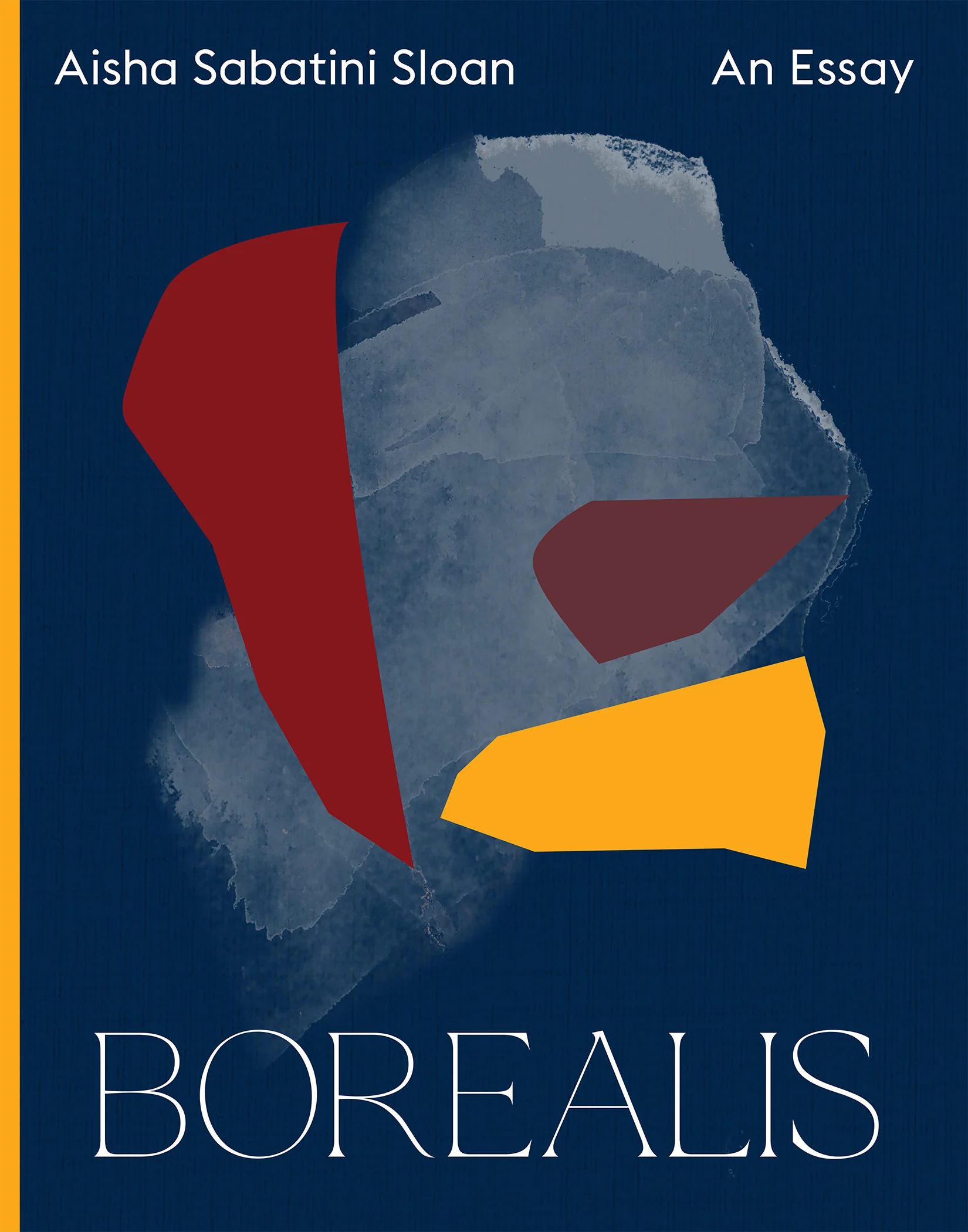
An essay by Aisha Sabatini Sloan
November 2, 2021 • 5.5 x 7 • 144 pages • 978-1-56689-619-1
Art about glaciers, queer relationships, political anxiety, and the meaning of Blackness in open space—Borealis is a shapeshifting logbook of Aisha Sabatini Sloan’s experiences moving through the Alaskan outdoors.
In Borealis, Aisha Sabatini Sloan observes shorelines, mountains, bald eagles, and Black fellow travelers while feeling menaced by the specter of nature writing. She considers the meaning of open spaces versus enclosed ones and maps out the web of queer relationships that connect her to this quaint Alaskan town. Triangulating the landscapes she moves through with glacial backdrops in the work of Black conceptual artists and writers, Sabatini Sloan complicates tropes of Alaska to suggest that the excitement, exploration, and possibility of myth-making can also be twinned by isolation, anxiety, and boredom.
Borealis is the first book commissioned for the Spatial Species series, edited by Youmna Chlala and Ken Chen. The series investigates the ways we activate space through language. In the tradition of Georges Perec’s An Attempt at Exhausting a Place in Paris, Spatial Species titles are pocket-sized editions, each keenly focused on place. Instead of tourist spots and public squares, we encounter unmarked, noncanonical spaces: edges, alleyways, diasporic traces. Such intimate journeying requires experiments in language and genre, moving travelogue, fiction, or memoir into something closer to eating, drinking, and dreaming.
About the Author
Aisha Sabatini Sloan was born and raised in Los Angeles. Her writing about race and current events is often coupled with analysis of art, film, and pop culture. She studied English literature at Carleton College and went on to earn an MA in cultural studies and studio art from the Gallatin School of Individualized Study at NYU and an MFA in creative nonfiction from the University of Arizona. She is the author of the essay collections The Fluency of Light: Coming of Age in a Theater of Black and White and Dreaming of Ramadi in Detroit. With her father, she is the author of Captioning the Archives, a conversation through image and text. She is a recipient of the 2018 CLMP Firecracker Award for Creative Nonfiction and a 2020 National Endowment for the Arts Literature Fellowship. She teaches creative writing at the University of Michigan.
Praise for Borealis
Winner of the 2022 Lambda Literary Award in Bisexual Nonfiction
Winner of the 2022 Jean Córdova Prize for Lesbian/Queer Nonfiction
Publishers Weekly, “Featured Travel Books 2021”
The A.V. Club, “Books to Read in November”
Ms. Magazine, “November Reads for the Rest of Us”
Literary Hub, “Indie Booksellers Recommend”
Book Riot, “8 Queer Books that Explore Place, Nature, and the Environment”
“There’s a push and pull to the movement of [Sabatini Sloan’s] ideas that engaged me completely. Structurally, this beautifully fragmented essay creates space for the reader to sit with the thoughts and images which engage Sloan. . . . Rigorous essays shake up memory, history, and what we consider the knowledge we possess.” —Lauren LeBlanc, Observer
“Teems with satisfying complexity. . . . Sloan has that rare ability to convey the astonishment of an insight at the instant of its arrival. . . . Not much happens on this trip. And yet everything happens. The body travels while the mind wanders and the sensation is that of roaming freely—the valorization of landscape as an interior experience.” —Lisa Hsiao Chen, The Rumpus
"This book-length essay is about Homer, Alaska, and what it’s like to be a queer Black woman in a very white town. It’s about Sloan’s own experience of wilderness, but it’s also about the history of nature writing and the racism inherent in so much of it, being an artist, photography, loneliness, and wildlife. . . . Expansive and spacious.” —Laura Sackton, Book Riot
“Essayist Sabatini Sloan muses on ice, art, and her exes in this lyrical exploration of Homer, Alaska. . . . Throughout, the descriptions are surprising and funny, the musings on race in Alaska poignant, and the prose punchy, vulnerable, and surprising.” —Publishers Weekly
“A meditative journey to Homer, Alaska. . . . No one lands in such a unique setting without a darn good story of how and why. This is stunning. Sloan’s prose is breathtaking as she explores the wilderness.” —Courtney Eathorne, Booklist
“Negotiating between the spaciousness of her environment and the strictures of history and identity, she frames travel as both fraught and illuminating.” —Publishers Weekly
“Borealis is an absolutely beautiful meditation on the cohabitation of linguistics and space, specifically interrogating the confines of being perceived. Weaving art and experience together, Aisha Sabatini Sloan complicates landscapes—both the physical understanding of place and the more difficult-to-pin-down landscape of one’s lived experiences. With intimacy and care, Sloan writes her own lifetime of art-making and what we might learn from the art and landscapes of others. Borealis is a delight and a truly stunning work.” —Kaitlynn Cassidy, Seminary Co-op Bookstores
“An extraordinary experience! The place Borealis takes us to is lodged within a vivid consciousness. Here, the environment is populated by memories of lovers and strangers with guns. Letters from prison arrive in this place, and confinement haunts its wide margins. The soundtrack fades in and out, art is found and made. A landscape has never felt so real to me, so like life.” —Eula Biss
“As aurora to her titular borealis, Aisha Sabatini Sloan bends and flashes with belletristic dexterity and a quietly big-sticked insistence upon her own agency. ‘I forget what’s a thing to say,’ she writes, even as her unique geometries of syntax, set against the book’s glacial blocks of white space, elicit revelatory ways not just to say a thing but to see it. Through dexterous collaging of art, literature, correspondence, music, overheards, skylight colors, and intellectual flexes set against a prison’s visiting-room wall, Borealis resists bindings of genre or collective propinquity. Instead, Sabatini Sloan’s conversational architectures of space illuminate landscape as internal experience whose vastness, she finds, forces her to become her own friend.” —Samiya Bashir
“‘I am, again, interested in my interest,’ Aisha Sabatini Sloan writes in her thoughtful, introspective meditation on art, glaciers, Alaska, queer relationships, and race. Like a great landscape painting, there is depth in the stillness of this essay and vibrancy in the coldness of its environment. Sloan is a fascinating thinker, who makes everything she is interested in interesting to everyone else.” —Josh Cook, Porter Square Books
Praise for Dreaming of Ramadi in Detroit
Winner of the 2018 CLMP Firecracker Award for Creative Nonfiction
“Though it’s hard to narrow down my choices in nonfiction, I can tell you that I put down Aisha Sabatini Sloan’s Dreaming of Ramadi in Detroit and instantly wanted to pick it up again. The intelligence and expansiveness of this book of essays astounded me.” —Camille Dungy
“She’s a master time-bender. Her essay ‘D is for the Dance of the Hours,’ which I particularly love, is set in contemporary Detroit but begins in her father’s childhood. Throughout that essay Detroit today is joined, by metaphor, to a centuries-old history of opera. The essay moves across one day in Detroit, but pulls that day toward the past in a way that stretches time and reminds the reader that the past, both near and far, is always present, always palpable in our day-to-day lives.” —Eula Biss, Literary Hub
“Dreaming of Ramadi in Detroit is an otherworldly meditation on the elasticity of memory, the liveliness of blackness, and possibilities of the essay. Aisha Sabatini Sloan manages to produce a collection of essays that are at once innovative, inspiring, sobering, and absolutely terrifying while daring every other essayist in the country to catch up.” —Kiese Laymon
“Dreaming, exploring, probing, confessing, Aisha Sabatini Sloan is always on the move. She crosses borders, turns fixed states of mind and heart into fresh sites of possibility and mystery. Those vast charged realities—race, class, gender, geography—become particular here, casting light and shadow on each other in startling ways. This is a luminous book.” —Margo Jefferson
“I’m so impressed by the critical lucidity of Aisha Sabatini Sloan’s Dreaming of Ramadi in Detroit. Essay by essay, paragraph by paragraph, sometimes even sentence by sentence, Sloan roves, guided by a deliberate, intelligent, associative logic which feels somehow both loose and exact, at times exacting. The implicit and explicit argument of these essays is that there’s no way out but through—and maybe even no way out. So here we are, so lucky to have Sloan as our patient, wry, questing companion and guide.” —Maggie Nelson
Praise for The Fluency of Light: Coming of Age in a Theater of Black and White
“One of the most original, startling memoirs I have seen in the past ten years, Sabatini Sloan’s The Fluency of Light charts an entirely fresh course through the tangled territory of race and class in modern-day America. Each page offers fresh insight, unexpected information, crystal-clear thinking on the current cultural moment—a nation about to turn more brown than white, more mixed than ‘pure.’” —Dinty W. Moore
“The Fluency of Light makes a very valuable contribution to the literature of mixed-race identity in America. . . . She doesn’t pretend to have any solutions to the entrenched (because entirely visual) nature of racial separation, but the way she keeps going, herself, as a photographer, throughout the story underscores the message that doing art is essential to survival.” —Fanny Howe
Original: $14.95
-65%$14.95
$5.23Product Information
Product Information
Shipping & Returns
Shipping & Returns
Description
An essay by Aisha Sabatini Sloan
November 2, 2021 • 5.5 x 7 • 144 pages • 978-1-56689-619-1
Art about glaciers, queer relationships, political anxiety, and the meaning of Blackness in open space—Borealis is a shapeshifting logbook of Aisha Sabatini Sloan’s experiences moving through the Alaskan outdoors.
In Borealis, Aisha Sabatini Sloan observes shorelines, mountains, bald eagles, and Black fellow travelers while feeling menaced by the specter of nature writing. She considers the meaning of open spaces versus enclosed ones and maps out the web of queer relationships that connect her to this quaint Alaskan town. Triangulating the landscapes she moves through with glacial backdrops in the work of Black conceptual artists and writers, Sabatini Sloan complicates tropes of Alaska to suggest that the excitement, exploration, and possibility of myth-making can also be twinned by isolation, anxiety, and boredom.
Borealis is the first book commissioned for the Spatial Species series, edited by Youmna Chlala and Ken Chen. The series investigates the ways we activate space through language. In the tradition of Georges Perec’s An Attempt at Exhausting a Place in Paris, Spatial Species titles are pocket-sized editions, each keenly focused on place. Instead of tourist spots and public squares, we encounter unmarked, noncanonical spaces: edges, alleyways, diasporic traces. Such intimate journeying requires experiments in language and genre, moving travelogue, fiction, or memoir into something closer to eating, drinking, and dreaming.
About the Author
Aisha Sabatini Sloan was born and raised in Los Angeles. Her writing about race and current events is often coupled with analysis of art, film, and pop culture. She studied English literature at Carleton College and went on to earn an MA in cultural studies and studio art from the Gallatin School of Individualized Study at NYU and an MFA in creative nonfiction from the University of Arizona. She is the author of the essay collections The Fluency of Light: Coming of Age in a Theater of Black and White and Dreaming of Ramadi in Detroit. With her father, she is the author of Captioning the Archives, a conversation through image and text. She is a recipient of the 2018 CLMP Firecracker Award for Creative Nonfiction and a 2020 National Endowment for the Arts Literature Fellowship. She teaches creative writing at the University of Michigan.
Praise for Borealis
Winner of the 2022 Lambda Literary Award in Bisexual Nonfiction
Winner of the 2022 Jean Córdova Prize for Lesbian/Queer Nonfiction
Publishers Weekly, “Featured Travel Books 2021”
The A.V. Club, “Books to Read in November”
Ms. Magazine, “November Reads for the Rest of Us”
Literary Hub, “Indie Booksellers Recommend”
Book Riot, “8 Queer Books that Explore Place, Nature, and the Environment”
“There’s a push and pull to the movement of [Sabatini Sloan’s] ideas that engaged me completely. Structurally, this beautifully fragmented essay creates space for the reader to sit with the thoughts and images which engage Sloan. . . . Rigorous essays shake up memory, history, and what we consider the knowledge we possess.” —Lauren LeBlanc, Observer
“Teems with satisfying complexity. . . . Sloan has that rare ability to convey the astonishment of an insight at the instant of its arrival. . . . Not much happens on this trip. And yet everything happens. The body travels while the mind wanders and the sensation is that of roaming freely—the valorization of landscape as an interior experience.” —Lisa Hsiao Chen, The Rumpus
"This book-length essay is about Homer, Alaska, and what it’s like to be a queer Black woman in a very white town. It’s about Sloan’s own experience of wilderness, but it’s also about the history of nature writing and the racism inherent in so much of it, being an artist, photography, loneliness, and wildlife. . . . Expansive and spacious.” —Laura Sackton, Book Riot
“Essayist Sabatini Sloan muses on ice, art, and her exes in this lyrical exploration of Homer, Alaska. . . . Throughout, the descriptions are surprising and funny, the musings on race in Alaska poignant, and the prose punchy, vulnerable, and surprising.” —Publishers Weekly
“A meditative journey to Homer, Alaska. . . . No one lands in such a unique setting without a darn good story of how and why. This is stunning. Sloan’s prose is breathtaking as she explores the wilderness.” —Courtney Eathorne, Booklist
“Negotiating between the spaciousness of her environment and the strictures of history and identity, she frames travel as both fraught and illuminating.” —Publishers Weekly
“Borealis is an absolutely beautiful meditation on the cohabitation of linguistics and space, specifically interrogating the confines of being perceived. Weaving art and experience together, Aisha Sabatini Sloan complicates landscapes—both the physical understanding of place and the more difficult-to-pin-down landscape of one’s lived experiences. With intimacy and care, Sloan writes her own lifetime of art-making and what we might learn from the art and landscapes of others. Borealis is a delight and a truly stunning work.” —Kaitlynn Cassidy, Seminary Co-op Bookstores
“An extraordinary experience! The place Borealis takes us to is lodged within a vivid consciousness. Here, the environment is populated by memories of lovers and strangers with guns. Letters from prison arrive in this place, and confinement haunts its wide margins. The soundtrack fades in and out, art is found and made. A landscape has never felt so real to me, so like life.” —Eula Biss
“As aurora to her titular borealis, Aisha Sabatini Sloan bends and flashes with belletristic dexterity and a quietly big-sticked insistence upon her own agency. ‘I forget what’s a thing to say,’ she writes, even as her unique geometries of syntax, set against the book’s glacial blocks of white space, elicit revelatory ways not just to say a thing but to see it. Through dexterous collaging of art, literature, correspondence, music, overheards, skylight colors, and intellectual flexes set against a prison’s visiting-room wall, Borealis resists bindings of genre or collective propinquity. Instead, Sabatini Sloan’s conversational architectures of space illuminate landscape as internal experience whose vastness, she finds, forces her to become her own friend.” —Samiya Bashir
“‘I am, again, interested in my interest,’ Aisha Sabatini Sloan writes in her thoughtful, introspective meditation on art, glaciers, Alaska, queer relationships, and race. Like a great landscape painting, there is depth in the stillness of this essay and vibrancy in the coldness of its environment. Sloan is a fascinating thinker, who makes everything she is interested in interesting to everyone else.” —Josh Cook, Porter Square Books
Praise for Dreaming of Ramadi in Detroit
Winner of the 2018 CLMP Firecracker Award for Creative Nonfiction
“Though it’s hard to narrow down my choices in nonfiction, I can tell you that I put down Aisha Sabatini Sloan’s Dreaming of Ramadi in Detroit and instantly wanted to pick it up again. The intelligence and expansiveness of this book of essays astounded me.” —Camille Dungy
“She’s a master time-bender. Her essay ‘D is for the Dance of the Hours,’ which I particularly love, is set in contemporary Detroit but begins in her father’s childhood. Throughout that essay Detroit today is joined, by metaphor, to a centuries-old history of opera. The essay moves across one day in Detroit, but pulls that day toward the past in a way that stretches time and reminds the reader that the past, both near and far, is always present, always palpable in our day-to-day lives.” —Eula Biss, Literary Hub
“Dreaming of Ramadi in Detroit is an otherworldly meditation on the elasticity of memory, the liveliness of blackness, and possibilities of the essay. Aisha Sabatini Sloan manages to produce a collection of essays that are at once innovative, inspiring, sobering, and absolutely terrifying while daring every other essayist in the country to catch up.” —Kiese Laymon
“Dreaming, exploring, probing, confessing, Aisha Sabatini Sloan is always on the move. She crosses borders, turns fixed states of mind and heart into fresh sites of possibility and mystery. Those vast charged realities—race, class, gender, geography—become particular here, casting light and shadow on each other in startling ways. This is a luminous book.” —Margo Jefferson
“I’m so impressed by the critical lucidity of Aisha Sabatini Sloan’s Dreaming of Ramadi in Detroit. Essay by essay, paragraph by paragraph, sometimes even sentence by sentence, Sloan roves, guided by a deliberate, intelligent, associative logic which feels somehow both loose and exact, at times exacting. The implicit and explicit argument of these essays is that there’s no way out but through—and maybe even no way out. So here we are, so lucky to have Sloan as our patient, wry, questing companion and guide.” —Maggie Nelson
Praise for The Fluency of Light: Coming of Age in a Theater of Black and White
“One of the most original, startling memoirs I have seen in the past ten years, Sabatini Sloan’s The Fluency of Light charts an entirely fresh course through the tangled territory of race and class in modern-day America. Each page offers fresh insight, unexpected information, crystal-clear thinking on the current cultural moment—a nation about to turn more brown than white, more mixed than ‘pure.’” —Dinty W. Moore
“The Fluency of Light makes a very valuable contribution to the literature of mixed-race identity in America. . . . She doesn’t pretend to have any solutions to the entrenched (because entirely visual) nature of racial separation, but the way she keeps going, herself, as a photographer, throughout the story underscores the message that doing art is essential to survival.” —Fanny Howe