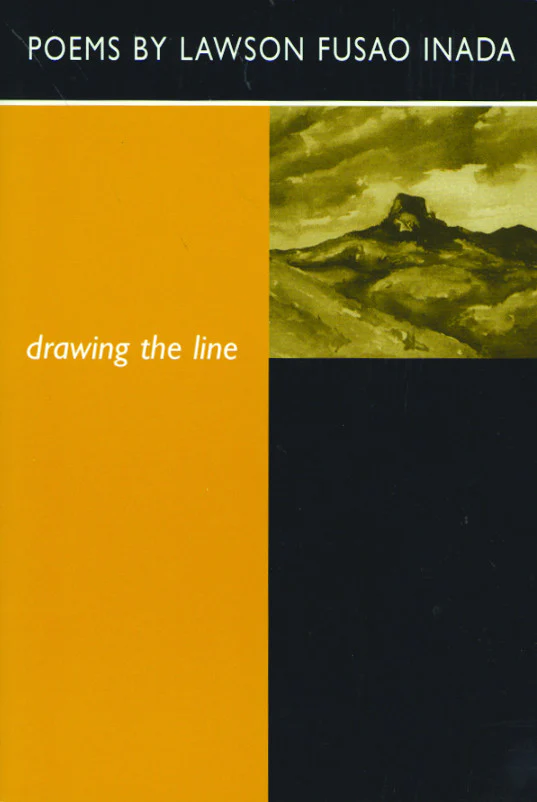
Drawing the Line
Poetry by Lawson Fusao Inada
April 1, 1997 • 6 x 9 • 128 pages • 978-1-56689-060-1
Inada hip hops from Buddhism to Soul, the mountains to jazz, concentration camps to Charlie Parker.
As World War Two began, not only were Japanese American herded into internment camps, the young men were then drafted. But at Heart Mountain, a group of resisters drew the line—they refused to comply, on constitutional grounds—and wound up in federal prison. As the author contemplates a simple line drawing of the Heart Mountain camp, he revisits this moment of history with pain, pride, and thoughtful historical perspective.
In a section about Japanese American life, Inada pays tribute to his elders, and delights in the detail of the day-to-day. His love for the landscape of Oregon is realized in poems that smell of pine and sparkle like a mountain stream. This is a rich, varied collection of poems brimming with hope, nourished by the wisdom of the past, alive with the electricity of the moment.
About the Author
Lawson Fusao Inada is an emeritus professor of writing at Southern Oregon University in Ashland. Inada is the author of five books: Legends from Camp, Drawing the Line, In This Great Land of Freedom, Just Into/Nations and Before the War. He is the editor of three important volumes, including the acclaimed Only What We Could Carry: The Japanese-American Internment Experience. On two previous occasions, in 1972 and 1985, Professor Inada won Poetry Fellowships from the National Endowment for the Arts and his work has appeared in The Best American Poetry.
In addition to these individual publications, Inada has written critical introductions to a number of works, such as John Okada’s No-No Boy.
Reviews
“Despite its often somber subjects, which include the World War II internment of the poet and other Japanese Americans, this is a joy-filled book. This joy arises in part from Inada’s irrepressible wit—a sort of slanting regard for the world that shows its peculiarity and loveliness at once. This wit and this regard are manifest in poetic equivalents of a stand-up comic’s one-liners; for instance, Inada assures us that ‘according to turtles, / rivers are a fluid / form of bridges,’ that ‘even a non-goat / can be happy,’ and that ‘dust doesn’t discriminate.’ In another poem, he ranges over the possible meanings of the words over here and over there, sweeping us along into memory and hope, anger and release. A spine of autobiography supports the collection, although these poems constitute a personal vision rather than a life story.” —Booklist
Original: $18.00
-65%$18.00
$6.30Product Information
Product Information
Shipping & Returns
Shipping & Returns
Description
Poetry by Lawson Fusao Inada
April 1, 1997 • 6 x 9 • 128 pages • 978-1-56689-060-1
Inada hip hops from Buddhism to Soul, the mountains to jazz, concentration camps to Charlie Parker.
As World War Two began, not only were Japanese American herded into internment camps, the young men were then drafted. But at Heart Mountain, a group of resisters drew the line—they refused to comply, on constitutional grounds—and wound up in federal prison. As the author contemplates a simple line drawing of the Heart Mountain camp, he revisits this moment of history with pain, pride, and thoughtful historical perspective.
In a section about Japanese American life, Inada pays tribute to his elders, and delights in the detail of the day-to-day. His love for the landscape of Oregon is realized in poems that smell of pine and sparkle like a mountain stream. This is a rich, varied collection of poems brimming with hope, nourished by the wisdom of the past, alive with the electricity of the moment.
About the Author
Lawson Fusao Inada is an emeritus professor of writing at Southern Oregon University in Ashland. Inada is the author of five books: Legends from Camp, Drawing the Line, In This Great Land of Freedom, Just Into/Nations and Before the War. He is the editor of three important volumes, including the acclaimed Only What We Could Carry: The Japanese-American Internment Experience. On two previous occasions, in 1972 and 1985, Professor Inada won Poetry Fellowships from the National Endowment for the Arts and his work has appeared in The Best American Poetry.
In addition to these individual publications, Inada has written critical introductions to a number of works, such as John Okada’s No-No Boy.
Reviews
“Despite its often somber subjects, which include the World War II internment of the poet and other Japanese Americans, this is a joy-filled book. This joy arises in part from Inada’s irrepressible wit—a sort of slanting regard for the world that shows its peculiarity and loveliness at once. This wit and this regard are manifest in poetic equivalents of a stand-up comic’s one-liners; for instance, Inada assures us that ‘according to turtles, / rivers are a fluid / form of bridges,’ that ‘even a non-goat / can be happy,’ and that ‘dust doesn’t discriminate.’ In another poem, he ranges over the possible meanings of the words over here and over there, sweeping us along into memory and hope, anger and release. A spine of autobiography supports the collection, although these poems constitute a personal vision rather than a life story.” —Booklist