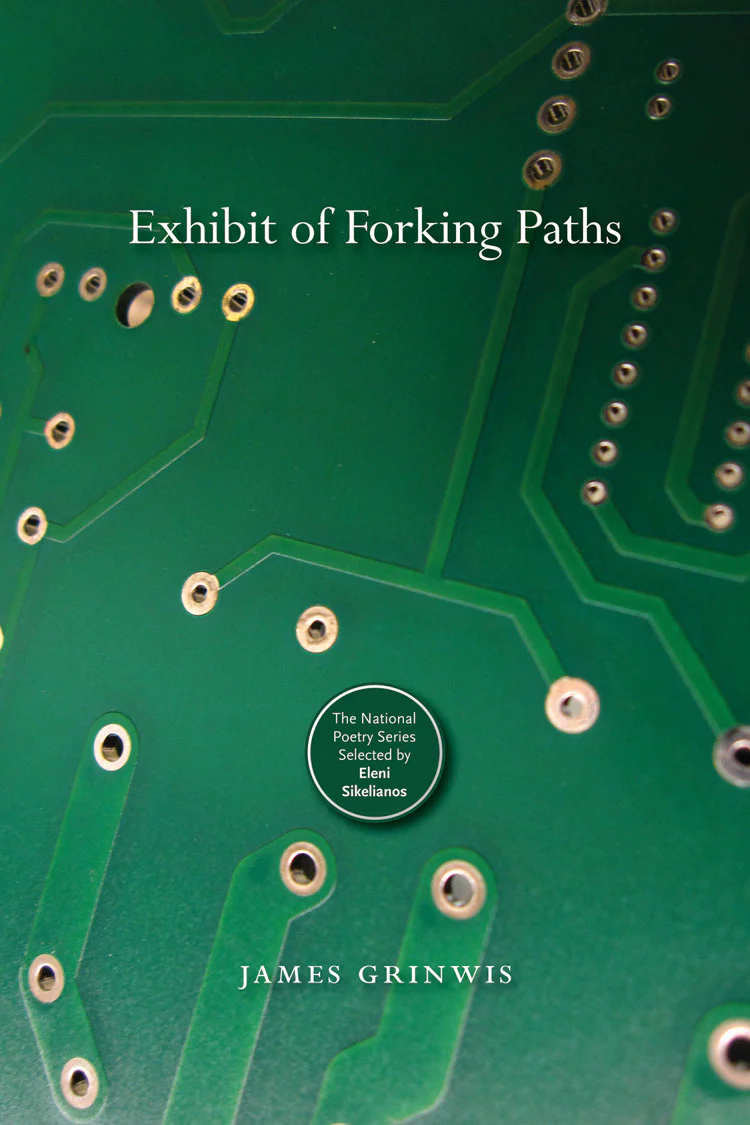
Exhibit of Forking Paths
Poetry by James Grinwis
October 18, 2011 • 5.9 x 8.7 • 68 pages • 978-1-56689-280-3
National Poetry Series winner Grinwis elegantly fuses poetry to circuitry.
These poems pair electrical circuit diagrams with prose poems to create an artful labyrinth of science, intellectual landscapes, and urban scenes. The title of the collection comes from a story by Jorge Luis Borges, “Garden of Forking Paths.”
About the Author
The founding editor of Bateau Press and the author of Exhibit of Forking Paths and The City from Nome, James Grinwis has been published in American Poetry Review, Columbia, Black Warrior Review, Quick Fiction, and Third Coast. He lives in Western Massachusetts with his wife and children.
Reviews
“Reminiscent of Russell Edson, Grinwis creates a series of nearly bewildering yet engaging microcosms. . . . Grinwis manages, throughout, to build poems that are fun, disjunctive, and seem improvisatory, while also sturdy.” —Publishers Weekly
“Grinwis’s collection attempts to locate the perfect living image by experimenting with how, like an electrical circuit, a poem controls and utilizes energy and work. . . . Grinwis’s poems end outside their circuitry in wonder, surprise, and non sequitir; their voltage is untenable. . . . By the end of this collection, Grinwis has beautifully interrogated ideas of both containment—‘To be a valley inside walls. . . . A downpour caught / in a carton of flowers’—and motion—‘What is seen in the motion / and what is felt.’” —Iowa Review
“[Grinwis’s] poems zing with surprise, with slantwise looks at the everyday that added up to something that read more like an image-drenched dream.” —Valley Advocate
“Words are squeezed into usage that had no right to be there—nouns, verbs, who cares what they once were? There is something illuminating at the core of this book, something bright and burning we can carry with us wherever we go.” —James Tate
“In James Grinwis’ Exhibit of Forking Paths, exuberance and restraint live side by side as the poet moves surface to interior and back again in a reconnaissance mission to find out what holds its identity at bay and what holds its identity inside itself like ‘a bigger stone / inside the smaller one’ or ‘a cloud empty of another cloud.’ By turns definition, transformation, hermeneutics, these poems make me revisit the scenes of my worlds, doubled and forked.” —Eleni Sikelianos, National Poetry Series Judge
“James Grinwis is a poet of felt imagination and originality. His poems wander happily through landscapes and locations that at first appear slightly abstract, and then find resolve in exciting particularities of language—language that is continually sensitive to origins, images, and inviting juxtapositions. An exciting and utterly remarkable book.” —Michael Burkard
Product Information
Product Information
Shipping & Returns
Shipping & Returns
Description
Poetry by James Grinwis
October 18, 2011 • 5.9 x 8.7 • 68 pages • 978-1-56689-280-3
National Poetry Series winner Grinwis elegantly fuses poetry to circuitry.
These poems pair electrical circuit diagrams with prose poems to create an artful labyrinth of science, intellectual landscapes, and urban scenes. The title of the collection comes from a story by Jorge Luis Borges, “Garden of Forking Paths.”
About the Author
The founding editor of Bateau Press and the author of Exhibit of Forking Paths and The City from Nome, James Grinwis has been published in American Poetry Review, Columbia, Black Warrior Review, Quick Fiction, and Third Coast. He lives in Western Massachusetts with his wife and children.
Reviews
“Reminiscent of Russell Edson, Grinwis creates a series of nearly bewildering yet engaging microcosms. . . . Grinwis manages, throughout, to build poems that are fun, disjunctive, and seem improvisatory, while also sturdy.” —Publishers Weekly
“Grinwis’s collection attempts to locate the perfect living image by experimenting with how, like an electrical circuit, a poem controls and utilizes energy and work. . . . Grinwis’s poems end outside their circuitry in wonder, surprise, and non sequitir; their voltage is untenable. . . . By the end of this collection, Grinwis has beautifully interrogated ideas of both containment—‘To be a valley inside walls. . . . A downpour caught / in a carton of flowers’—and motion—‘What is seen in the motion / and what is felt.’” —Iowa Review
“[Grinwis’s] poems zing with surprise, with slantwise looks at the everyday that added up to something that read more like an image-drenched dream.” —Valley Advocate
“Words are squeezed into usage that had no right to be there—nouns, verbs, who cares what they once were? There is something illuminating at the core of this book, something bright and burning we can carry with us wherever we go.” —James Tate
“In James Grinwis’ Exhibit of Forking Paths, exuberance and restraint live side by side as the poet moves surface to interior and back again in a reconnaissance mission to find out what holds its identity at bay and what holds its identity inside itself like ‘a bigger stone / inside the smaller one’ or ‘a cloud empty of another cloud.’ By turns definition, transformation, hermeneutics, these poems make me revisit the scenes of my worlds, doubled and forked.” —Eleni Sikelianos, National Poetry Series Judge
“James Grinwis is a poet of felt imagination and originality. His poems wander happily through landscapes and locations that at first appear slightly abstract, and then find resolve in exciting particularities of language—language that is continually sensitive to origins, images, and inviting juxtapositions. An exciting and utterly remarkable book.” —Michael Burkard