Isle of the Signatories
Poetry by Marjorie Welish
April 1, 2008 • 6 x 9 • 128 pages • 978-1-56689-212-4
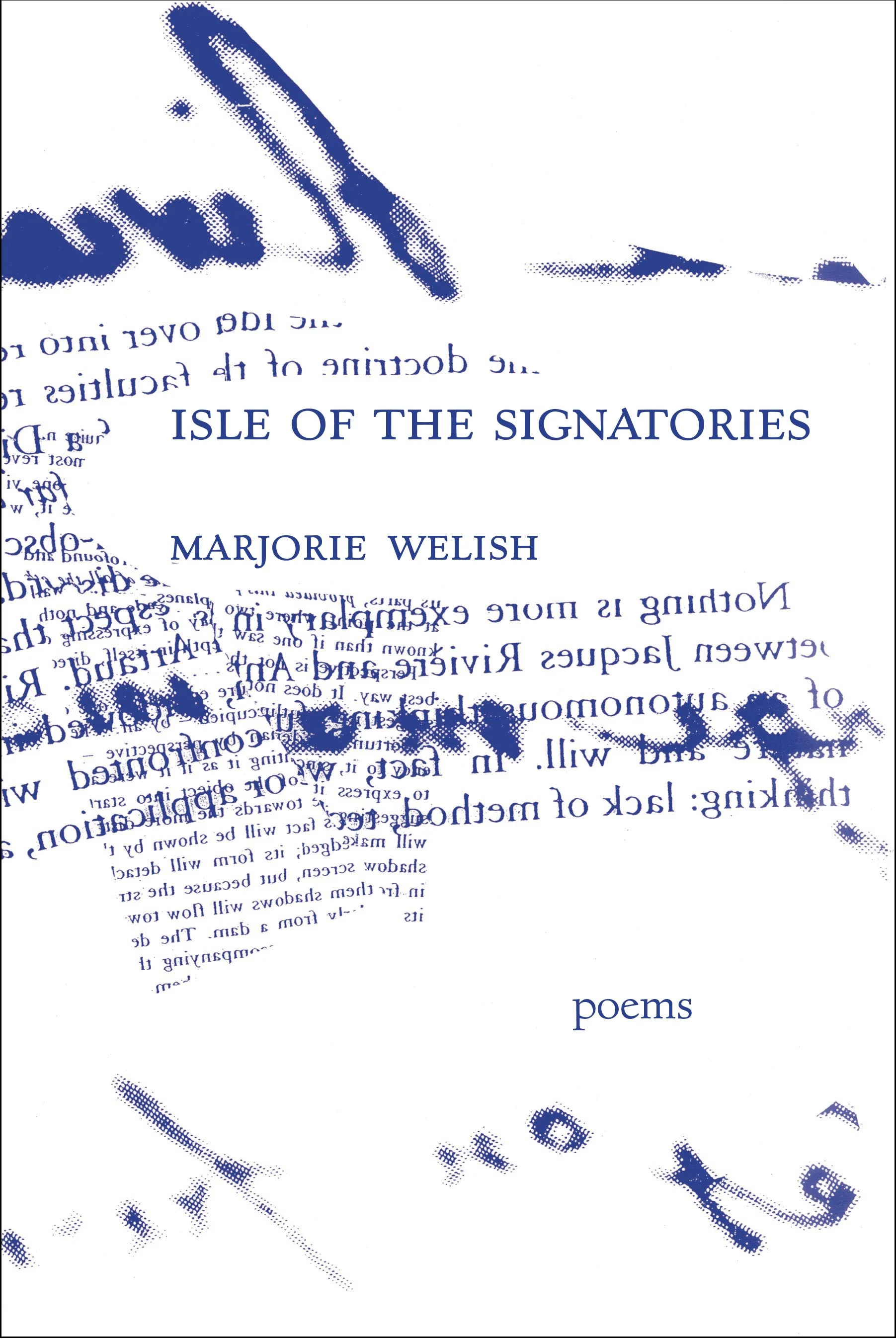
Sophisticated wordplay, bold textual logic, and striking graphic innovation.
In her latest collection, Marjorie Welish invents a world of public inscriptions. From graffiti to scholarly dedication and from historical placards to words etched in granite, she employs a variety of fonts to explore the dangers of rhetoric, the mysteries of coded language, the enigmas of form, the powerful gift of dedication, and the strange sense and substance of both new and dying literary conventions.
About the Author
Marjorie Welish is the author of The Annotated “Here” and Selected Poems, Word Group, Isle of the Signatories, In the Futurity Lounge / Asylum for Indeterminacy, and So What So That (Winter 2016), all from Coffee House Press. The papers delivered at a conference on her writing and art held at the University of Pennsylvania were published in the book Of the Diagram: The Work of Marjorie Welish (Slought Books). In 2009, Granary Books published Oaths? Questions?, a collaborative artists’ book by Marjorie Welish and James Siena which was the subject of a special exhibition at Denison University Museum, Granville, Ohio; the book is in permanent collections, including that of The Metropolitan Museum of Art. Recent art exhibitions have occurred at Emanuel von Baeyer Cabinet, London, Ruskin Gallery, Cambridge, England, and ART-3, Brooklyn. Her honors include the George A. and Eliza Gardner Howard Fellowship from Brown University, the Judith E. Wilson Visiting Poetry Fellowship at Cambridge University, and two fellowships from the New York Foundation for the Arts. She has held a Senior Fulbright Fellowship, which has taken her to the University of Frankfurt and to the Edinburgh College of Art. She is now Madelon Leventhal Rand Chair in Literature at Brooklyn College.
Reviews
“What is the ‘trace’ of a word? Does a word signify authorship, ownership, narrative? Marjorie Welish’s new book of poems Isle of Signatories concerns itself with the implications of a word’s imprint. These are poems formed from a text we often relegate to the background—graffiti, signposts, and advertisements. Graffiti’s ‘unentitled word’ is here elevated to the same level as ‘the entitled word’ of poetry—the two become indistinguishable. If we no longer disregard this text, what with our postmodern lens, we are still assuming it to be authorless. It is basically regarded as negligable, while poetry remains rarefied. But aren’t we in contact with this negligible text to a far greater degree than we are with poetry’s ‘entitled text.’” —Allen Mozek, For the Birds
“Welish’s poems do for language what great abstract paintings do for paint.” —No: A Journal of the Arts
“Always thoughtful. . . . This book could be Welish’s breakthrough, offering her clearest, most discursive works, proximate in their edgy attentions not only to art-world thinkers but to Anne Carson.” —Publishers Weekly
“Welish has developed something of a crossover following in the art world, as poet as well as art critic, and Isle of the Signatories evokes the discourse of each medium. These poems critique themselves, they critique the contexts of their subjects—walls, signs, flyers, graffiti—and, most notably, play freely with ideas, language, and, of course, representation. One can imagine ‘Art & Language Writes an Epitaph’ all-caps, littered in blocks across the page, exhibited on a gallery wall. And this seems to be one of the points here, that words on the page are but a small part of the meaning and are themselves malleable. ‘Which modernity?’ Welish asks of us.” —Austin Chronicle
“I suspect that the seamless and efficient arrangement of things is directly related to the fact that Welish is also a prominent painter (abstraction, deconstructed strands); she’s got an eye for placement and a clearly present sense of theory. The notion of ‘ear’ that you might want as you read is lovingly gestured at, but never fed to you outright. The effect is like humming to yourself in the presence of a great and soothing din.” —Bookslut
Product Information
Product Information
Shipping & Returns
Shipping & Returns
Description
Poetry by Marjorie Welish
April 1, 2008 • 6 x 9 • 128 pages • 978-1-56689-212-4
Sophisticated wordplay, bold textual logic, and striking graphic innovation.
In her latest collection, Marjorie Welish invents a world of public inscriptions. From graffiti to scholarly dedication and from historical placards to words etched in granite, she employs a variety of fonts to explore the dangers of rhetoric, the mysteries of coded language, the enigmas of form, the powerful gift of dedication, and the strange sense and substance of both new and dying literary conventions.
About the Author
Marjorie Welish is the author of The Annotated “Here” and Selected Poems, Word Group, Isle of the Signatories, In the Futurity Lounge / Asylum for Indeterminacy, and So What So That (Winter 2016), all from Coffee House Press. The papers delivered at a conference on her writing and art held at the University of Pennsylvania were published in the book Of the Diagram: The Work of Marjorie Welish (Slought Books). In 2009, Granary Books published Oaths? Questions?, a collaborative artists’ book by Marjorie Welish and James Siena which was the subject of a special exhibition at Denison University Museum, Granville, Ohio; the book is in permanent collections, including that of The Metropolitan Museum of Art. Recent art exhibitions have occurred at Emanuel von Baeyer Cabinet, London, Ruskin Gallery, Cambridge, England, and ART-3, Brooklyn. Her honors include the George A. and Eliza Gardner Howard Fellowship from Brown University, the Judith E. Wilson Visiting Poetry Fellowship at Cambridge University, and two fellowships from the New York Foundation for the Arts. She has held a Senior Fulbright Fellowship, which has taken her to the University of Frankfurt and to the Edinburgh College of Art. She is now Madelon Leventhal Rand Chair in Literature at Brooklyn College.
Reviews
“What is the ‘trace’ of a word? Does a word signify authorship, ownership, narrative? Marjorie Welish’s new book of poems Isle of Signatories concerns itself with the implications of a word’s imprint. These are poems formed from a text we often relegate to the background—graffiti, signposts, and advertisements. Graffiti’s ‘unentitled word’ is here elevated to the same level as ‘the entitled word’ of poetry—the two become indistinguishable. If we no longer disregard this text, what with our postmodern lens, we are still assuming it to be authorless. It is basically regarded as negligable, while poetry remains rarefied. But aren’t we in contact with this negligible text to a far greater degree than we are with poetry’s ‘entitled text.’” —Allen Mozek, For the Birds
“Welish’s poems do for language what great abstract paintings do for paint.” —No: A Journal of the Arts
“Always thoughtful. . . . This book could be Welish’s breakthrough, offering her clearest, most discursive works, proximate in their edgy attentions not only to art-world thinkers but to Anne Carson.” —Publishers Weekly
“Welish has developed something of a crossover following in the art world, as poet as well as art critic, and Isle of the Signatories evokes the discourse of each medium. These poems critique themselves, they critique the contexts of their subjects—walls, signs, flyers, graffiti—and, most notably, play freely with ideas, language, and, of course, representation. One can imagine ‘Art & Language Writes an Epitaph’ all-caps, littered in blocks across the page, exhibited on a gallery wall. And this seems to be one of the points here, that words on the page are but a small part of the meaning and are themselves malleable. ‘Which modernity?’ Welish asks of us.” —Austin Chronicle
“I suspect that the seamless and efficient arrangement of things is directly related to the fact that Welish is also a prominent painter (abstraction, deconstructed strands); she’s got an eye for placement and a clearly present sense of theory. The notion of ‘ear’ that you might want as you read is lovingly gestured at, but never fed to you outright. The effect is like humming to yourself in the presence of a great and soothing din.” —Bookslut