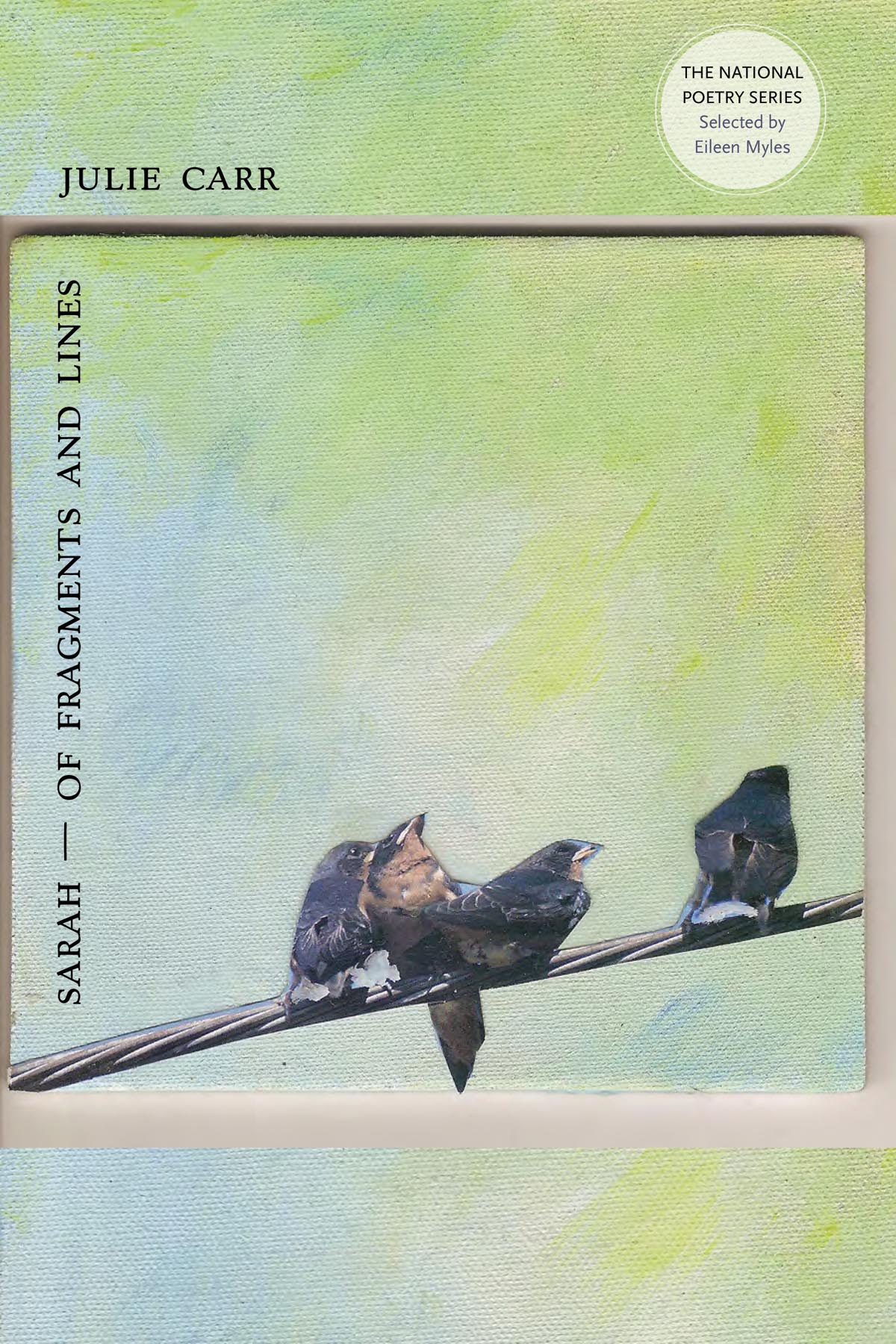
Sarah—Of Fragments and Lines
Poetry by Julie Carr
August 17, 2010 • 6 x 9 • 74 pages • 978-1-56689-251-3
Set to the music of rain, these shattered elegies seek communion in the ethereal place between birth and death.
In the wake of a mother’s battle with Alzheimer’s and a child’s impending birth, Julie Carr gathers the shards of both mourning and joy to give readers poems that encompass it all: “Zebra and xylophone cyclone and sorrow.” Here she says, “Since I lost her I stored her like ore in my / form as if later I’d find her, restore her,” giving voice to the longing that accompanies life’s most profound losses and its most anticipated arrivals.
About the Author
Julie Carr is the author of Sarah—Of Fragments and Lines, Mead: An Epithalamion, selected by Cole Swensen for the University of Georgia Press’s Contemporary Poetry Series Prize, Equivocal (Alice James Books), and 100 Notes on Violence, selected by Rae Armantrout for the Sawtooth Award (Ahsahta Press). Her poems have appeared in the Best American Poetry, Boston Review, Nation, A Public Space, and elsewhere. Raised in Massachusetts, she received her MFA at New York University and her PhD at University of California-Berkeley. She is the co-publisher of Counterpath Press, teaches at the University of Colorado at Boulder, and lives in Denver.
Reviews
“As Carr shuttles among her triple roles as mother, daughter, writer, individual words and phonemes shuttle back and forth like classical melodies.” —Publishers Weekly, starred review
“As a reader I feel included a lot in Julie Carr’s hard and beautiful book. I can pretty much hear its author speak—a whispering that enables us into its world. . . . A masterfully sutured journey, painfully useful. Sarah—Of Fragments and Lines is a book I know I will return to. And urge it on my friends who have lives too and write in them.” —Eileen Myles, National Poetry Series judge
“[Julie Carr’s] lyrical style expresses the complex and often frustrating experience of being human: of constantly thinking, feeling, being, and changing.” —Powell’s Books
“Weaving like wind among echoes and abstracts, monodies and metaphors, becoming a mother again and losing a mom, Sarah—selected by Eileen Myles for the National Poetry Series—manages to sound like a paean of grief, delivered by a singer suspended between two sides. One is the past, with its ghosts and unkept promises, its desires unfulfilled or else gone astray; the other is the future’s promise of moving on—and of purifying return.” —Rain Taxi
“Carr’s is clearly a voice of tender lyricism and much intimacy, yet it is never obscure.” —Library Journal
“Julie Carr’s harrowing new book is composed of a complex music of grief and fragmentation that illuminates the fragile distance between mothers and daughters. To read Sarah—Of Fragments and Lines is to recall once again that memory might just be the singular attribute of being human and that there can be no poetics of daily life that does not confront loss. Such is the domain of love; such is the vocation of poetry.” —Peter Gizzi
“To write about serious issues without them becoming cliched, to look closely at the feelings attached to powerful life events and how they manifest in our hearts and minds can be incredibly challenging. Carr is not only equal to the task, she also manages to unearth a mental mindfield of emotion in these poems.” —The Nervous Breakdown
“But [‘Lines to Scatter’] also quotes the biblical promise of ‘ever and ever’ shining, and Sarah discovers that luminosity in the spaces between pieces and moments—as in the early ‘Daily Abstracts,’ which gathers up clauses of a morning’s waking. ‘Now flare. Now come to this,’ the poem begins. For Carr, fragments can spark a brief transfiguration even as they sustain a daily melancholy.” —Boston Review
“Birth and death elegantly do their pas de deux as daughter and mother in Sarah—Of Fragments and Lines by Julie Carr who was selected by Eileen Myles for the National Poetry Series. Sarah is the first matriarch in the Torah and her eternity is fused here with our mortality. ‘The body’s a hole through which other bodies move.’ The poems are composed of fragments, lines, and abstracts that leave spaces for the “pillaged language” to make new connections. Lyrically a Contralto, Carr’s music is deeply resounding.” —Brooklyn Rail
“Carr formally and linearly structures her manuscript into a typology of grieving. . . . [and] offers a scattering of her own past life to show what is transformed in this decline of her mother and in her own shift into motherhood.” —Kenyon Review
“Julie Carr manages to humanize the abstractions and wordplay of language poetry, without losing her disciplinary vigor, if you will. The intertwined subjects are her mother’s illness, and her own pregnancy and childbirth. The oppositions would be almost too neat and clean for traditional verse, the ‘closures’ too convenient. But in Carr’s fragments . . . the provisional nature of all our metaphors, our common and uncommon lines of defense, comes through. Whereas conventional poetry seeks to heal the wounds and seal the ruptures, avant-garde poetry takes as its subject the insufficiency of language itself—and in the process makes language itself more pliable and potent.” —Huffington Post
“I was unprepared for Carr’s music. . . . I find myself drawn in by the sounds and (here halting) rhythm of the poem, by its music, which conveys its meaning. If you read this book straight through, as I found myself doing, there is a vortex-like, physical effect to Carr’s language, which draws a reader in to another’s reality, simultaneously (through the reference to the archetypal matriarch, the Hebrew Sarah) moving us into a time-out-of-time.” —Verse Wisconsin
Product Information
Product Information
Shipping & Returns
Shipping & Returns
Description
Poetry by Julie Carr
August 17, 2010 • 6 x 9 • 74 pages • 978-1-56689-251-3
Set to the music of rain, these shattered elegies seek communion in the ethereal place between birth and death.
In the wake of a mother’s battle with Alzheimer’s and a child’s impending birth, Julie Carr gathers the shards of both mourning and joy to give readers poems that encompass it all: “Zebra and xylophone cyclone and sorrow.” Here she says, “Since I lost her I stored her like ore in my / form as if later I’d find her, restore her,” giving voice to the longing that accompanies life’s most profound losses and its most anticipated arrivals.
About the Author
Julie Carr is the author of Sarah—Of Fragments and Lines, Mead: An Epithalamion, selected by Cole Swensen for the University of Georgia Press’s Contemporary Poetry Series Prize, Equivocal (Alice James Books), and 100 Notes on Violence, selected by Rae Armantrout for the Sawtooth Award (Ahsahta Press). Her poems have appeared in the Best American Poetry, Boston Review, Nation, A Public Space, and elsewhere. Raised in Massachusetts, she received her MFA at New York University and her PhD at University of California-Berkeley. She is the co-publisher of Counterpath Press, teaches at the University of Colorado at Boulder, and lives in Denver.
Reviews
“As Carr shuttles among her triple roles as mother, daughter, writer, individual words and phonemes shuttle back and forth like classical melodies.” —Publishers Weekly, starred review
“As a reader I feel included a lot in Julie Carr’s hard and beautiful book. I can pretty much hear its author speak—a whispering that enables us into its world. . . . A masterfully sutured journey, painfully useful. Sarah—Of Fragments and Lines is a book I know I will return to. And urge it on my friends who have lives too and write in them.” —Eileen Myles, National Poetry Series judge
“[Julie Carr’s] lyrical style expresses the complex and often frustrating experience of being human: of constantly thinking, feeling, being, and changing.” —Powell’s Books
“Weaving like wind among echoes and abstracts, monodies and metaphors, becoming a mother again and losing a mom, Sarah—selected by Eileen Myles for the National Poetry Series—manages to sound like a paean of grief, delivered by a singer suspended between two sides. One is the past, with its ghosts and unkept promises, its desires unfulfilled or else gone astray; the other is the future’s promise of moving on—and of purifying return.” —Rain Taxi
“Carr’s is clearly a voice of tender lyricism and much intimacy, yet it is never obscure.” —Library Journal
“Julie Carr’s harrowing new book is composed of a complex music of grief and fragmentation that illuminates the fragile distance between mothers and daughters. To read Sarah—Of Fragments and Lines is to recall once again that memory might just be the singular attribute of being human and that there can be no poetics of daily life that does not confront loss. Such is the domain of love; such is the vocation of poetry.” —Peter Gizzi
“To write about serious issues without them becoming cliched, to look closely at the feelings attached to powerful life events and how they manifest in our hearts and minds can be incredibly challenging. Carr is not only equal to the task, she also manages to unearth a mental mindfield of emotion in these poems.” —The Nervous Breakdown
“But [‘Lines to Scatter’] also quotes the biblical promise of ‘ever and ever’ shining, and Sarah discovers that luminosity in the spaces between pieces and moments—as in the early ‘Daily Abstracts,’ which gathers up clauses of a morning’s waking. ‘Now flare. Now come to this,’ the poem begins. For Carr, fragments can spark a brief transfiguration even as they sustain a daily melancholy.” —Boston Review
“Birth and death elegantly do their pas de deux as daughter and mother in Sarah—Of Fragments and Lines by Julie Carr who was selected by Eileen Myles for the National Poetry Series. Sarah is the first matriarch in the Torah and her eternity is fused here with our mortality. ‘The body’s a hole through which other bodies move.’ The poems are composed of fragments, lines, and abstracts that leave spaces for the “pillaged language” to make new connections. Lyrically a Contralto, Carr’s music is deeply resounding.” —Brooklyn Rail
“Carr formally and linearly structures her manuscript into a typology of grieving. . . . [and] offers a scattering of her own past life to show what is transformed in this decline of her mother and in her own shift into motherhood.” —Kenyon Review
“Julie Carr manages to humanize the abstractions and wordplay of language poetry, without losing her disciplinary vigor, if you will. The intertwined subjects are her mother’s illness, and her own pregnancy and childbirth. The oppositions would be almost too neat and clean for traditional verse, the ‘closures’ too convenient. But in Carr’s fragments . . . the provisional nature of all our metaphors, our common and uncommon lines of defense, comes through. Whereas conventional poetry seeks to heal the wounds and seal the ruptures, avant-garde poetry takes as its subject the insufficiency of language itself—and in the process makes language itself more pliable and potent.” —Huffington Post
“I was unprepared for Carr’s music. . . . I find myself drawn in by the sounds and (here halting) rhythm of the poem, by its music, which conveys its meaning. If you read this book straight through, as I found myself doing, there is a vortex-like, physical effect to Carr’s language, which draws a reader in to another’s reality, simultaneously (through the reference to the archetypal matriarch, the Hebrew Sarah) moving us into a time-out-of-time.” —Verse Wisconsin