Winner of the 2020 Lambda Literary Award in Bisexual Nonfiction
Winner of the 2019 Believer Book Award in Nonfiction
Autostraddle, “Best Queer Books of 2019”
“Slipping smoothly between stylistic registers and across time in a relaxed stream-of-consciousness style, this highly readable, lyrical autobiographical essay promises much for Low’s further excursions into prose.” —Publishers Weekly
“A consistently incisive and surprising new work of nonfiction. . . . The frequent meditations on global politics and contemporary works of art never feel like gratuitous digressions but constitute the most reliable pleasures of the text, and serve to deepen what is ultimately an intimate and complex portrait of a life.” —Los Angeles Review of Books
“Low embraces the specifics of her own experiences and aesthetics . . . The result is one of the most evocative books you're likely to encounter this year.” —Star Tribune
“Inventive, wise, and revelatory . . . a searching interrogation of identity, art, and a desire for a life beyond what we are told is possible.” —Chicago Review of Books
“Few works of art. . . . offer as scintillating a vision of what it means to yearn for the comfort of home alongside the utter strangeness and sparkle of irresolution. . . . Low is at home in her electric mind, and we are happy to have been invited in.” —The Believer
“Expansive and freeing, like the best kind of daydream.” —Nylon
“Offers piercing reflections full of intellectual power and personal resonance… a work that defies normativity in every way, as Low moves with a kind of vulnerable virtuosity from one illuminating entry to the next.” —VICE
“Socialist Realism might itself be a parable, in that it dares the reader to interpret it too literally—mistaking the showing of a wound for vulnerability, or uncertainty about political or artistic effects for a lack of commitment—but I count myself among the believers.” —Frieze Magazine
“Mostly earnest, always engrossing…This book sees Low struggling mightily, with intention and passion and verve, to accommodate seemingly oppositional impulses.” —Bookforum
“A book about what it means to try to fulfill our deepest desires.” —Book Riot
“Reading Socialist Realism is like falling into a dream.” —Overland
“Like a transgressive Binx Bolling . . . she takes away equally cathartic feelings from the experimental films of Chantal Ackerman as she does from a documentary about One Direction.” —The Rupture
“Low writes about her queerness . . . performance art installations that ask identity questions, the socio-economic history of Singapore, and literary analysis of Patricia Highsmith’s novels. To all of these topics, Low applies the full force of her compelling intellect.” —Booklist
“In this book-length essay, the problem of how to account for one’s life comes to the fore.” —Cultura Colectiva
“It’s a joy to watch Trisha Low’s mind at work in this book as she contemplates utopia, identity, and how art expands her understanding of the world. Low doesn’t just have an idea—she interrogates it, examines it, and cuts it open. Socialist Realism is sharp, inventive, and transformative.” —Chelsea Hodson, author of Tonight I’m Someone Else
“In years like ours, what a relief it is to be allowed into the mind of Trisha Low. With infectious aplomb and zero pandering to the mind games of social grace, Socialist Realism weaves together intimate and moment-defining considerations of heritage, religion, masochism, sexuality, authenticity, utopia, transgressive art, and so much more, laying bare the myriad layers and projections of a persona surrounded by duress and still in search of something more. Equally candid and courageous, this meditation from the dark side of the heart may have arrived in the nick of time.” —Blake Butler
Praise for Trisha Low
“Trisha Low has been leaving us periodic notes about what we can keep of hers if she should happen to go off the deep end. She’s also been leaving us her email password, her ATM PIN code, and an astonishing amalgamation of amatory fiction, IMs, craft patterns, magic spells, and film noir in which every romantic interest is a MacGuffin. Low says her virtuosic appropriations owe less to conceptual poetics than to her adolescent days of punk vandalism. Never mind if this booty was shoplifted, its stunning, and I promise you’ll want to keep everything she gives you.” —Barbara Browning
“Like hands reaching out from the grave in the final scene of Brian Di Palma’s Carrie, Trisha Low’s The Compleat Purge reaches out to beg the question: ‘What’s happened to the real Trisha?’ In Low’s epically eloquent new book, she hands us the keys to a crypt wherein identity is theorized as an act of para-suicide and girlhood a version of being buried alive. The Compleat Purge reframes Freud’s infamous query: ‘What do women want?’ by breathing new life into shifting ideals of feminine identity, sexuality, and erotics before the culturally determined ones land us in a coma.” —Kim Rosenfield
“Trisha Low is always dying. Age, place, fictional rendering all are subsumed to an origin already negated. She and her doubles evacuate with unmoving horror their teenage mania, displacing it, emptying the identities about whom its despair circulates. Once, maybe, this Trisha Low generated bodily heat, ate breakfast, loved and desired. No more. The Compleat Purge razes its confessional charms like effigies, foreclosing Low’s final vixi to her own secrets before they too are obliterated in time immemorial. He had gone from her sight, he had not lifted his bowed head, he had not looked back.” —J. Gordon Faylor
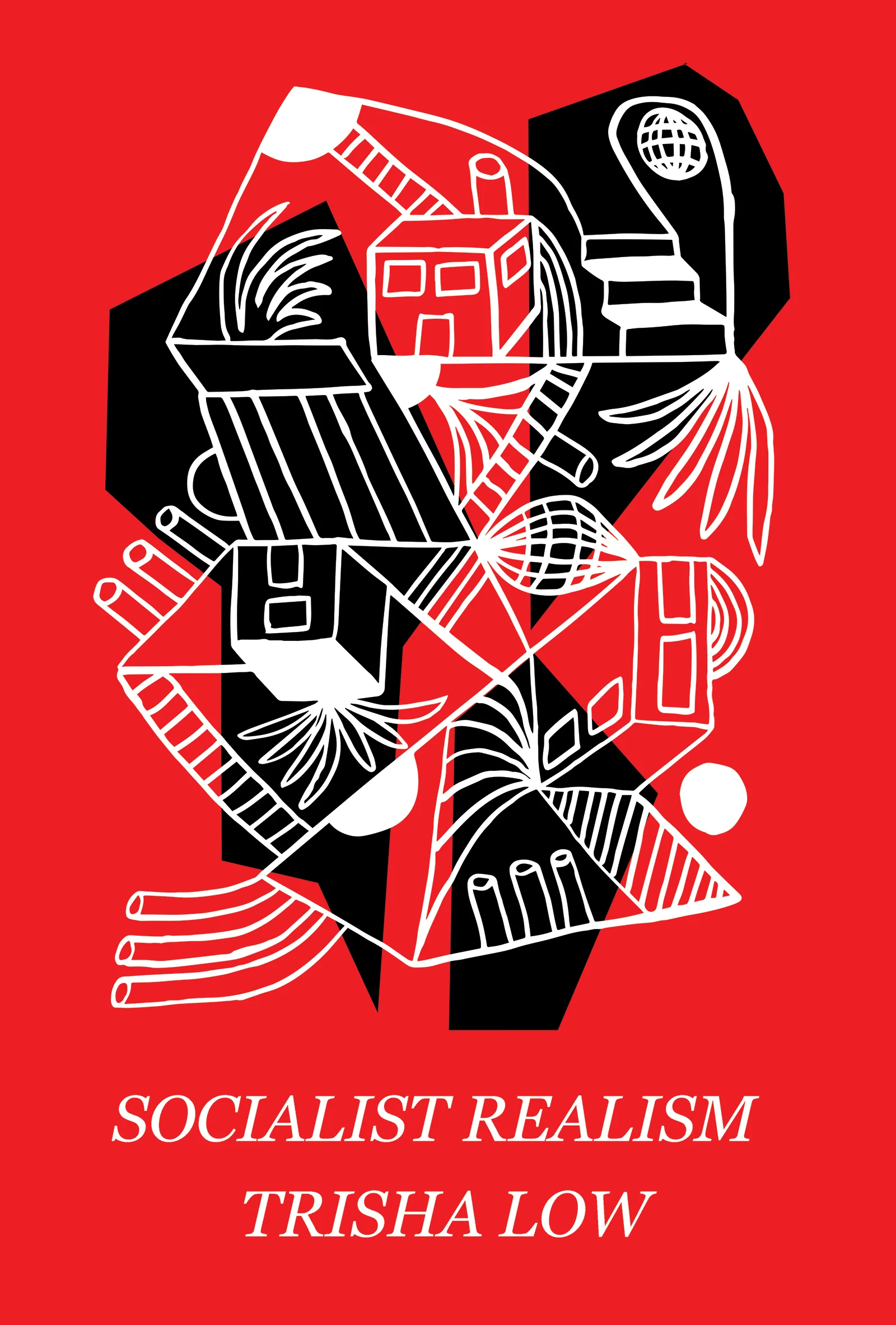
Socialist Realism
An essay by Trisha Low
August 13, 2019 • 5.5 x 8.25 • 168 pages • 978-1-56689-551-4
Moving West—from Singapore to America, from New York to California—a woman examines the myth of “finding home” even as she comes to terms with its impossibilities.
When Trisha Low moves West, her journey is motivated by the need to arrive “somewhere better”—someplace utopian, like revolution; or safe, like home; or even clarifying, like identity. Instead, she faces the end of her relationships, a family whose values she has difficulty sharing, and America’s casual racism, sexism, and homophobia.
In this book-length essay, the problem of how to account for one’s life comes to the fore—sliding unpredictably between memory, speculation, self-criticism, and art criticism, Low seeks answers that she knows she won’t find. Attempting to reconcile her desires with her radical politics, she asks: do our quests to fulfill our deepest wishes propel us forward, or keep us trapped in the rubble of our deteriorating world?
About the Author
Trisha Low is the author of The Compleat Purge (Kenning Editions 2013). She earned a BA at the University of Pennsylvania and an MA in performance studies at New York University. She lives in the East Bay.
Praise for Socialist Realism
Winner of the 2020 Lambda Literary Award in Bisexual Nonfiction
Winner of the 2019 Believer Book Award in Nonfiction
Autostraddle, “Best Queer Books of 2019”
“Slipping smoothly between stylistic registers and across time in a relaxed stream-of-consciousness style, this highly readable, lyrical autobiographical essay promises much for Low’s further excursions into prose.” —Publishers Weekly
“A consistently incisive and surprising new work of nonfiction. . . . The frequent meditations on global politics and contemporary works of art never feel like gratuitous digressions but constitute the most reliable pleasures of the text, and serve to deepen what is ultimately an intimate and complex portrait of a life.” —Los Angeles Review of Books
“Low embraces the specifics of her own experiences and aesthetics . . . The result is one of the most evocative books you're likely to encounter this year.” —Star Tribune
“Inventive, wise, and revelatory . . . a searching interrogation of identity, art, and a desire for a life beyond what we are told is possible.” —Chicago Review of Books
“Few works of art. . . . offer as scintillating a vision of what it means to yearn for the comfort of home alongside the utter strangeness and sparkle of irresolution. . . . Low is at home in her electric mind, and we are happy to have been invited in.” —The Believer
“Expansive and freeing, like the best kind of daydream.” —Nylon
“Offers piercing reflections full of intellectual power and personal resonance… a work that defies normativity in every way, as Low moves with a kind of vulnerable virtuosity from one illuminating entry to the next.” —VICE
“Socialist Realism might itself be a parable, in that it dares the reader to interpret it too literally—mistaking the showing of a wound for vulnerability, or uncertainty about political or artistic effects for a lack of commitment—but I count myself among the believers.” —Frieze Magazine
“Mostly earnest, always engrossing…This book sees Low struggling mightily, with intention and passion and verve, to accommodate seemingly oppositional impulses.” —Bookforum
“A book about what it means to try to fulfill our deepest desires.” —Book Riot
“Reading Socialist Realism is like falling into a dream.” —Overland
“Like a transgressive Binx Bolling . . . she takes away equally cathartic feelings from the experimental films of Chantal Ackerman as she does from a documentary about One Direction.” —The Rupture
“Low writes about her queerness . . . performance art installations that ask identity questions, the socio-economic history of Singapore, and literary analysis of Patricia Highsmith’s novels. To all of these topics, Low applies the full force of her compelling intellect.” —Booklist
“In this book-length essay, the problem of how to account for one’s life comes to the fore.” —Cultura Colectiva
“It’s a joy to watch Trisha Low’s mind at work in this book as she contemplates utopia, identity, and how art expands her understanding of the world. Low doesn’t just have an idea—she interrogates it, examines it, and cuts it open. Socialist Realism is sharp, inventive, and transformative.” —Chelsea Hodson, author of Tonight I’m Someone Else
“In years like ours, what a relief it is to be allowed into the mind of Trisha Low. With infectious aplomb and zero pandering to the mind games of social grace, Socialist Realism weaves together intimate and moment-defining considerations of heritage, religion, masochism, sexuality, authenticity, utopia, transgressive art, and so much more, laying bare the myriad layers and projections of a persona surrounded by duress and still in search of something more. Equally candid and courageous, this meditation from the dark side of the heart may have arrived in the nick of time.” —Blake Butler
Praise for Trisha Low
“Trisha Low has been leaving us periodic notes about what we can keep of hers if she should happen to go off the deep end. She’s also been leaving us her email password, her ATM PIN code, and an astonishing amalgamation of amatory fiction, IMs, craft patterns, magic spells, and film noir in which every romantic interest is a MacGuffin. Low says her virtuosic appropriations owe less to conceptual poetics than to her adolescent days of punk vandalism. Never mind if this booty was shoplifted, its stunning, and I promise you’ll want to keep everything she gives you.” —Barbara Browning
“Like hands reaching out from the grave in the final scene of Brian Di Palma’s Carrie, Trisha Low’s The Compleat Purge reaches out to beg the question: ‘What’s happened to the real Trisha?’ In Low’s epically eloquent new book, she hands us the keys to a crypt wherein identity is theorized as an act of para-suicide and girlhood a version of being buried alive. The Compleat Purge reframes Freud’s infamous query: ‘What do women want?’ by breathing new life into shifting ideals of feminine identity, sexuality, and erotics before the culturally determined ones land us in a coma.” —Kim Rosenfield
“Trisha Low is always dying. Age, place, fictional rendering all are subsumed to an origin already negated. She and her doubles evacuate with unmoving horror their teenage mania, displacing it, emptying the identities about whom its despair circulates. Once, maybe, this Trisha Low generated bodily heat, ate breakfast, loved and desired. No more. The Compleat Purge razes its confessional charms like effigies, foreclosing Low’s final vixi to her own secrets before they too are obliterated in time immemorial. He had gone from her sight, he had not lifted his bowed head, he had not looked back.” —J. Gordon Faylor
Original: $18.00
-65%$18.00
$6.30Product Information
Product Information
Shipping & Returns
Shipping & Returns
Description
An essay by Trisha Low
August 13, 2019 • 5.5 x 8.25 • 168 pages • 978-1-56689-551-4
Moving West—from Singapore to America, from New York to California—a woman examines the myth of “finding home” even as she comes to terms with its impossibilities.
When Trisha Low moves West, her journey is motivated by the need to arrive “somewhere better”—someplace utopian, like revolution; or safe, like home; or even clarifying, like identity. Instead, she faces the end of her relationships, a family whose values she has difficulty sharing, and America’s casual racism, sexism, and homophobia.
In this book-length essay, the problem of how to account for one’s life comes to the fore—sliding unpredictably between memory, speculation, self-criticism, and art criticism, Low seeks answers that she knows she won’t find. Attempting to reconcile her desires with her radical politics, she asks: do our quests to fulfill our deepest wishes propel us forward, or keep us trapped in the rubble of our deteriorating world?
About the Author
Trisha Low is the author of The Compleat Purge (Kenning Editions 2013). She earned a BA at the University of Pennsylvania and an MA in performance studies at New York University. She lives in the East Bay.
Praise for Socialist Realism
Winner of the 2020 Lambda Literary Award in Bisexual Nonfiction
Winner of the 2019 Believer Book Award in Nonfiction
Autostraddle, “Best Queer Books of 2019”
“Slipping smoothly between stylistic registers and across time in a relaxed stream-of-consciousness style, this highly readable, lyrical autobiographical essay promises much for Low’s further excursions into prose.” —Publishers Weekly
“A consistently incisive and surprising new work of nonfiction. . . . The frequent meditations on global politics and contemporary works of art never feel like gratuitous digressions but constitute the most reliable pleasures of the text, and serve to deepen what is ultimately an intimate and complex portrait of a life.” —Los Angeles Review of Books
“Low embraces the specifics of her own experiences and aesthetics . . . The result is one of the most evocative books you're likely to encounter this year.” —Star Tribune
“Inventive, wise, and revelatory . . . a searching interrogation of identity, art, and a desire for a life beyond what we are told is possible.” —Chicago Review of Books
“Few works of art. . . . offer as scintillating a vision of what it means to yearn for the comfort of home alongside the utter strangeness and sparkle of irresolution. . . . Low is at home in her electric mind, and we are happy to have been invited in.” —The Believer
“Expansive and freeing, like the best kind of daydream.” —Nylon
“Offers piercing reflections full of intellectual power and personal resonance… a work that defies normativity in every way, as Low moves with a kind of vulnerable virtuosity from one illuminating entry to the next.” —VICE
“Socialist Realism might itself be a parable, in that it dares the reader to interpret it too literally—mistaking the showing of a wound for vulnerability, or uncertainty about political or artistic effects for a lack of commitment—but I count myself among the believers.” —Frieze Magazine
“Mostly earnest, always engrossing…This book sees Low struggling mightily, with intention and passion and verve, to accommodate seemingly oppositional impulses.” —Bookforum
“A book about what it means to try to fulfill our deepest desires.” —Book Riot
“Reading Socialist Realism is like falling into a dream.” —Overland
“Like a transgressive Binx Bolling . . . she takes away equally cathartic feelings from the experimental films of Chantal Ackerman as she does from a documentary about One Direction.” —The Rupture
“Low writes about her queerness . . . performance art installations that ask identity questions, the socio-economic history of Singapore, and literary analysis of Patricia Highsmith’s novels. To all of these topics, Low applies the full force of her compelling intellect.” —Booklist
“In this book-length essay, the problem of how to account for one’s life comes to the fore.” —Cultura Colectiva
“It’s a joy to watch Trisha Low’s mind at work in this book as she contemplates utopia, identity, and how art expands her understanding of the world. Low doesn’t just have an idea—she interrogates it, examines it, and cuts it open. Socialist Realism is sharp, inventive, and transformative.” —Chelsea Hodson, author of Tonight I’m Someone Else
“In years like ours, what a relief it is to be allowed into the mind of Trisha Low. With infectious aplomb and zero pandering to the mind games of social grace, Socialist Realism weaves together intimate and moment-defining considerations of heritage, religion, masochism, sexuality, authenticity, utopia, transgressive art, and so much more, laying bare the myriad layers and projections of a persona surrounded by duress and still in search of something more. Equally candid and courageous, this meditation from the dark side of the heart may have arrived in the nick of time.” —Blake Butler
Praise for Trisha Low
“Trisha Low has been leaving us periodic notes about what we can keep of hers if she should happen to go off the deep end. She’s also been leaving us her email password, her ATM PIN code, and an astonishing amalgamation of amatory fiction, IMs, craft patterns, magic spells, and film noir in which every romantic interest is a MacGuffin. Low says her virtuosic appropriations owe less to conceptual poetics than to her adolescent days of punk vandalism. Never mind if this booty was shoplifted, its stunning, and I promise you’ll want to keep everything she gives you.” —Barbara Browning
“Like hands reaching out from the grave in the final scene of Brian Di Palma’s Carrie, Trisha Low’s The Compleat Purge reaches out to beg the question: ‘What’s happened to the real Trisha?’ In Low’s epically eloquent new book, she hands us the keys to a crypt wherein identity is theorized as an act of para-suicide and girlhood a version of being buried alive. The Compleat Purge reframes Freud’s infamous query: ‘What do women want?’ by breathing new life into shifting ideals of feminine identity, sexuality, and erotics before the culturally determined ones land us in a coma.” —Kim Rosenfield
“Trisha Low is always dying. Age, place, fictional rendering all are subsumed to an origin already negated. She and her doubles evacuate with unmoving horror their teenage mania, displacing it, emptying the identities about whom its despair circulates. Once, maybe, this Trisha Low generated bodily heat, ate breakfast, loved and desired. No more. The Compleat Purge razes its confessional charms like effigies, foreclosing Low’s final vixi to her own secrets before they too are obliterated in time immemorial. He had gone from her sight, he had not lifted his bowed head, he had not looked back.” —J. Gordon Faylor