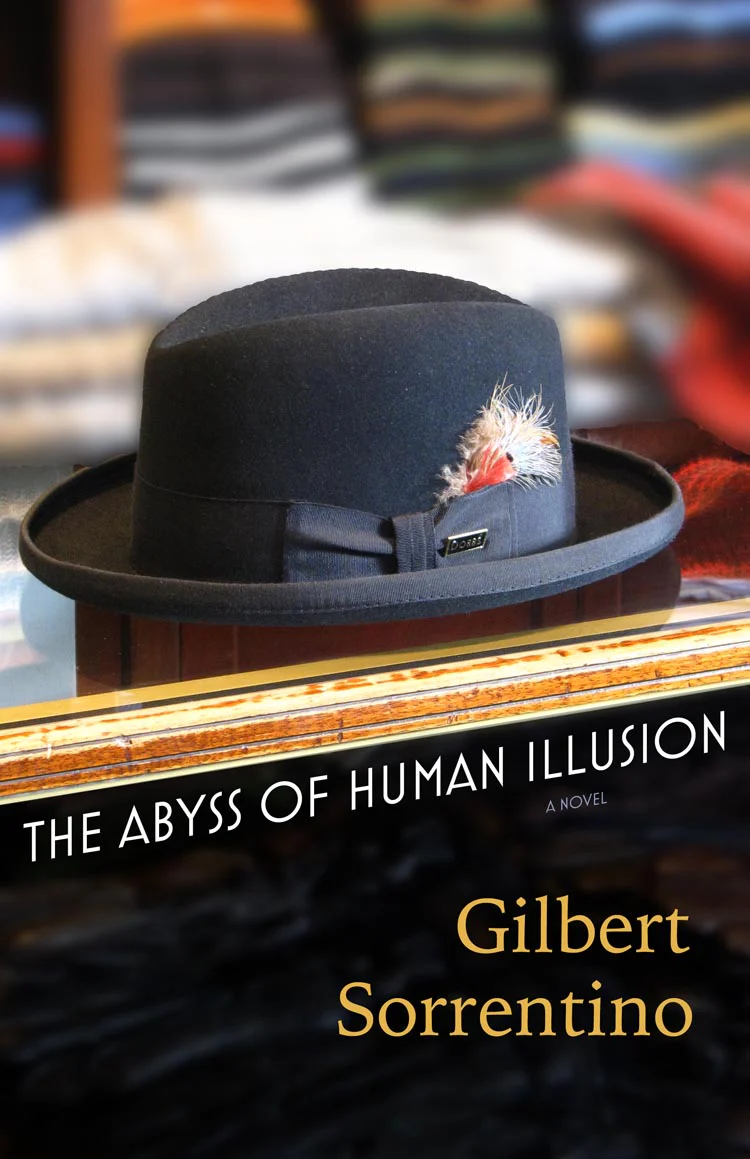
The Abyss of Human Illusion
A novel by Gilbert Sorrentino, with a preface by Christopher Sorrentino
February 1, 2010 • 5.5 x 8.5 • 144 pages • 978-1-56689-233-9
The final novel from the postmodern American master.
Titled after a line from Henry James, The Abyss of Human Illusion consists of fifty narrative set pieces full of savage humor and cathartic passion—an elegiac paean to the bleak world Gilbert Sorrentino so brilliantly captured in his long and storied career. Mirroring the inexplicable coincidences, encounters, and hallmarks of modern life, this novel revisits familiar characters—the aging artists, miserable couples, crackerjack salesmen, and drunken soldiers of previous books, placing them in familiar landscapes lost in time between the Depression era and some fraudulent bohemia of the present.
About the Author
A luminary of American literature, Gilbert Sorrentino was a boyhood friend of Hubert Selby, Jr., a confidant of William Carlos Williams, a two-time PEN/Faulkner Award finalist, and the recipient of a Lannan Literary Lifetime Achievement Award. He taught at Stanford for many years before returning to his native Brooklyn and published over thirty books before his death in 2006.
The son of Gilbert Sorrentino, Christopher Sorrentino is a novelist and short story writer whose fictional account of the Patty Hearst saga, Trance, was a finalist for the National Book Award. He lives in Brooklyn.
Reviews
“[Sorrentino] was a clear-eyed observer of human illusion and the frailties and follies of the species. He was also a very funny writer. . . . [His] ear for American, especially New York, speech, and his attention to the spirit of place and compassion for the average loser, all defined him as a kindred spirit of such great American humorists as Mark Twain and Peter De Vries. . . . [His characters] seem to have wandered out of one of Edward Hopper’s haunted cityscapes, with fading memories of another, bolder age, one chronicled by Richard Yates, perhaps, or John Updike. . . . Fortunately none of this ennui settles on the reader of The Abyss of Human Illusion, in which Sorrentino is frequently hilarious, in a vein more Swiftian than postmodern.” —New York Times Book Review
“The writing here is alive—words dance emphatically like the lusty, jazz-spun youngsters who populate Sorrentino’s early fiction. Ultimately, there’s solace to be found in the book’s near-perfect sentences, even when the author is dwelling on the futility of writing sentences.” —Time Out New York
“Quite funny, masterfully spinning through rhetoric high and low. . . . [Sorrentino] opens himself anew, four decades into the vocation, to the passions engaged by an art made of words. Sorrentino’s final work remains prickly about those passions, to be sure, but it nonetheless reveals a respect for how the best prose can embody what we call insight.” —Believer
“The Abyss of Human Illusion is a monumental final work from one of America’s greatest writers.” —Rain Taxi
“The juxtaposition of sorrow and humour permeates [Sorrentino’s] work with masterful precision and speaks of a writer whose perspective is both broad and deep. . . . The crafting is consistently acute, frequently surprising, and resolutely beautiful. Sorrentino plunges us into the abyss, and we find ourselves unwilling to leave.” —Bookmunch
“All Sorrentino’s work rebuts what we were endlessly taught: Literature contains singular imagery, the perfect word lodged in its perfect spot, rounded characters, believable settings, a confident narrative. . . . This demolition liberates readers, and writers, from stale expectations, and stylistic aesthetic molds. . . . It’s fiction, nothing more, and definitely not a bit less: an illusion that has depths we may never see the bottom of.” —Literary Review
“Sorrentino’s writing is marked by exquisite, and exquisitely unexpected, turns of phrase. . . . [His] prose weds the real with the fantastic, holding up some obscure facet of humanity to the light.” —NewPages
“A unique and highly entertaining story filled with humor that doesn’t hold itself back.” —Midwest Book Review
“This fine, final work by Brooklyn native Sorrentino finds a rueful charm in the ‘wretched clichés’ of ordinary failure.” —Publishers Weekly
“It’s still hard to accept a world without the great Gilbert Sorrentino writing in it. Over the last several decades, nobody that smart was ever funnier, nobody that funny was ever a better prose artist, nobody that original was ever more attuned to the pain and trickiness of being—and thinking about being—human. That his final book evinces all the complexity, poetry and dark mirth that made him so revered might not surprise, but it does inspire.” —Sam Lipsyte
Product Information
Product Information
Shipping & Returns
Shipping & Returns
Description
A novel by Gilbert Sorrentino, with a preface by Christopher Sorrentino
February 1, 2010 • 5.5 x 8.5 • 144 pages • 978-1-56689-233-9
The final novel from the postmodern American master.
Titled after a line from Henry James, The Abyss of Human Illusion consists of fifty narrative set pieces full of savage humor and cathartic passion—an elegiac paean to the bleak world Gilbert Sorrentino so brilliantly captured in his long and storied career. Mirroring the inexplicable coincidences, encounters, and hallmarks of modern life, this novel revisits familiar characters—the aging artists, miserable couples, crackerjack salesmen, and drunken soldiers of previous books, placing them in familiar landscapes lost in time between the Depression era and some fraudulent bohemia of the present.
About the Author
A luminary of American literature, Gilbert Sorrentino was a boyhood friend of Hubert Selby, Jr., a confidant of William Carlos Williams, a two-time PEN/Faulkner Award finalist, and the recipient of a Lannan Literary Lifetime Achievement Award. He taught at Stanford for many years before returning to his native Brooklyn and published over thirty books before his death in 2006.
The son of Gilbert Sorrentino, Christopher Sorrentino is a novelist and short story writer whose fictional account of the Patty Hearst saga, Trance, was a finalist for the National Book Award. He lives in Brooklyn.
Reviews
“[Sorrentino] was a clear-eyed observer of human illusion and the frailties and follies of the species. He was also a very funny writer. . . . [His] ear for American, especially New York, speech, and his attention to the spirit of place and compassion for the average loser, all defined him as a kindred spirit of such great American humorists as Mark Twain and Peter De Vries. . . . [His characters] seem to have wandered out of one of Edward Hopper’s haunted cityscapes, with fading memories of another, bolder age, one chronicled by Richard Yates, perhaps, or John Updike. . . . Fortunately none of this ennui settles on the reader of The Abyss of Human Illusion, in which Sorrentino is frequently hilarious, in a vein more Swiftian than postmodern.” —New York Times Book Review
“The writing here is alive—words dance emphatically like the lusty, jazz-spun youngsters who populate Sorrentino’s early fiction. Ultimately, there’s solace to be found in the book’s near-perfect sentences, even when the author is dwelling on the futility of writing sentences.” —Time Out New York
“Quite funny, masterfully spinning through rhetoric high and low. . . . [Sorrentino] opens himself anew, four decades into the vocation, to the passions engaged by an art made of words. Sorrentino’s final work remains prickly about those passions, to be sure, but it nonetheless reveals a respect for how the best prose can embody what we call insight.” —Believer
“The Abyss of Human Illusion is a monumental final work from one of America’s greatest writers.” —Rain Taxi
“The juxtaposition of sorrow and humour permeates [Sorrentino’s] work with masterful precision and speaks of a writer whose perspective is both broad and deep. . . . The crafting is consistently acute, frequently surprising, and resolutely beautiful. Sorrentino plunges us into the abyss, and we find ourselves unwilling to leave.” —Bookmunch
“All Sorrentino’s work rebuts what we were endlessly taught: Literature contains singular imagery, the perfect word lodged in its perfect spot, rounded characters, believable settings, a confident narrative. . . . This demolition liberates readers, and writers, from stale expectations, and stylistic aesthetic molds. . . . It’s fiction, nothing more, and definitely not a bit less: an illusion that has depths we may never see the bottom of.” —Literary Review
“Sorrentino’s writing is marked by exquisite, and exquisitely unexpected, turns of phrase. . . . [His] prose weds the real with the fantastic, holding up some obscure facet of humanity to the light.” —NewPages
“A unique and highly entertaining story filled with humor that doesn’t hold itself back.” —Midwest Book Review
“This fine, final work by Brooklyn native Sorrentino finds a rueful charm in the ‘wretched clichés’ of ordinary failure.” —Publishers Weekly
“It’s still hard to accept a world without the great Gilbert Sorrentino writing in it. Over the last several decades, nobody that smart was ever funnier, nobody that funny was ever a better prose artist, nobody that original was ever more attuned to the pain and trickiness of being—and thinking about being—human. That his final book evinces all the complexity, poetry and dark mirth that made him so revered might not surprise, but it does inspire.” —Sam Lipsyte