Poets & Writers, “New and Noteworthy”
Ms. Magazine, “February Reads for the Rest of Us”
Literary Hub, “New Books to Dive Into”
“In this radiant work, poet and performance artist Civil pays tribute to a legacy of Black artists while contending with the ‘twin moments of pandemic and uprising’ after the murder of George Floyd. . . . Taken together, [Civil’s] musings act as a radical reclamation of place and identity, and challenge the ‘pandemic of white supremacy.’ The result is an evocative work of art that brings to life an era ripe for a revolution.” —Publishers Weekly, starred review
“Civil describes herself as an ‘idiosyncratic writer’—a brilliant synthesis of the subtly self-conscious thinking-out-loud displayed throughout the text. Alongside Alexis Pauline Gumbs and other self-proclaimed Black feminists who have risen on the shoulders of bell hooks, Audre Lorde, and June Jordan, I count Civil as a trailblazer with my generation of writers committed to Black feminist consciousness, as a fluid, genre busting, ‘idiosyncratic’ archive, dedicated to uncontained, vulgar, and shimmering cycles of curiosity.” —Erica N. Cardwell, The Brooklyn Rail
“As a tour, mapping, archive, and cross-genre reckoning, like [Civil’s] other work, each page of the déjà vu opens up space by addressing time through dreams, memories, archived performances, and visitations to old writings with fresh eyes. . . . Her distinct voice and style rise from the page.” —Amy Bobeda, Full Stop
“An exuberant collection of texts and artifacts by a Black feminist performance artist. . . An unwavering commitment to upholding a unique personal aesthetic while exploring black dreams is the driving force behind this unusual book, a kind of archive or scrapbook of performance pieces, scripts, poems, conversations, collaborations, lectures, and essays. . . .To be read, as the author suggests, like a dream: Garner what you can, and hopefully something new will unfurl in your mind.” —Kirkus
“Civil’s memoir blends performance, personal thoughts and letters, critical analysis, conversational prose and poetry, and much more to create a work that treats memory, time, and space with reverence. She fuses history and Black feminist tradition with personal meditation, moving around and outside the confines inherent in the categorizing of time.” —Alta
“Phenomenally creative and passionate, this collection of work by performance artist and poet Gabrielle Civil is also expansive, feminist and inspirational.” —Karla J. Strand, Ms. Magazine
“Gabrielle Civil’s ambitious project the déjà vu integrates the author’s performance pieces and poetry into an ongoing narrative of her life. Civil runs with the idea of black time, which melds and melts and flows and runs against the dominant and thereby white-centered conception of time. She brings up questions of what it means to dream, and to enact one’s dreams, while encouraging readers to themselves keep dreaming—to dream things into being. Civil has crafted her own self-archive, documenting performances that would otherwise have been temporally and spatially situated, ensuring that she is not looked over and forgotten as black women have been for as long as memory allows. At once a meditation, a reflection, and a call to action, Civil's unique work expands genre boundaries of memoir and performance studies.” —Meghana Kandlur, Seminary Co-op Bookstores
“What if we could offer our archives to each other like flowers? Hold them in glass, heavy but transparent. What if we could show each other the journey of unknowing and remembering ourselves now? Why would we wait? With this work, Gabrielle Civil continues to model generosity, bravery, and vulnerability as core principles of black feminist performance, creativity, and living. Read it for the beauty, the black feminist references. Read it for a particular herstory of this time. Look for what you might be unknowing right now and what you need urgently to remember.” —Alexis Pauline Gumbs
“Civil soldiers for the possibility of black life to dream beyond the confines of colonialist rhetoric laden within modern world systems. Here, she asks the reader to think and experiment playfully with her as she skillfully complicates our time-dream-space continuum with new poetic knowledge. the déjà vu is a book project that performs as a conceptual artwork crafting its own genre of intertextual experience.” —jaamil olawale kosoko
“While the world insists that blackness exists only in the body, Gabrielle Civil shows us that black feminist consciousness extends well beyond any corporeal limitations. Affirming the power of black dreams and black time, the déjà vu notes metaphysical links between the ancestors and the stars. It is an astounding book.” —Wendy S. Walters
“This is the book I wish I’d had as an artist as a young woman. And it’s the book I’ll relish in sharing now. Performance studies has a new one for the mantel in this generous, funny, tender journey through the thicket and politic of Becoming.” —Cauleen Smith, filmmaker
“the déjà vu is a rousing, eclectic black feminist project. It blends elements of spoken word, critical writing, poetry, letters, journal writing, book review, photography, artwork, and performance, defying at once the limitations imposed by more conventional approaches to genre. Here, Gabrielle Civil has crafted a pedagogical model for writing performance art.” —Alexis De Veaux, author of Yabo
“So often, in reading the déjà vu, I’m reminded of how breakable memory is, especially when that memory tries to hold trauma within it. The act of remembering itself haunts the déjà vu as Gabrielle Civil catalogues her experience through impetuous lists, vigorous anaphora, repetition, and the interpretation of dreams, both waking and asleep. Civil meets the multiplicity of memory with formal multiplicity. There are several categories of memory, after all: childhood nostalgia has a peculiar quality to it; history is never yet fully formed; and visioning, also, is related to dreams. Moving in and out of enjambment, Civil works from poetry to prose to arts criticism to inexplicable junctures of poetic bravery to sheer amplitude to breaks into the conversational to epistolary to performance. In all this plurality, Civil manages to deliver a kind of replete self-accounting, or auto-theory, in the déjà vu. She goes deeper than ekphrasis or arts criticism, toward an experience that’s closer to that of intimately living with, and within, the text of our culture.” —Anaïs Duplan, author of Blackspace: On the Poetics of an Afrofuture
“Gabrielle Civil’s luminous the déjà vu emanates deeply within and around the speaker’s memory, in which the politics of joy are palpable intimacies of language and performance, a ‘sphericity’ in which ‘all the time / is seeping and oozing.’ Civil brilliantly envelops the reader in BLACK TIME, hers, ours, a way into the present moment by excavating a self, one taking great risks and following big dreams, where humility and compassion ignite a vivid tableau and conceptual stratagem, ever human, where ‘blood clots form . . . a bright red arterial flash that leads . . . a few steps to find a SNOW GLOBE.’ This book is roundly wise and rich with surprise, where ‘art-making and black feminist professing’ reveal the heart of this incredibly moving work: Gabrielle Civil’s ‘own vibrating, undeniable power ~~~~~~~~~~~~~black future~~~~~~~~~.’ Civil inspires a life of love for the self, for others, for the human condition, as we follow hers, engaged in ‘practice and play as human beings,’ out of which Civil urges and instructs: ‘Imagine an iridescent bubble around your head / This is your dreams happening now.’” —Ronaldo V. Wilson
Praise for Swallow the Fish
“‘Enjoy. Enjoy? Enjoy!’ Perhaps this is Gabrielle Civil’s calculus for performance art, though I suspect that accuses her praxis of being too pat. Instead, Swallow the Fish discloses that the ‘Enjoy?’—that doubt, her sense that she’s maybe said or done the wrong thing—is catalyst and outcome. Thus, this remarkable book is a monograph and manual, a catalog and travelogue rendered as a progress of generative failures. An intimate showcase for Civil’s fierce eros, mordant humor, and intellectual appetites, Swallow the Fish is also a vital record of how a black woman moves through spaces where desire and aversion make equally rough contact. So, enjoy! But enjoy(?), too.” —Douglas Kearney, Mess and Mess and
“This book paints a beautiful Black woman sky of possibilities. This book makes me want to perform/it makes me want to write-to holla-to hold it close. I love this book!” —Sharon Bridgforth
“This book is so meticulous and so absorbing, I am in awe. It is declamation, reflection, proposal, documentation, blueprint. Gabrielle Civil is revealed as an artist perfectly poised to speak to how race, gender, and sexuality enact embodied performativity. She writes and performs herself into history in ferociously intelligent and relentlessly personal ways. And I’ve never read such a perfect articulation of the turbulence of performing—the way that externalizing the possibility and conflicts of one’s body leaves you open and vulnerable to the quagmire of interpretation, misunderstanding, and projection. How the specificity of identity mixes with desire to confound, comfort or disrupt public space. As with so many things that I love, I want everyone to read this book.” —Miguel Gutierrez
Praise for Experiments in Joy
“Gabrielle Civil has made a book into a performance space and living archive. Words dance and bodies speak: together they invent languages of keen pleasure and ardent thought. Experiments In Joy is the memoir as solo and as collaboration with other questing artists. Led by Civil, they engage—tease, tangle with—the stuff of history, of particularity, of imagination. Read, watch, listen, and dream. Be transformed.” —Margo Jefferson, author of Negroland: A Memoir
“Experiments in Joy is a transformational literary work of material magic. Poised alongside the most medicinal works of mystic intellectuals like Søren Kierkegaard, bell hooks, Jerzy Growtowski, Eve Sedgwick, Grace Jones, Adrienne Kennedy, and Leonard Cohen, this collection enacts (rather than professes) transdisciplinary theories on inter-being, inter-rupture, and inter-becoming for the subtlest, hungriest, and wisest organ of admittance—the mind-heart, which will not suffer bullshit. Go ahead and clear some space on your shelf for ‘Books that Help Us Be,’ but know that you won’t be shelving it for long; like a stash of toys or a weird secret key, this book wants to be shared.” —Anna Joy Springer, author of The Vicious Red Relic, Love
“Civil’s Experiments in Joy invites readers to trace the idea of ‘gesture’ from the body to the page and back, to follow her footsteps to the various entryways into Black Girl Studies, and to witness the role of friendship in the making of art and survival. Reading it, we are also reminded that the blues is not just a document of trouble, but also a journey to the pleasure on the other side of it.” —Mendi + Keith Obadike, creators of Four Electric Ghosts
Praise for ( ghost gestures )
“How do you summon a public? How do you shatter the mirror that a doll might be? How do you find your way back to love, or the capacity to feel something when love comes toward you, on a wave of life? ( ghost gestures ) is a complex work that starts to oscillate, the more it gets to what it is: about. Lateral shifts appear on the page as this writer engages race, mimicry, migration, and desire as core themes, so rapidly that the chapbook's distension, the way this writing changes what a chapbook is, becomes a part of what it is to read it. That: ‘struggle,’ or: ‘blur.’ When a queen becomes an effigy, the writer asks us to consider, as a working definition of Caribbean performance art: what it might be to ‘burn finally alive.’ All of this works together to create an experience of world-contact through micromovements, kinesthesia, the body’s trace as much as its ongoing being. The ghost gestures are experienced as fully, in other words, as they might be experienced. This is a philosophy of performance that the writer elaborates for us: ‘The performance texts here serve as past projections, transcriptions and scores.’ Yes. How do you choreograph notes so they magnetize their own columnar, prehensile order? Like this.” —Bhanu Kapil
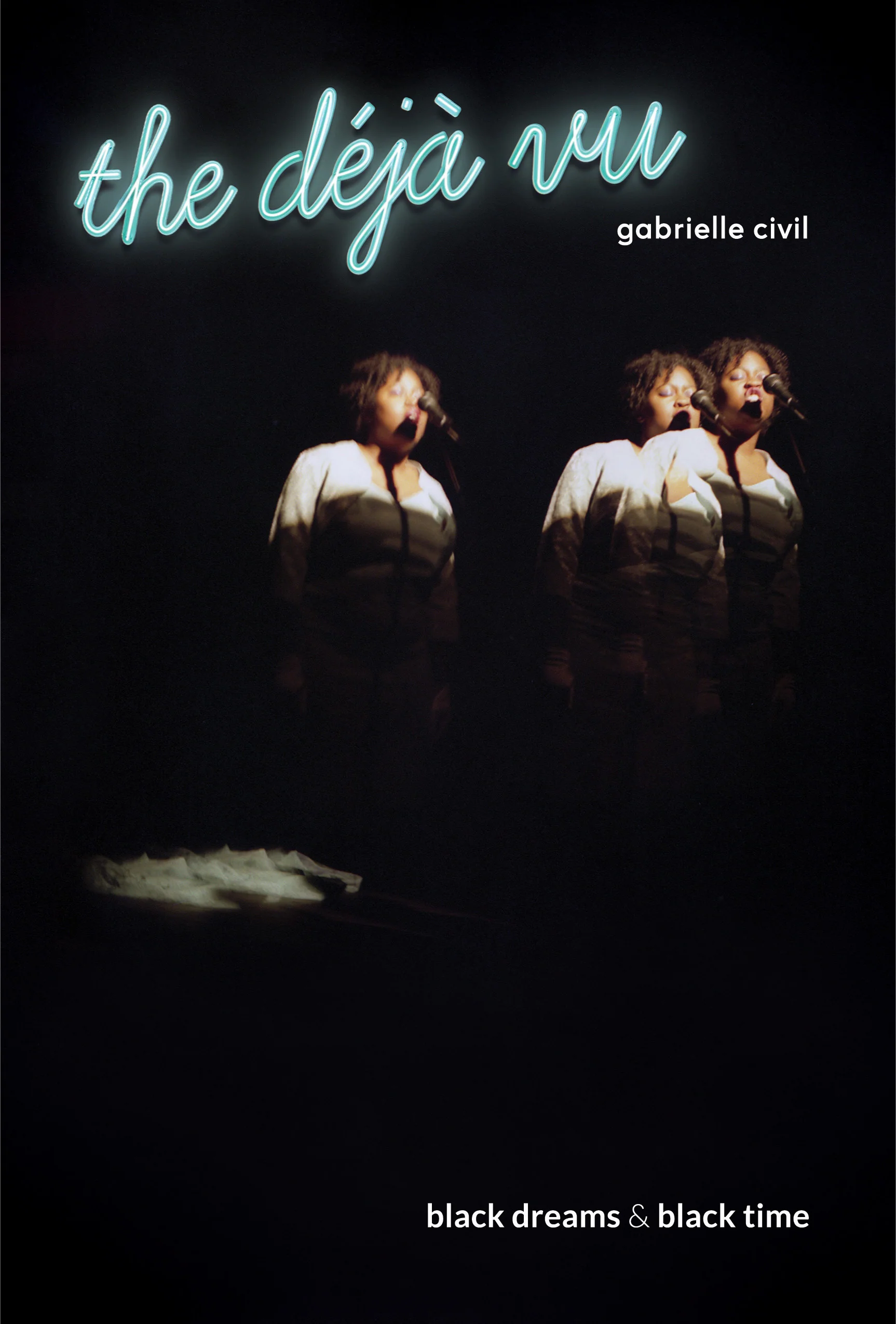
the déjà vu
Nonfiction by Gabrielle Civil
February 22, 2022 • 5.5 x 8.25 • 240 pages • 978-1-56689-622-1
Gabrielle Civil mines black dreams and black time to reveal a vibrant archive of black feminist creative expression.
Emerging from the intersection of pandemic and uprising, the déjà vu activates forms both new and ancestral, drawing movement, speech, and lyric essay into performance memoir. As Civil considers Haitian tourist paintings, dance rituals, race at the movies, black feminist legacies, and more, she reflects on her personal losses and desires, speculates on black time, and dreams into expansive black life. With intimacy, humor, and verve, the déjà vu blurs boundaries between memory, grief, and love; then, now, and the future.
Download the teaching / reading group guide by Lisa Brimmer here.
About the Author
Gabrielle Civil is a black feminist performance artist, poet, and writer originally from Detroit. She has premiered fifty performance artworks around the world. Her performance memoirs include Swallow the Fish, Experiments in Joy, ( ghost gestures ) and in and out of place. She teaches at the California Institute of the Arts. The aim of her work is to open up space.
Praise for the déjà vu
Poets & Writers, “New and Noteworthy”
Ms. Magazine, “February Reads for the Rest of Us”
Literary Hub, “New Books to Dive Into”
“In this radiant work, poet and performance artist Civil pays tribute to a legacy of Black artists while contending with the ‘twin moments of pandemic and uprising’ after the murder of George Floyd. . . . Taken together, [Civil’s] musings act as a radical reclamation of place and identity, and challenge the ‘pandemic of white supremacy.’ The result is an evocative work of art that brings to life an era ripe for a revolution.” —Publishers Weekly, starred review
“Civil describes herself as an ‘idiosyncratic writer’—a brilliant synthesis of the subtly self-conscious thinking-out-loud displayed throughout the text. Alongside Alexis Pauline Gumbs and other self-proclaimed Black feminists who have risen on the shoulders of bell hooks, Audre Lorde, and June Jordan, I count Civil as a trailblazer with my generation of writers committed to Black feminist consciousness, as a fluid, genre busting, ‘idiosyncratic’ archive, dedicated to uncontained, vulgar, and shimmering cycles of curiosity.” —Erica N. Cardwell, The Brooklyn Rail
“As a tour, mapping, archive, and cross-genre reckoning, like [Civil’s] other work, each page of the déjà vu opens up space by addressing time through dreams, memories, archived performances, and visitations to old writings with fresh eyes. . . . Her distinct voice and style rise from the page.” —Amy Bobeda, Full Stop
“An exuberant collection of texts and artifacts by a Black feminist performance artist. . . An unwavering commitment to upholding a unique personal aesthetic while exploring black dreams is the driving force behind this unusual book, a kind of archive or scrapbook of performance pieces, scripts, poems, conversations, collaborations, lectures, and essays. . . .To be read, as the author suggests, like a dream: Garner what you can, and hopefully something new will unfurl in your mind.” —Kirkus
“Civil’s memoir blends performance, personal thoughts and letters, critical analysis, conversational prose and poetry, and much more to create a work that treats memory, time, and space with reverence. She fuses history and Black feminist tradition with personal meditation, moving around and outside the confines inherent in the categorizing of time.” —Alta
“Phenomenally creative and passionate, this collection of work by performance artist and poet Gabrielle Civil is also expansive, feminist and inspirational.” —Karla J. Strand, Ms. Magazine
“Gabrielle Civil’s ambitious project the déjà vu integrates the author’s performance pieces and poetry into an ongoing narrative of her life. Civil runs with the idea of black time, which melds and melts and flows and runs against the dominant and thereby white-centered conception of time. She brings up questions of what it means to dream, and to enact one’s dreams, while encouraging readers to themselves keep dreaming—to dream things into being. Civil has crafted her own self-archive, documenting performances that would otherwise have been temporally and spatially situated, ensuring that she is not looked over and forgotten as black women have been for as long as memory allows. At once a meditation, a reflection, and a call to action, Civil's unique work expands genre boundaries of memoir and performance studies.” —Meghana Kandlur, Seminary Co-op Bookstores
“What if we could offer our archives to each other like flowers? Hold them in glass, heavy but transparent. What if we could show each other the journey of unknowing and remembering ourselves now? Why would we wait? With this work, Gabrielle Civil continues to model generosity, bravery, and vulnerability as core principles of black feminist performance, creativity, and living. Read it for the beauty, the black feminist references. Read it for a particular herstory of this time. Look for what you might be unknowing right now and what you need urgently to remember.” —Alexis Pauline Gumbs
“Civil soldiers for the possibility of black life to dream beyond the confines of colonialist rhetoric laden within modern world systems. Here, she asks the reader to think and experiment playfully with her as she skillfully complicates our time-dream-space continuum with new poetic knowledge. the déjà vu is a book project that performs as a conceptual artwork crafting its own genre of intertextual experience.” —jaamil olawale kosoko
“While the world insists that blackness exists only in the body, Gabrielle Civil shows us that black feminist consciousness extends well beyond any corporeal limitations. Affirming the power of black dreams and black time, the déjà vu notes metaphysical links between the ancestors and the stars. It is an astounding book.” —Wendy S. Walters
“This is the book I wish I’d had as an artist as a young woman. And it’s the book I’ll relish in sharing now. Performance studies has a new one for the mantel in this generous, funny, tender journey through the thicket and politic of Becoming.” —Cauleen Smith, filmmaker
“the déjà vu is a rousing, eclectic black feminist project. It blends elements of spoken word, critical writing, poetry, letters, journal writing, book review, photography, artwork, and performance, defying at once the limitations imposed by more conventional approaches to genre. Here, Gabrielle Civil has crafted a pedagogical model for writing performance art.” —Alexis De Veaux, author of Yabo
“So often, in reading the déjà vu, I’m reminded of how breakable memory is, especially when that memory tries to hold trauma within it. The act of remembering itself haunts the déjà vu as Gabrielle Civil catalogues her experience through impetuous lists, vigorous anaphora, repetition, and the interpretation of dreams, both waking and asleep. Civil meets the multiplicity of memory with formal multiplicity. There are several categories of memory, after all: childhood nostalgia has a peculiar quality to it; history is never yet fully formed; and visioning, also, is related to dreams. Moving in and out of enjambment, Civil works from poetry to prose to arts criticism to inexplicable junctures of poetic bravery to sheer amplitude to breaks into the conversational to epistolary to performance. In all this plurality, Civil manages to deliver a kind of replete self-accounting, or auto-theory, in the déjà vu. She goes deeper than ekphrasis or arts criticism, toward an experience that’s closer to that of intimately living with, and within, the text of our culture.” —Anaïs Duplan, author of Blackspace: On the Poetics of an Afrofuture
“Gabrielle Civil’s luminous the déjà vu emanates deeply within and around the speaker’s memory, in which the politics of joy are palpable intimacies of language and performance, a ‘sphericity’ in which ‘all the time / is seeping and oozing.’ Civil brilliantly envelops the reader in BLACK TIME, hers, ours, a way into the present moment by excavating a self, one taking great risks and following big dreams, where humility and compassion ignite a vivid tableau and conceptual stratagem, ever human, where ‘blood clots form . . . a bright red arterial flash that leads . . . a few steps to find a SNOW GLOBE.’ This book is roundly wise and rich with surprise, where ‘art-making and black feminist professing’ reveal the heart of this incredibly moving work: Gabrielle Civil’s ‘own vibrating, undeniable power ~~~~~~~~~~~~~black future~~~~~~~~~.’ Civil inspires a life of love for the self, for others, for the human condition, as we follow hers, engaged in ‘practice and play as human beings,’ out of which Civil urges and instructs: ‘Imagine an iridescent bubble around your head / This is your dreams happening now.’” —Ronaldo V. Wilson
Praise for Swallow the Fish
“‘Enjoy. Enjoy? Enjoy!’ Perhaps this is Gabrielle Civil’s calculus for performance art, though I suspect that accuses her praxis of being too pat. Instead, Swallow the Fish discloses that the ‘Enjoy?’—that doubt, her sense that she’s maybe said or done the wrong thing—is catalyst and outcome. Thus, this remarkable book is a monograph and manual, a catalog and travelogue rendered as a progress of generative failures. An intimate showcase for Civil’s fierce eros, mordant humor, and intellectual appetites, Swallow the Fish is also a vital record of how a black woman moves through spaces where desire and aversion make equally rough contact. So, enjoy! But enjoy(?), too.” —Douglas Kearney, Mess and Mess and
“This book paints a beautiful Black woman sky of possibilities. This book makes me want to perform/it makes me want to write-to holla-to hold it close. I love this book!” —Sharon Bridgforth
“This book is so meticulous and so absorbing, I am in awe. It is declamation, reflection, proposal, documentation, blueprint. Gabrielle Civil is revealed as an artist perfectly poised to speak to how race, gender, and sexuality enact embodied performativity. She writes and performs herself into history in ferociously intelligent and relentlessly personal ways. And I’ve never read such a perfect articulation of the turbulence of performing—the way that externalizing the possibility and conflicts of one’s body leaves you open and vulnerable to the quagmire of interpretation, misunderstanding, and projection. How the specificity of identity mixes with desire to confound, comfort or disrupt public space. As with so many things that I love, I want everyone to read this book.” —Miguel Gutierrez
Praise for Experiments in Joy
“Gabrielle Civil has made a book into a performance space and living archive. Words dance and bodies speak: together they invent languages of keen pleasure and ardent thought. Experiments In Joy is the memoir as solo and as collaboration with other questing artists. Led by Civil, they engage—tease, tangle with—the stuff of history, of particularity, of imagination. Read, watch, listen, and dream. Be transformed.” —Margo Jefferson, author of Negroland: A Memoir
“Experiments in Joy is a transformational literary work of material magic. Poised alongside the most medicinal works of mystic intellectuals like Søren Kierkegaard, bell hooks, Jerzy Growtowski, Eve Sedgwick, Grace Jones, Adrienne Kennedy, and Leonard Cohen, this collection enacts (rather than professes) transdisciplinary theories on inter-being, inter-rupture, and inter-becoming for the subtlest, hungriest, and wisest organ of admittance—the mind-heart, which will not suffer bullshit. Go ahead and clear some space on your shelf for ‘Books that Help Us Be,’ but know that you won’t be shelving it for long; like a stash of toys or a weird secret key, this book wants to be shared.” —Anna Joy Springer, author of The Vicious Red Relic, Love
“Civil’s Experiments in Joy invites readers to trace the idea of ‘gesture’ from the body to the page and back, to follow her footsteps to the various entryways into Black Girl Studies, and to witness the role of friendship in the making of art and survival. Reading it, we are also reminded that the blues is not just a document of trouble, but also a journey to the pleasure on the other side of it.” —Mendi + Keith Obadike, creators of Four Electric Ghosts
Praise for ( ghost gestures )
“How do you summon a public? How do you shatter the mirror that a doll might be? How do you find your way back to love, or the capacity to feel something when love comes toward you, on a wave of life? ( ghost gestures ) is a complex work that starts to oscillate, the more it gets to what it is: about. Lateral shifts appear on the page as this writer engages race, mimicry, migration, and desire as core themes, so rapidly that the chapbook's distension, the way this writing changes what a chapbook is, becomes a part of what it is to read it. That: ‘struggle,’ or: ‘blur.’ When a queen becomes an effigy, the writer asks us to consider, as a working definition of Caribbean performance art: what it might be to ‘burn finally alive.’ All of this works together to create an experience of world-contact through micromovements, kinesthesia, the body’s trace as much as its ongoing being. The ghost gestures are experienced as fully, in other words, as they might be experienced. This is a philosophy of performance that the writer elaborates for us: ‘The performance texts here serve as past projections, transcriptions and scores.’ Yes. How do you choreograph notes so they magnetize their own columnar, prehensile order? Like this.” —Bhanu Kapil
Original: $17.95
-65%$17.95
$6.28Product Information
Product Information
Shipping & Returns
Shipping & Returns
Description
Nonfiction by Gabrielle Civil
February 22, 2022 • 5.5 x 8.25 • 240 pages • 978-1-56689-622-1
Gabrielle Civil mines black dreams and black time to reveal a vibrant archive of black feminist creative expression.
Emerging from the intersection of pandemic and uprising, the déjà vu activates forms both new and ancestral, drawing movement, speech, and lyric essay into performance memoir. As Civil considers Haitian tourist paintings, dance rituals, race at the movies, black feminist legacies, and more, she reflects on her personal losses and desires, speculates on black time, and dreams into expansive black life. With intimacy, humor, and verve, the déjà vu blurs boundaries between memory, grief, and love; then, now, and the future.
Download the teaching / reading group guide by Lisa Brimmer here.
About the Author
Gabrielle Civil is a black feminist performance artist, poet, and writer originally from Detroit. She has premiered fifty performance artworks around the world. Her performance memoirs include Swallow the Fish, Experiments in Joy, ( ghost gestures ) and in and out of place. She teaches at the California Institute of the Arts. The aim of her work is to open up space.
Praise for the déjà vu
Poets & Writers, “New and Noteworthy”
Ms. Magazine, “February Reads for the Rest of Us”
Literary Hub, “New Books to Dive Into”
“In this radiant work, poet and performance artist Civil pays tribute to a legacy of Black artists while contending with the ‘twin moments of pandemic and uprising’ after the murder of George Floyd. . . . Taken together, [Civil’s] musings act as a radical reclamation of place and identity, and challenge the ‘pandemic of white supremacy.’ The result is an evocative work of art that brings to life an era ripe for a revolution.” —Publishers Weekly, starred review
“Civil describes herself as an ‘idiosyncratic writer’—a brilliant synthesis of the subtly self-conscious thinking-out-loud displayed throughout the text. Alongside Alexis Pauline Gumbs and other self-proclaimed Black feminists who have risen on the shoulders of bell hooks, Audre Lorde, and June Jordan, I count Civil as a trailblazer with my generation of writers committed to Black feminist consciousness, as a fluid, genre busting, ‘idiosyncratic’ archive, dedicated to uncontained, vulgar, and shimmering cycles of curiosity.” —Erica N. Cardwell, The Brooklyn Rail
“As a tour, mapping, archive, and cross-genre reckoning, like [Civil’s] other work, each page of the déjà vu opens up space by addressing time through dreams, memories, archived performances, and visitations to old writings with fresh eyes. . . . Her distinct voice and style rise from the page.” —Amy Bobeda, Full Stop
“An exuberant collection of texts and artifacts by a Black feminist performance artist. . . An unwavering commitment to upholding a unique personal aesthetic while exploring black dreams is the driving force behind this unusual book, a kind of archive or scrapbook of performance pieces, scripts, poems, conversations, collaborations, lectures, and essays. . . .To be read, as the author suggests, like a dream: Garner what you can, and hopefully something new will unfurl in your mind.” —Kirkus
“Civil’s memoir blends performance, personal thoughts and letters, critical analysis, conversational prose and poetry, and much more to create a work that treats memory, time, and space with reverence. She fuses history and Black feminist tradition with personal meditation, moving around and outside the confines inherent in the categorizing of time.” —Alta
“Phenomenally creative and passionate, this collection of work by performance artist and poet Gabrielle Civil is also expansive, feminist and inspirational.” —Karla J. Strand, Ms. Magazine
“Gabrielle Civil’s ambitious project the déjà vu integrates the author’s performance pieces and poetry into an ongoing narrative of her life. Civil runs with the idea of black time, which melds and melts and flows and runs against the dominant and thereby white-centered conception of time. She brings up questions of what it means to dream, and to enact one’s dreams, while encouraging readers to themselves keep dreaming—to dream things into being. Civil has crafted her own self-archive, documenting performances that would otherwise have been temporally and spatially situated, ensuring that she is not looked over and forgotten as black women have been for as long as memory allows. At once a meditation, a reflection, and a call to action, Civil's unique work expands genre boundaries of memoir and performance studies.” —Meghana Kandlur, Seminary Co-op Bookstores
“What if we could offer our archives to each other like flowers? Hold them in glass, heavy but transparent. What if we could show each other the journey of unknowing and remembering ourselves now? Why would we wait? With this work, Gabrielle Civil continues to model generosity, bravery, and vulnerability as core principles of black feminist performance, creativity, and living. Read it for the beauty, the black feminist references. Read it for a particular herstory of this time. Look for what you might be unknowing right now and what you need urgently to remember.” —Alexis Pauline Gumbs
“Civil soldiers for the possibility of black life to dream beyond the confines of colonialist rhetoric laden within modern world systems. Here, she asks the reader to think and experiment playfully with her as she skillfully complicates our time-dream-space continuum with new poetic knowledge. the déjà vu is a book project that performs as a conceptual artwork crafting its own genre of intertextual experience.” —jaamil olawale kosoko
“While the world insists that blackness exists only in the body, Gabrielle Civil shows us that black feminist consciousness extends well beyond any corporeal limitations. Affirming the power of black dreams and black time, the déjà vu notes metaphysical links between the ancestors and the stars. It is an astounding book.” —Wendy S. Walters
“This is the book I wish I’d had as an artist as a young woman. And it’s the book I’ll relish in sharing now. Performance studies has a new one for the mantel in this generous, funny, tender journey through the thicket and politic of Becoming.” —Cauleen Smith, filmmaker
“the déjà vu is a rousing, eclectic black feminist project. It blends elements of spoken word, critical writing, poetry, letters, journal writing, book review, photography, artwork, and performance, defying at once the limitations imposed by more conventional approaches to genre. Here, Gabrielle Civil has crafted a pedagogical model for writing performance art.” —Alexis De Veaux, author of Yabo
“So often, in reading the déjà vu, I’m reminded of how breakable memory is, especially when that memory tries to hold trauma within it. The act of remembering itself haunts the déjà vu as Gabrielle Civil catalogues her experience through impetuous lists, vigorous anaphora, repetition, and the interpretation of dreams, both waking and asleep. Civil meets the multiplicity of memory with formal multiplicity. There are several categories of memory, after all: childhood nostalgia has a peculiar quality to it; history is never yet fully formed; and visioning, also, is related to dreams. Moving in and out of enjambment, Civil works from poetry to prose to arts criticism to inexplicable junctures of poetic bravery to sheer amplitude to breaks into the conversational to epistolary to performance. In all this plurality, Civil manages to deliver a kind of replete self-accounting, or auto-theory, in the déjà vu. She goes deeper than ekphrasis or arts criticism, toward an experience that’s closer to that of intimately living with, and within, the text of our culture.” —Anaïs Duplan, author of Blackspace: On the Poetics of an Afrofuture
“Gabrielle Civil’s luminous the déjà vu emanates deeply within and around the speaker’s memory, in which the politics of joy are palpable intimacies of language and performance, a ‘sphericity’ in which ‘all the time / is seeping and oozing.’ Civil brilliantly envelops the reader in BLACK TIME, hers, ours, a way into the present moment by excavating a self, one taking great risks and following big dreams, where humility and compassion ignite a vivid tableau and conceptual stratagem, ever human, where ‘blood clots form . . . a bright red arterial flash that leads . . . a few steps to find a SNOW GLOBE.’ This book is roundly wise and rich with surprise, where ‘art-making and black feminist professing’ reveal the heart of this incredibly moving work: Gabrielle Civil’s ‘own vibrating, undeniable power ~~~~~~~~~~~~~black future~~~~~~~~~.’ Civil inspires a life of love for the self, for others, for the human condition, as we follow hers, engaged in ‘practice and play as human beings,’ out of which Civil urges and instructs: ‘Imagine an iridescent bubble around your head / This is your dreams happening now.’” —Ronaldo V. Wilson
Praise for Swallow the Fish
“‘Enjoy. Enjoy? Enjoy!’ Perhaps this is Gabrielle Civil’s calculus for performance art, though I suspect that accuses her praxis of being too pat. Instead, Swallow the Fish discloses that the ‘Enjoy?’—that doubt, her sense that she’s maybe said or done the wrong thing—is catalyst and outcome. Thus, this remarkable book is a monograph and manual, a catalog and travelogue rendered as a progress of generative failures. An intimate showcase for Civil’s fierce eros, mordant humor, and intellectual appetites, Swallow the Fish is also a vital record of how a black woman moves through spaces where desire and aversion make equally rough contact. So, enjoy! But enjoy(?), too.” —Douglas Kearney, Mess and Mess and
“This book paints a beautiful Black woman sky of possibilities. This book makes me want to perform/it makes me want to write-to holla-to hold it close. I love this book!” —Sharon Bridgforth
“This book is so meticulous and so absorbing, I am in awe. It is declamation, reflection, proposal, documentation, blueprint. Gabrielle Civil is revealed as an artist perfectly poised to speak to how race, gender, and sexuality enact embodied performativity. She writes and performs herself into history in ferociously intelligent and relentlessly personal ways. And I’ve never read such a perfect articulation of the turbulence of performing—the way that externalizing the possibility and conflicts of one’s body leaves you open and vulnerable to the quagmire of interpretation, misunderstanding, and projection. How the specificity of identity mixes with desire to confound, comfort or disrupt public space. As with so many things that I love, I want everyone to read this book.” —Miguel Gutierrez
Praise for Experiments in Joy
“Gabrielle Civil has made a book into a performance space and living archive. Words dance and bodies speak: together they invent languages of keen pleasure and ardent thought. Experiments In Joy is the memoir as solo and as collaboration with other questing artists. Led by Civil, they engage—tease, tangle with—the stuff of history, of particularity, of imagination. Read, watch, listen, and dream. Be transformed.” —Margo Jefferson, author of Negroland: A Memoir
“Experiments in Joy is a transformational literary work of material magic. Poised alongside the most medicinal works of mystic intellectuals like Søren Kierkegaard, bell hooks, Jerzy Growtowski, Eve Sedgwick, Grace Jones, Adrienne Kennedy, and Leonard Cohen, this collection enacts (rather than professes) transdisciplinary theories on inter-being, inter-rupture, and inter-becoming for the subtlest, hungriest, and wisest organ of admittance—the mind-heart, which will not suffer bullshit. Go ahead and clear some space on your shelf for ‘Books that Help Us Be,’ but know that you won’t be shelving it for long; like a stash of toys or a weird secret key, this book wants to be shared.” —Anna Joy Springer, author of The Vicious Red Relic, Love
“Civil’s Experiments in Joy invites readers to trace the idea of ‘gesture’ from the body to the page and back, to follow her footsteps to the various entryways into Black Girl Studies, and to witness the role of friendship in the making of art and survival. Reading it, we are also reminded that the blues is not just a document of trouble, but also a journey to the pleasure on the other side of it.” —Mendi + Keith Obadike, creators of Four Electric Ghosts
Praise for ( ghost gestures )
“How do you summon a public? How do you shatter the mirror that a doll might be? How do you find your way back to love, or the capacity to feel something when love comes toward you, on a wave of life? ( ghost gestures ) is a complex work that starts to oscillate, the more it gets to what it is: about. Lateral shifts appear on the page as this writer engages race, mimicry, migration, and desire as core themes, so rapidly that the chapbook's distension, the way this writing changes what a chapbook is, becomes a part of what it is to read it. That: ‘struggle,’ or: ‘blur.’ When a queen becomes an effigy, the writer asks us to consider, as a working definition of Caribbean performance art: what it might be to ‘burn finally alive.’ All of this works together to create an experience of world-contact through micromovements, kinesthesia, the body’s trace as much as its ongoing being. The ghost gestures are experienced as fully, in other words, as they might be experienced. This is a philosophy of performance that the writer elaborates for us: ‘The performance texts here serve as past projections, transcriptions and scores.’ Yes. How do you choreograph notes so they magnetize their own columnar, prehensile order? Like this.” —Bhanu Kapil