“Symphonic, both in its structure—four movements, the third of which is the most distinct and the last of which references the first and goes out in a brilliant burst—and in the way language echoes, builds, works its accretive magic. . . . Seeing the world like this, without us, traversed in a way we could never traverse it in our human bodies, is a powerful and exhilarating experience.” —Cara Blue Adams, The New Yorker
“A marvel of textual collation on a par with Christian Marclay’s supercut film ‘The Clock.’ It’s remarkable how coherently the narrative reads, despite its countless patchwork pieces, a testament not only to Comitta’s diligence but to the likeminded ways that novelists have tended to write about natural phenomena like snowfall or sunrise.” —Sam Sacks, The Wall Street Journal
“A meditative, lush narrative on the relationship between time and nature. . . . Like Proust, Comitta centers you in the reading experience, not just demanding your labor of comprehension at the languorous, long sentence level, but also requiring your attention and patience. . . . You’ll be hard-pressed to find another book with as verdant an archive of beautiful descriptive sentences as the one contained in The Nature Book.” —Darina Sikmashvili, Los Angeles Review of Books
“With long asides alongside neat rhymes, with ponderous thoughts on the nature of time near light scenes showing time’s mysterious passing, with ‘a great nest of angry snakes’ and still green apple trees, Comitta has created something a lot like an ecosystem.” —Madeleine Crum, The Baffler
“An epic journey—visual, textural and musical—that illustrates the vastness of our environment and its representation in literature.” —Joseph Holt, Star Tribune
“Their authorial vision weaves together a wild variety of styles with a steady eye on the land, sky, and water, as well as on the plants and animals living in each. Comitta approaches assembly with a conceptual rigor, but they do not sacrifice polish or readability. The novel flows beautifully. . . . An optimistic critique of the form, made entirely of the form.” —Crow Jonah Norlander, BOMB Magazine
“A magnum opus about the planet using only found text. . . . A dynamic and singular reading experience.” —Kirkus, starred review
“An immersive exhibition of nature writing. . . . [The Nature Book] pulls the reader along with gorgeous language and animal protagonists worth rooting for.” —Publishers Weekly
“In this seamless anthology, we forget that the experience of reading about nature is mediated by human voices and, when suspended in the text, succumb to the magical illusion that we are perceiving the world in itself.” —Will Chancellor, The Brooklyn Rail
“In their mind-bending compendium of just the nature parts from 300 novels, Comitta asks what makes narrative, what merits attention, and whether humans have any business in this literary world at all. This is the novel to read conspicuously in your garden so the plants know you’re on their side. It’s only a matter of time before the weeds shall inherit the earth.” —Katy Simpson Smith, Electric Literature
“It’s all this different, beautiful language synthesized into one narrative that mostly describes the environments you’re passing through. I think it’s amazing.” —Jeff Tweedy of Wilco
“Here it is at last, and what a bloody relief to at last have it: The Novel Without Us. Using the suprasensory medium of the human vessel Tom Comitta, the trees and sky and earth have accessed the hyperobject or hyperartifact known as ‘literature’ in order to be heard from, across time and space. This is a novel to dwarf all others.” —Jonathan Lethem
“Tom Comitta’s original novel—composed of descriptions of animals, plants, weather, water, earth, time and space from canonical English-language works—is a feat of conceptual art, biblical in tone and panoramic in scope. The absence of human life in The Nature Book is a relief and a delight, yet Comitta’s devotion to the ‘ancillary’ builds a subtle and uncomfortable portrait of human consciousness: its judgments and observations, its habit of projecting itself into the minds of animals, and its tendency to see the natural world in terms of how it resembles, serves, or threatens the human one.” —Kathryn Scanlan
“In The Nature Book, language denuded from its original context serves its own surprising ends. An astounding project.” —Jarett Kobek
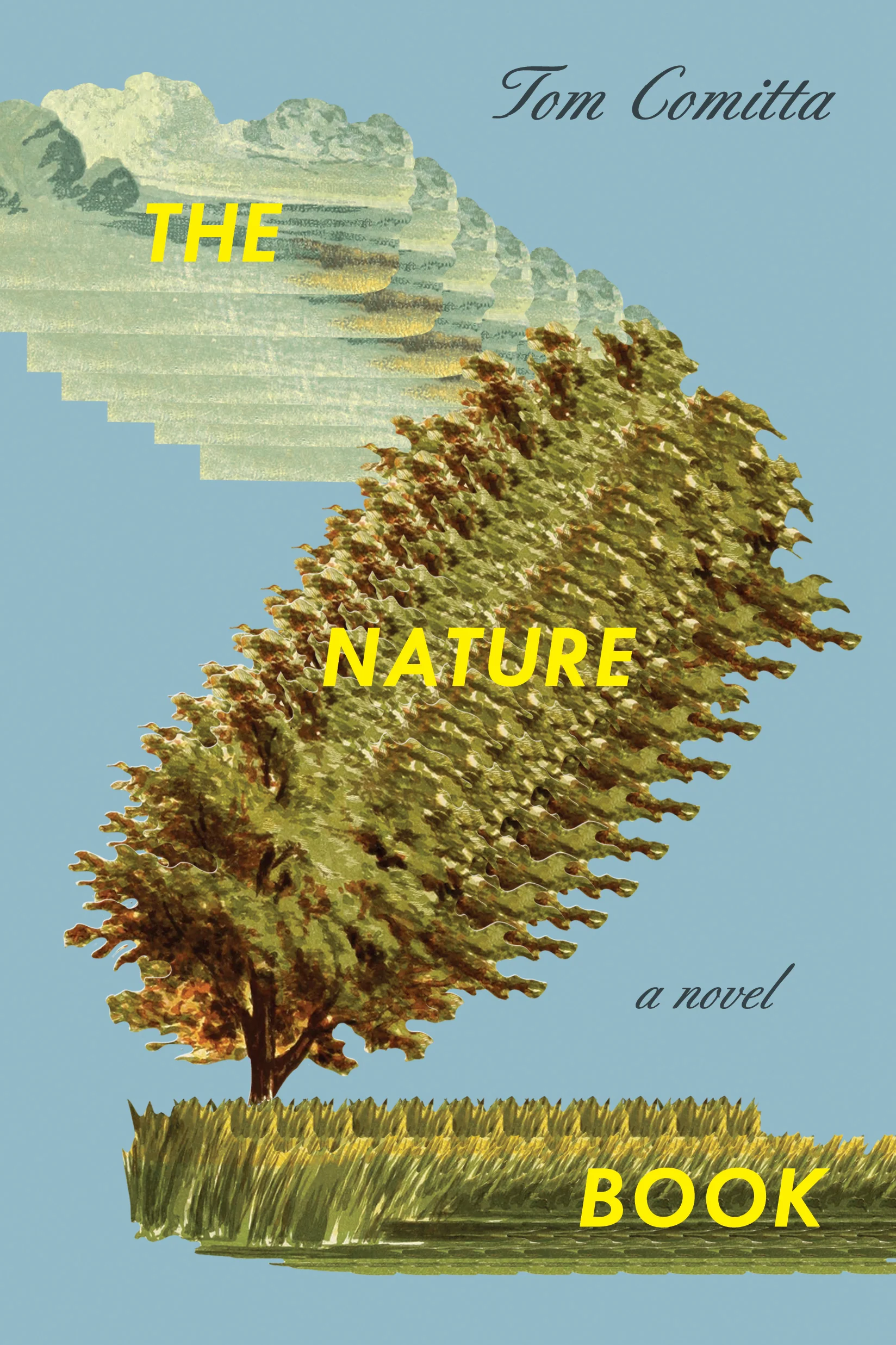
The Nature Book
A novel by Tom Comitta
March 14, 2023 • 5.5 x 8.25 • 272 pages • 978-1-56689-663-4
Part sweeping evocation of Earth’s rhythms, part literary archive, part post-human novel, The Nature Book collages descriptions of the natural world into a singular symphonic paean to the planet.
What does our nature writing say about us, and more urgently, what would it say without us? Tom Comitta investigates these questions and more in The Nature Book, a “literary supercut” that arranges writing about the natural world from three hundred works of fiction into a provocative re-envisioning of the novel. With fiction’s traditional background of flora and fauna brought to the fore, people and their structures disappear, giving center stage to animals, landforms, and weather patterns—honored in their own right rather than for their ambient role in human drama. The Nature Book challenges the confines of anthropocentrism with sublime artistic vision, traversing mountains, forests, oceans, and space to shift our attention toward the magnificently complex and interconnected world around us.
About the author
Tom Comitta is the author of 〇, Airport Novella, and First Thought Worst Thought: Collected Books 2011–2014, a print and digital archive of forty “night novels,” art books, and poetry collections. Comitta’s fiction and essays have appeared in WIRED, Lit Hub, Electric Literature, the Los Angeles Review of Books, the Believer, BOMB, and Best American Experimental Writing 2020. They live in Brooklyn.
Praise for The Nature Book
Independent Book Review, "Best Books We Read in 2023"
“Symphonic, both in its structure—four movements, the third of which is the most distinct and the last of which references the first and goes out in a brilliant burst—and in the way language echoes, builds, works its accretive magic. . . . Seeing the world like this, without us, traversed in a way we could never traverse it in our human bodies, is a powerful and exhilarating experience.” —Cara Blue Adams, The New Yorker
“A marvel of textual collation on a par with Christian Marclay’s supercut film ‘The Clock.’ It’s remarkable how coherently the narrative reads, despite its countless patchwork pieces, a testament not only to Comitta’s diligence but to the likeminded ways that novelists have tended to write about natural phenomena like snowfall or sunrise.” —Sam Sacks, The Wall Street Journal
“A meditative, lush narrative on the relationship between time and nature. . . . Like Proust, Comitta centers you in the reading experience, not just demanding your labor of comprehension at the languorous, long sentence level, but also requiring your attention and patience. . . . You’ll be hard-pressed to find another book with as verdant an archive of beautiful descriptive sentences as the one contained in The Nature Book.” —Darina Sikmashvili, Los Angeles Review of Books
“With long asides alongside neat rhymes, with ponderous thoughts on the nature of time near light scenes showing time’s mysterious passing, with ‘a great nest of angry snakes’ and still green apple trees, Comitta has created something a lot like an ecosystem.” —Madeleine Crum, The Baffler
“An epic journey—visual, textural and musical—that illustrates the vastness of our environment and its representation in literature.” —Joseph Holt, Star Tribune
“Their authorial vision weaves together a wild variety of styles with a steady eye on the land, sky, and water, as well as on the plants and animals living in each. Comitta approaches assembly with a conceptual rigor, but they do not sacrifice polish or readability. The novel flows beautifully. . . . An optimistic critique of the form, made entirely of the form.” —Crow Jonah Norlander, BOMB Magazine
“A magnum opus about the planet using only found text. . . . A dynamic and singular reading experience.” —Kirkus, starred review
“An immersive exhibition of nature writing. . . . [The Nature Book] pulls the reader along with gorgeous language and animal protagonists worth rooting for.” —Publishers Weekly
“In this seamless anthology, we forget that the experience of reading about nature is mediated by human voices and, when suspended in the text, succumb to the magical illusion that we are perceiving the world in itself.” —Will Chancellor, The Brooklyn Rail
“In their mind-bending compendium of just the nature parts from 300 novels, Comitta asks what makes narrative, what merits attention, and whether humans have any business in this literary world at all. This is the novel to read conspicuously in your garden so the plants know you’re on their side. It’s only a matter of time before the weeds shall inherit the earth.” —Katy Simpson Smith, Electric Literature
“It’s all this different, beautiful language synthesized into one narrative that mostly describes the environments you’re passing through. I think it’s amazing.” —Jeff Tweedy of Wilco
“Here it is at last, and what a bloody relief to at last have it: The Novel Without Us. Using the suprasensory medium of the human vessel Tom Comitta, the trees and sky and earth have accessed the hyperobject or hyperartifact known as ‘literature’ in order to be heard from, across time and space. This is a novel to dwarf all others.” —Jonathan Lethem
“Tom Comitta’s original novel—composed of descriptions of animals, plants, weather, water, earth, time and space from canonical English-language works—is a feat of conceptual art, biblical in tone and panoramic in scope. The absence of human life in The Nature Book is a relief and a delight, yet Comitta’s devotion to the ‘ancillary’ builds a subtle and uncomfortable portrait of human consciousness: its judgments and observations, its habit of projecting itself into the minds of animals, and its tendency to see the natural world in terms of how it resembles, serves, or threatens the human one.” —Kathryn Scanlan
“In The Nature Book, language denuded from its original context serves its own surprising ends. An astounding project.” —Jarett Kobek
Original: $17.95
-65%$17.95
$6.28Product Information
Product Information
Shipping & Returns
Shipping & Returns
Description
A novel by Tom Comitta
March 14, 2023 • 5.5 x 8.25 • 272 pages • 978-1-56689-663-4
Part sweeping evocation of Earth’s rhythms, part literary archive, part post-human novel, The Nature Book collages descriptions of the natural world into a singular symphonic paean to the planet.
What does our nature writing say about us, and more urgently, what would it say without us? Tom Comitta investigates these questions and more in The Nature Book, a “literary supercut” that arranges writing about the natural world from three hundred works of fiction into a provocative re-envisioning of the novel. With fiction’s traditional background of flora and fauna brought to the fore, people and their structures disappear, giving center stage to animals, landforms, and weather patterns—honored in their own right rather than for their ambient role in human drama. The Nature Book challenges the confines of anthropocentrism with sublime artistic vision, traversing mountains, forests, oceans, and space to shift our attention toward the magnificently complex and interconnected world around us.
About the author
Tom Comitta is the author of 〇, Airport Novella, and First Thought Worst Thought: Collected Books 2011–2014, a print and digital archive of forty “night novels,” art books, and poetry collections. Comitta’s fiction and essays have appeared in WIRED, Lit Hub, Electric Literature, the Los Angeles Review of Books, the Believer, BOMB, and Best American Experimental Writing 2020. They live in Brooklyn.
Praise for The Nature Book
Independent Book Review, "Best Books We Read in 2023"
“Symphonic, both in its structure—four movements, the third of which is the most distinct and the last of which references the first and goes out in a brilliant burst—and in the way language echoes, builds, works its accretive magic. . . . Seeing the world like this, without us, traversed in a way we could never traverse it in our human bodies, is a powerful and exhilarating experience.” —Cara Blue Adams, The New Yorker
“A marvel of textual collation on a par with Christian Marclay’s supercut film ‘The Clock.’ It’s remarkable how coherently the narrative reads, despite its countless patchwork pieces, a testament not only to Comitta’s diligence but to the likeminded ways that novelists have tended to write about natural phenomena like snowfall or sunrise.” —Sam Sacks, The Wall Street Journal
“A meditative, lush narrative on the relationship between time and nature. . . . Like Proust, Comitta centers you in the reading experience, not just demanding your labor of comprehension at the languorous, long sentence level, but also requiring your attention and patience. . . . You’ll be hard-pressed to find another book with as verdant an archive of beautiful descriptive sentences as the one contained in The Nature Book.” —Darina Sikmashvili, Los Angeles Review of Books
“With long asides alongside neat rhymes, with ponderous thoughts on the nature of time near light scenes showing time’s mysterious passing, with ‘a great nest of angry snakes’ and still green apple trees, Comitta has created something a lot like an ecosystem.” —Madeleine Crum, The Baffler
“An epic journey—visual, textural and musical—that illustrates the vastness of our environment and its representation in literature.” —Joseph Holt, Star Tribune
“Their authorial vision weaves together a wild variety of styles with a steady eye on the land, sky, and water, as well as on the plants and animals living in each. Comitta approaches assembly with a conceptual rigor, but they do not sacrifice polish or readability. The novel flows beautifully. . . . An optimistic critique of the form, made entirely of the form.” —Crow Jonah Norlander, BOMB Magazine
“A magnum opus about the planet using only found text. . . . A dynamic and singular reading experience.” —Kirkus, starred review
“An immersive exhibition of nature writing. . . . [The Nature Book] pulls the reader along with gorgeous language and animal protagonists worth rooting for.” —Publishers Weekly
“In this seamless anthology, we forget that the experience of reading about nature is mediated by human voices and, when suspended in the text, succumb to the magical illusion that we are perceiving the world in itself.” —Will Chancellor, The Brooklyn Rail
“In their mind-bending compendium of just the nature parts from 300 novels, Comitta asks what makes narrative, what merits attention, and whether humans have any business in this literary world at all. This is the novel to read conspicuously in your garden so the plants know you’re on their side. It’s only a matter of time before the weeds shall inherit the earth.” —Katy Simpson Smith, Electric Literature
“It’s all this different, beautiful language synthesized into one narrative that mostly describes the environments you’re passing through. I think it’s amazing.” —Jeff Tweedy of Wilco
“Here it is at last, and what a bloody relief to at last have it: The Novel Without Us. Using the suprasensory medium of the human vessel Tom Comitta, the trees and sky and earth have accessed the hyperobject or hyperartifact known as ‘literature’ in order to be heard from, across time and space. This is a novel to dwarf all others.” —Jonathan Lethem
“Tom Comitta’s original novel—composed of descriptions of animals, plants, weather, water, earth, time and space from canonical English-language works—is a feat of conceptual art, biblical in tone and panoramic in scope. The absence of human life in The Nature Book is a relief and a delight, yet Comitta’s devotion to the ‘ancillary’ builds a subtle and uncomfortable portrait of human consciousness: its judgments and observations, its habit of projecting itself into the minds of animals, and its tendency to see the natural world in terms of how it resembles, serves, or threatens the human one.” —Kathryn Scanlan
“In The Nature Book, language denuded from its original context serves its own surprising ends. An astounding project.” —Jarett Kobek