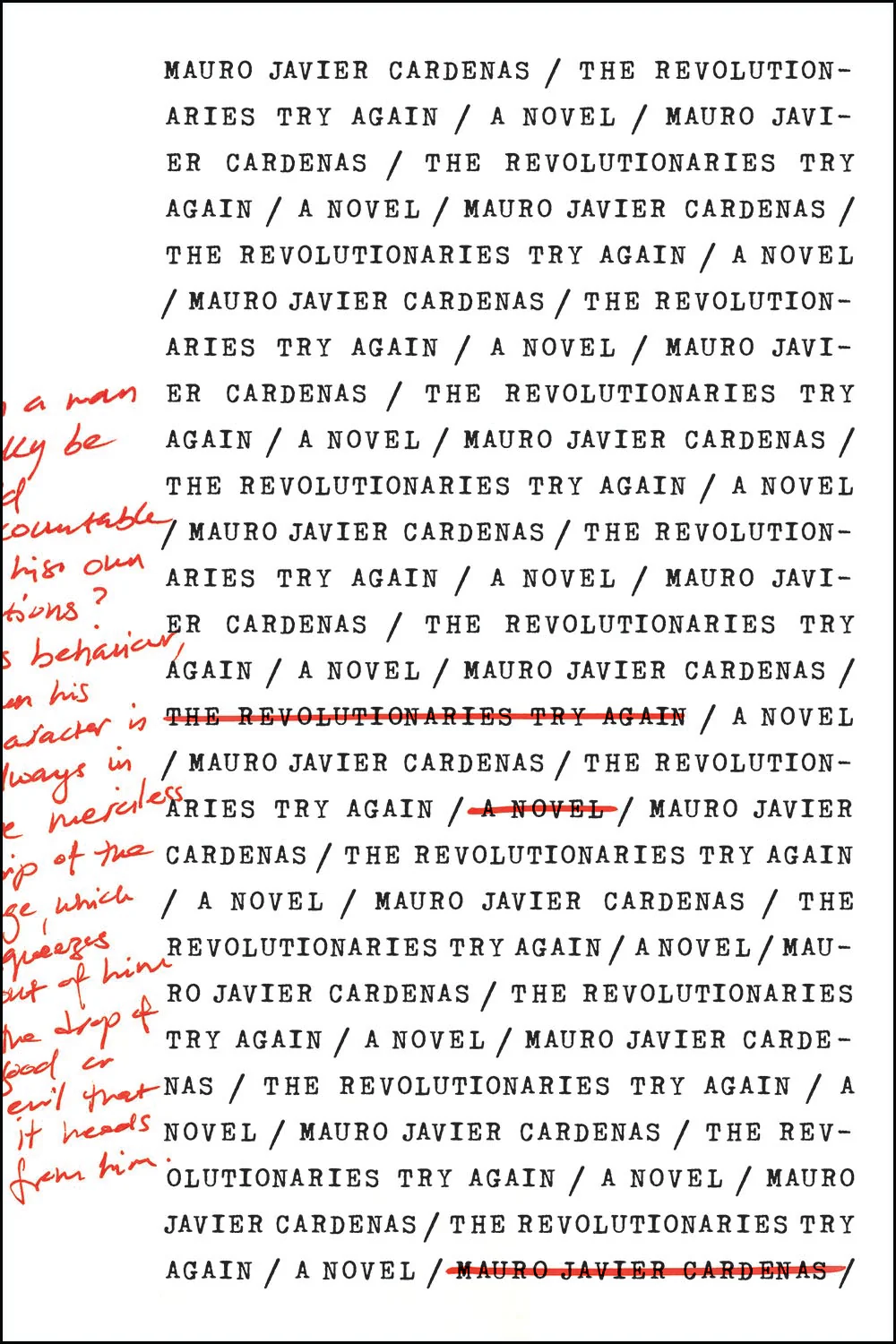
The Revolutionaries Try Again
A novel by Mauro Javier Cardenas
September 6, 2016 • 6 x 9 • 296 Pages • 978-1-56689-446-3
Three childhood friends reunite to transform Ecuador only to find their idealism has succumbed to the cynicism of their fathers.
Extravagant, absurd, and self-aware, The Revolutionaries Try Again plays out against the lost decade of Ecuador’s austerity and the stymied idealism of three childhood friends—an expat, a bureaucrat, and a playwright—who are as sure about the evils of dictatorship as they are unsure of everything else, including each other.
About the Author
Mauro Javier Cardenas grew up in Guayaquil, Ecuador, and graduated with a degree in economics from Stanford University. Excerpts from his first novel, The Revolutionaries Try Again, have appeared in Conjunctions, the Antioch Review, Guernica, Witness, and BOMB. His interviews and essays on/with László Krasznahorkai, Javier Marías, Horacio Castellanos Moya, Juan Villoro, and António Lobo Antunes have appeared in Music & Literature, the San Francisco Chronicle, BOMB, and the Quarterly Conversation.
Thanks to a 2013 ADA Access Improvement Grant administered by VSA Minnesota for the Metropolitan Regional Arts Council, this title is also formatted for screen readers which make text accessible to the blind and visually impaired. To purchase this title for use with a screen reader please email us at [email protected].
Reviews
“Cardenas’s exuberant debut novel, The Revolutionaries Try Again, profiles a group of Ecuadorans trying, some harder than others, to change the political situation in their country. Stuffed with dizzying leaps from character to character, from street protests to swanky soirees, and from lengthy uninterrupted interior monologues to rapid-fire dialogues, the novel also includes some wonderful long sentences.” —Publishers Weekly
“This is an original, insubordinate novel, like his grammar, like his syntax, but fabulously, compellingly readable, with endearing characters like Leopoldo’s grandma, who would tie a white plastic bag on her head like a wig and perform Macbeth for him at her farm, proclaiming in unintelligible English, ‘Blo win, crack you cheek, rage! Blo!’” —New York Times Sunday Book Review
“The Ecuadorian writer has delivered his debut, The Revolutionaries Try Again. While it is, indeed, very much a novel rather than a political manifesto—it depicts four childhood friends as they regroup in adulthood and aim to change their country’s politics for the better—Cardenas reveals, via some stunning and shapeshifting prose, that politics in Ecuador isn’t as straightforward as it appears on its surface, and very often it amounts to little more than a vain exercise in egobuilding and self-fantasy.” —Kenyon Review
“Mauro Javier Cardenas’s début, The Revolutionaries Try Again, tells the tale of three Ecuadorian friends—one living in exile in San Francisco, the other two still in Guayaquil—who come together in a quixotic attempt to take the country’s Presidency. ‘Everyone thinks they’re the chosen ones,’ one character reminds another, and Cardenas’s gift is to show, through long, brilliant sentences, the charm of inaction and delinquency.” —New Yorker
“Drawing on everything from pop culture to Ecuadorian politics, and posing questions about faith, morality, and devotion to one’s country and ideals (all expressed in a deviant postmodern style), Cardenas’s spellbinding book should appeal to McOndo devotees and Bolaño fans alike. But The Revolutionaries taps into something more comprehensive and universally conscientious. . . . It’s a novel that redefines the Latin American identity in a world characterized by social technology and ever-blurring ethnic boundaries.” —Los Angeles Review of Books
“There’s an infectious warmth in the recollections of the friends’ school days, and the prose often draws blood.” —New Yorker
“Each story’s hook is keenly sharpened, pulling you into the center of a tortured psyche . . . Revelations come through a steady drip of plot tinged with unease, with each story wholly delivered and wholly strange.” —Stake
“Exuberant, cacophonous. . . . Cardenas dizzyingly leaps from character to character, from street protests to swanky soirees, and from lengthy uninterrupted interior monologues to rapid-fire dialogues and freewheeling satirical radio programs, resulting in extended passages of brilliance.” —Publishers Weekly, starred review
“Even if Cardenas isn’t quite ready to run for office in Ecuador, The Revolutionaries Try Again is a rare book—it’s political without drowning in politics, it’s innovative without languishing in theatrics, and it also blends the historically accurate with the personal. It’s part satire, part social commentary, and 100% a good story with rich, compelling characters.” —Kirkus
“Cardenas displays an ambitious intelligence that eschews easy answers. His inclusive sympathy is balanced by an unsparing eye. By the end, Antonio questions his own motives for returning, asking himself ‘how are we to be humans in a world of destitution and injustice.’ A strong debut written with nuance and authority.” —Kirkus
“This inventive novel shares some of the revolutionary spirit of Ecuador’s ill-served people who, as one character puts it, ‘want to trounce the same old narratives.’” —Publishers Weekly
“Cardenas brilliantly transforms his ‘book of ideas’ into an unraveling interrogation into Antonio’s past, employing unorthodox paragraph structures that slip seamlessly between long passages of fast-paced stream-of-consciousness, unexpected song lyrics, and sudden dialogue.” —Booklist
“An unhinged novel about three childhood friends contemplating a presidential run against the crooked Ecuadorian president Abdalá ‘El Loco’ Bucaram. This is double-black-diamond high modernism, so do some warm-up stretches before you crack this baby.” —Shelf Awareness
“Cardenas’s The Revolutionaries Try Again is a delirious account of several Ecuadorians attempting to wrest control of their country from the hands of brutal oligarchs and buffoonish populists.” —Publishers Weekly
“The style of this book is as ambitious as its territory, moving fluidly from voice to voice, from luminous long sentences to syntactical fragmentation. Cardenas, an Ecuadoran now living in San Francisco, has made the Nabokovian move of claiming adoptive English as his own, and he gives us many beautifully eloquent moments.” —San Francisco Chronicle
“Told in winding sentences propelled by interjections and an almost manic energy, The Revolutionaries Try Again . . . is both ambitious and irreverent, its language as suffused with childhood jest as with profound, urgent questions of purpose.” —San Francisco Chronicle
“Then along came The Revolutionaries Try Again. . . a high-octane, high-modernist debut novel from the gifted, fleet Mauro Javier Cardenas.” —Harper’s
“The novel veers toward the nonlinear and the fragmentary, gesturing at the brokenness and inadequacy of available narratives and their inability to represent the tangled, messy realities of lives caught in the snare of failed neoliberalism. From this brokenness emerges an exuberant, virtuosic language that encompasses song, colloquial speech in English and Spanish, rapid-fire dialogues, fragmentary, elegiac interior monologues, narrative in verse form, and two chapters written exclusively in Spanish.” —Guernica
“The Revolutionaries Try Again dissects a decade of Ecuadorian austerity and idealism through often jarring and always stunning literary montage.” —The Millions
“Cardenas uses the trappings of Modernism to traditionally Modernist ends—mirroring the workings of consciousness, and depicting a society, reeling from violence, that has lost faith in itself—but The Revolutionaries Try Again is set in a country and time that we don’t normally associate with Modernism: the Ecuador of the mid-90s, in the months leading up to the demagogue ‘El Loco’ Bucaram’s election.” —Electric Literature
“Like Tulathimutte in particular, Cardenas is conjuring a modish and streamlined maximalism that soaks postmodernism and hyperrealism in multicultural and social media colloquialism. The Revolutionaries Try Again could be spun as the The Recognitions of our age, with Otto reborn as Antonio. In any case, it’s revolutionary.” —Culture Trip
“It’s a particularly galvanizing novel to read in the aftermath of Election Day as it considers the questions—what do we owe? and to whom to we owe it? Of course, The Revolutionaries Try Again . . . is much more than that: experimental, funny, many tongued.” —Brooklyn Magazine
“Like its cast of characters, the novel is colorful and disarming, bristling with idealism and disillusionment and profoundly embattled intelligence; like the country it brings to life without ever fully inhabiting, it’s noisy and claustrophobic and a dizzying thrill to get lost in.” —Electric Literature
“Antonio returns to Ecuador with dreams of saving his country from corrupt oligarchs and (also corrupt) populist demagogues; but everybody feels like they’ve been chosen, and Cardenas picks brilliantly at this scab—the tension between the call to service and the desire for more, the strangeness of having seen miracles while knowing the power of mass delusion.” —The Rumpus
“Cardenas’s first novel The Revolutionaries Try Again has the trappings of a ravishing debut: smart blurbs, a brilliant cover, a modernist narrative set amongst political turmoil in South America, and a flurry of pre-pub excitement on Twitter.” —The Millions
“All told, The Revolutionaries Try Again is a remarkable achievement; Cardenas’ expansive voice and vision are too brilliant to let pass you by.” —BuzzFeed
“The first time a so-called industry person asked me about The Revolutionaries Try Again, a novel of voices in an altered state of recollection, I said it was about alien chickens. Somewhere in the clouds the ghost of Gombrowicz nodded in approval. Somewhere in Minnesota my editor is nodding in disapproval.” —Flavorwire
“Its style is ambitious, yes, entirely unique, one could even say difficult if one were so inclined, but the most difficult theme of the novel for an American audience is the degree to which we American readers are also complicit in the degraded existence of the poor and oppressed below our southern border.” —The Scofield
“Filtering the saga through Cardenas’s defiantly experimental writing style, means readers are left with an extraordinary, unapologetic book, an almost unbelievable debut.” —Music & Literature
“An amazing book rife with intelligence and love for the potential of one’s homeland.” —Electric Literature
“All told, The Revolutionaries Try Again is a remarkable achievement; Cardenas’ expansive voice and vision are too brilliant to let pass you by.” —BuzzFeed
“Followers of Latin American literature won’t want to miss the American debut of Ecuadorian writer Mauro Javier Cardenas, The Revolutionaries Try Again.” —BookPage
“The prose [in The Revolutionaries Try Again] darkens into avant-garde genius.” —Artforum
“This dazzling debut by Mauro Javier Cardenas reads like António Lobo Antunes having a cup of coffee (or a beer) with Garcia Marquez.” —Literary Hub
“In The Revolutionaries Try Again, Cardenas explores the many facets of friendships, the things we leave unsaid, and all of the ways nostalgia acts as a fun house mirror on our memories.” —Literary Hub
“Cardenas’ fiction does compute, though not by traditional means. It speaks instead like a wise but fevered man—exalting in digression, pining for something lost, planting profundity amid little clouds of chaos.” —Dallas News
“[The Revolutionaries Try Again] is stylish, daring, dense and polyphonic; voices and ideas are braided together seamlessly. It is also a Latin American novel written in English by a native of Ecuador and it’s astounding.” —Brazos Bookstore
"Mauro Javier Cardenas’ debut novel The Revolutionaries Try Again . . . has evoked comparisons to great Latin American novels like Roberto Bolaños The Savage Detectives and Julio Cortázar’s Hopscotch.” —KQED
“He’s a tremendously skilled storyteller and monologuist; his writing is so exuberant.” —Paul Yamazaki
“In The Revolutionaries Try Again, Mauro Javier Cardenas has taken the edifice of arch modernism and suffused it with tender details of a boyhood in Ecuador. The long, unraveling sentences reveal an extraordinarily musical ear. This is a debut that will last.” —Karan Mahajan
“The Revolutionaries Try Again is a daring novel that pits youthful idealism against persistent and inescapable corruption. Mauro Javier Cardenas is an exciting new voice in Latin American literature, and his debut crackles with an exuberance that readers of Valeria Luiselli, Julio Cortázar, and Horacio Castellanos Moya will love.” —Stephen Sparks
“Beware of this writer! The book you’re holding bites. If the reader dares enter after this warning, he’ll never forget it, and the memory will stay just as sharp as the humor and velocity in the stories themselves. Incisive, forceful, and written in an English that’s fiercely subversive, The Revolutionaries Try Again evokes a pair of great Latin American novels: Bolaño’s The Savage Detectives and Cortázar’s Hopscotch. But this book goes even further: it’s the novel we’ve been waiting for, witness to the most recent wave of immigration from Latin America to the US, told through the eyes of a privileged class that forces their conationals out of their countries. It’s been ten years since a book this alive, this incandescent, has fallen into my hands.” —Carmen Boullosa
“Irreverent, shape-shifting, and wise, The Revolutionaries Try Again is as relentless in its indictment of political depredation as it is heartfelt in its devotion to the friendships and wild idealisms of youth. This forceful debut novel is a blast of fresh air, and I had a blast reading it.” —Justin Taylor
“What begins as an Ecuadorian political farce in Mauro Javier Cardenas’s The Revolutionaries Try Again quickly becomes the most exciting experimental novel in years—a vision so uncompromising in form and sensation that readers will leave sighing, swearing, and returning to page one.” —Tony Tulathimutte
“The Revolutionaries Try Again transfixes on every page—across every world-devouring sentence—with a rigorous, incandescent language rarely seen in contemporary fiction. It’s a bit early to say, but Cardenas’s debut is either the jubilant beginning or the rapturous end of the Latin American novel: a revelation of a book.” —Hal Hlavinka, Community Bookstore
Original: $16.95
-65%$16.95
$5.93Product Information
Product Information
Shipping & Returns
Shipping & Returns
Description
A novel by Mauro Javier Cardenas
September 6, 2016 • 6 x 9 • 296 Pages • 978-1-56689-446-3
Three childhood friends reunite to transform Ecuador only to find their idealism has succumbed to the cynicism of their fathers.
Extravagant, absurd, and self-aware, The Revolutionaries Try Again plays out against the lost decade of Ecuador’s austerity and the stymied idealism of three childhood friends—an expat, a bureaucrat, and a playwright—who are as sure about the evils of dictatorship as they are unsure of everything else, including each other.
About the Author
Mauro Javier Cardenas grew up in Guayaquil, Ecuador, and graduated with a degree in economics from Stanford University. Excerpts from his first novel, The Revolutionaries Try Again, have appeared in Conjunctions, the Antioch Review, Guernica, Witness, and BOMB. His interviews and essays on/with László Krasznahorkai, Javier Marías, Horacio Castellanos Moya, Juan Villoro, and António Lobo Antunes have appeared in Music & Literature, the San Francisco Chronicle, BOMB, and the Quarterly Conversation.
Thanks to a 2013 ADA Access Improvement Grant administered by VSA Minnesota for the Metropolitan Regional Arts Council, this title is also formatted for screen readers which make text accessible to the blind and visually impaired. To purchase this title for use with a screen reader please email us at [email protected].
Reviews
“Cardenas’s exuberant debut novel, The Revolutionaries Try Again, profiles a group of Ecuadorans trying, some harder than others, to change the political situation in their country. Stuffed with dizzying leaps from character to character, from street protests to swanky soirees, and from lengthy uninterrupted interior monologues to rapid-fire dialogues, the novel also includes some wonderful long sentences.” —Publishers Weekly
“This is an original, insubordinate novel, like his grammar, like his syntax, but fabulously, compellingly readable, with endearing characters like Leopoldo’s grandma, who would tie a white plastic bag on her head like a wig and perform Macbeth for him at her farm, proclaiming in unintelligible English, ‘Blo win, crack you cheek, rage! Blo!’” —New York Times Sunday Book Review
“The Ecuadorian writer has delivered his debut, The Revolutionaries Try Again. While it is, indeed, very much a novel rather than a political manifesto—it depicts four childhood friends as they regroup in adulthood and aim to change their country’s politics for the better—Cardenas reveals, via some stunning and shapeshifting prose, that politics in Ecuador isn’t as straightforward as it appears on its surface, and very often it amounts to little more than a vain exercise in egobuilding and self-fantasy.” —Kenyon Review
“Mauro Javier Cardenas’s début, The Revolutionaries Try Again, tells the tale of three Ecuadorian friends—one living in exile in San Francisco, the other two still in Guayaquil—who come together in a quixotic attempt to take the country’s Presidency. ‘Everyone thinks they’re the chosen ones,’ one character reminds another, and Cardenas’s gift is to show, through long, brilliant sentences, the charm of inaction and delinquency.” —New Yorker
“Drawing on everything from pop culture to Ecuadorian politics, and posing questions about faith, morality, and devotion to one’s country and ideals (all expressed in a deviant postmodern style), Cardenas’s spellbinding book should appeal to McOndo devotees and Bolaño fans alike. But The Revolutionaries taps into something more comprehensive and universally conscientious. . . . It’s a novel that redefines the Latin American identity in a world characterized by social technology and ever-blurring ethnic boundaries.” —Los Angeles Review of Books
“There’s an infectious warmth in the recollections of the friends’ school days, and the prose often draws blood.” —New Yorker
“Each story’s hook is keenly sharpened, pulling you into the center of a tortured psyche . . . Revelations come through a steady drip of plot tinged with unease, with each story wholly delivered and wholly strange.” —Stake
“Exuberant, cacophonous. . . . Cardenas dizzyingly leaps from character to character, from street protests to swanky soirees, and from lengthy uninterrupted interior monologues to rapid-fire dialogues and freewheeling satirical radio programs, resulting in extended passages of brilliance.” —Publishers Weekly, starred review
“Even if Cardenas isn’t quite ready to run for office in Ecuador, The Revolutionaries Try Again is a rare book—it’s political without drowning in politics, it’s innovative without languishing in theatrics, and it also blends the historically accurate with the personal. It’s part satire, part social commentary, and 100% a good story with rich, compelling characters.” —Kirkus
“Cardenas displays an ambitious intelligence that eschews easy answers. His inclusive sympathy is balanced by an unsparing eye. By the end, Antonio questions his own motives for returning, asking himself ‘how are we to be humans in a world of destitution and injustice.’ A strong debut written with nuance and authority.” —Kirkus
“This inventive novel shares some of the revolutionary spirit of Ecuador’s ill-served people who, as one character puts it, ‘want to trounce the same old narratives.’” —Publishers Weekly
“Cardenas brilliantly transforms his ‘book of ideas’ into an unraveling interrogation into Antonio’s past, employing unorthodox paragraph structures that slip seamlessly between long passages of fast-paced stream-of-consciousness, unexpected song lyrics, and sudden dialogue.” —Booklist
“An unhinged novel about three childhood friends contemplating a presidential run against the crooked Ecuadorian president Abdalá ‘El Loco’ Bucaram. This is double-black-diamond high modernism, so do some warm-up stretches before you crack this baby.” —Shelf Awareness
“Cardenas’s The Revolutionaries Try Again is a delirious account of several Ecuadorians attempting to wrest control of their country from the hands of brutal oligarchs and buffoonish populists.” —Publishers Weekly
“The style of this book is as ambitious as its territory, moving fluidly from voice to voice, from luminous long sentences to syntactical fragmentation. Cardenas, an Ecuadoran now living in San Francisco, has made the Nabokovian move of claiming adoptive English as his own, and he gives us many beautifully eloquent moments.” —San Francisco Chronicle
“Told in winding sentences propelled by interjections and an almost manic energy, The Revolutionaries Try Again . . . is both ambitious and irreverent, its language as suffused with childhood jest as with profound, urgent questions of purpose.” —San Francisco Chronicle
“Then along came The Revolutionaries Try Again. . . a high-octane, high-modernist debut novel from the gifted, fleet Mauro Javier Cardenas.” —Harper’s
“The novel veers toward the nonlinear and the fragmentary, gesturing at the brokenness and inadequacy of available narratives and their inability to represent the tangled, messy realities of lives caught in the snare of failed neoliberalism. From this brokenness emerges an exuberant, virtuosic language that encompasses song, colloquial speech in English and Spanish, rapid-fire dialogues, fragmentary, elegiac interior monologues, narrative in verse form, and two chapters written exclusively in Spanish.” —Guernica
“The Revolutionaries Try Again dissects a decade of Ecuadorian austerity and idealism through often jarring and always stunning literary montage.” —The Millions
“Cardenas uses the trappings of Modernism to traditionally Modernist ends—mirroring the workings of consciousness, and depicting a society, reeling from violence, that has lost faith in itself—but The Revolutionaries Try Again is set in a country and time that we don’t normally associate with Modernism: the Ecuador of the mid-90s, in the months leading up to the demagogue ‘El Loco’ Bucaram’s election.” —Electric Literature
“Like Tulathimutte in particular, Cardenas is conjuring a modish and streamlined maximalism that soaks postmodernism and hyperrealism in multicultural and social media colloquialism. The Revolutionaries Try Again could be spun as the The Recognitions of our age, with Otto reborn as Antonio. In any case, it’s revolutionary.” —Culture Trip
“It’s a particularly galvanizing novel to read in the aftermath of Election Day as it considers the questions—what do we owe? and to whom to we owe it? Of course, The Revolutionaries Try Again . . . is much more than that: experimental, funny, many tongued.” —Brooklyn Magazine
“Like its cast of characters, the novel is colorful and disarming, bristling with idealism and disillusionment and profoundly embattled intelligence; like the country it brings to life without ever fully inhabiting, it’s noisy and claustrophobic and a dizzying thrill to get lost in.” —Electric Literature
“Antonio returns to Ecuador with dreams of saving his country from corrupt oligarchs and (also corrupt) populist demagogues; but everybody feels like they’ve been chosen, and Cardenas picks brilliantly at this scab—the tension between the call to service and the desire for more, the strangeness of having seen miracles while knowing the power of mass delusion.” —The Rumpus
“Cardenas’s first novel The Revolutionaries Try Again has the trappings of a ravishing debut: smart blurbs, a brilliant cover, a modernist narrative set amongst political turmoil in South America, and a flurry of pre-pub excitement on Twitter.” —The Millions
“All told, The Revolutionaries Try Again is a remarkable achievement; Cardenas’ expansive voice and vision are too brilliant to let pass you by.” —BuzzFeed
“The first time a so-called industry person asked me about The Revolutionaries Try Again, a novel of voices in an altered state of recollection, I said it was about alien chickens. Somewhere in the clouds the ghost of Gombrowicz nodded in approval. Somewhere in Minnesota my editor is nodding in disapproval.” —Flavorwire
“Its style is ambitious, yes, entirely unique, one could even say difficult if one were so inclined, but the most difficult theme of the novel for an American audience is the degree to which we American readers are also complicit in the degraded existence of the poor and oppressed below our southern border.” —The Scofield
“Filtering the saga through Cardenas’s defiantly experimental writing style, means readers are left with an extraordinary, unapologetic book, an almost unbelievable debut.” —Music & Literature
“An amazing book rife with intelligence and love for the potential of one’s homeland.” —Electric Literature
“All told, The Revolutionaries Try Again is a remarkable achievement; Cardenas’ expansive voice and vision are too brilliant to let pass you by.” —BuzzFeed
“Followers of Latin American literature won’t want to miss the American debut of Ecuadorian writer Mauro Javier Cardenas, The Revolutionaries Try Again.” —BookPage
“The prose [in The Revolutionaries Try Again] darkens into avant-garde genius.” —Artforum
“This dazzling debut by Mauro Javier Cardenas reads like António Lobo Antunes having a cup of coffee (or a beer) with Garcia Marquez.” —Literary Hub
“In The Revolutionaries Try Again, Cardenas explores the many facets of friendships, the things we leave unsaid, and all of the ways nostalgia acts as a fun house mirror on our memories.” —Literary Hub
“Cardenas’ fiction does compute, though not by traditional means. It speaks instead like a wise but fevered man—exalting in digression, pining for something lost, planting profundity amid little clouds of chaos.” —Dallas News
“[The Revolutionaries Try Again] is stylish, daring, dense and polyphonic; voices and ideas are braided together seamlessly. It is also a Latin American novel written in English by a native of Ecuador and it’s astounding.” —Brazos Bookstore
"Mauro Javier Cardenas’ debut novel The Revolutionaries Try Again . . . has evoked comparisons to great Latin American novels like Roberto Bolaños The Savage Detectives and Julio Cortázar’s Hopscotch.” —KQED
“He’s a tremendously skilled storyteller and monologuist; his writing is so exuberant.” —Paul Yamazaki
“In The Revolutionaries Try Again, Mauro Javier Cardenas has taken the edifice of arch modernism and suffused it with tender details of a boyhood in Ecuador. The long, unraveling sentences reveal an extraordinarily musical ear. This is a debut that will last.” —Karan Mahajan
“The Revolutionaries Try Again is a daring novel that pits youthful idealism against persistent and inescapable corruption. Mauro Javier Cardenas is an exciting new voice in Latin American literature, and his debut crackles with an exuberance that readers of Valeria Luiselli, Julio Cortázar, and Horacio Castellanos Moya will love.” —Stephen Sparks
“Beware of this writer! The book you’re holding bites. If the reader dares enter after this warning, he’ll never forget it, and the memory will stay just as sharp as the humor and velocity in the stories themselves. Incisive, forceful, and written in an English that’s fiercely subversive, The Revolutionaries Try Again evokes a pair of great Latin American novels: Bolaño’s The Savage Detectives and Cortázar’s Hopscotch. But this book goes even further: it’s the novel we’ve been waiting for, witness to the most recent wave of immigration from Latin America to the US, told through the eyes of a privileged class that forces their conationals out of their countries. It’s been ten years since a book this alive, this incandescent, has fallen into my hands.” —Carmen Boullosa
“Irreverent, shape-shifting, and wise, The Revolutionaries Try Again is as relentless in its indictment of political depredation as it is heartfelt in its devotion to the friendships and wild idealisms of youth. This forceful debut novel is a blast of fresh air, and I had a blast reading it.” —Justin Taylor
“What begins as an Ecuadorian political farce in Mauro Javier Cardenas’s The Revolutionaries Try Again quickly becomes the most exciting experimental novel in years—a vision so uncompromising in form and sensation that readers will leave sighing, swearing, and returning to page one.” —Tony Tulathimutte
“The Revolutionaries Try Again transfixes on every page—across every world-devouring sentence—with a rigorous, incandescent language rarely seen in contemporary fiction. It’s a bit early to say, but Cardenas’s debut is either the jubilant beginning or the rapturous end of the Latin American novel: a revelation of a book.” —Hal Hlavinka, Community Bookstore