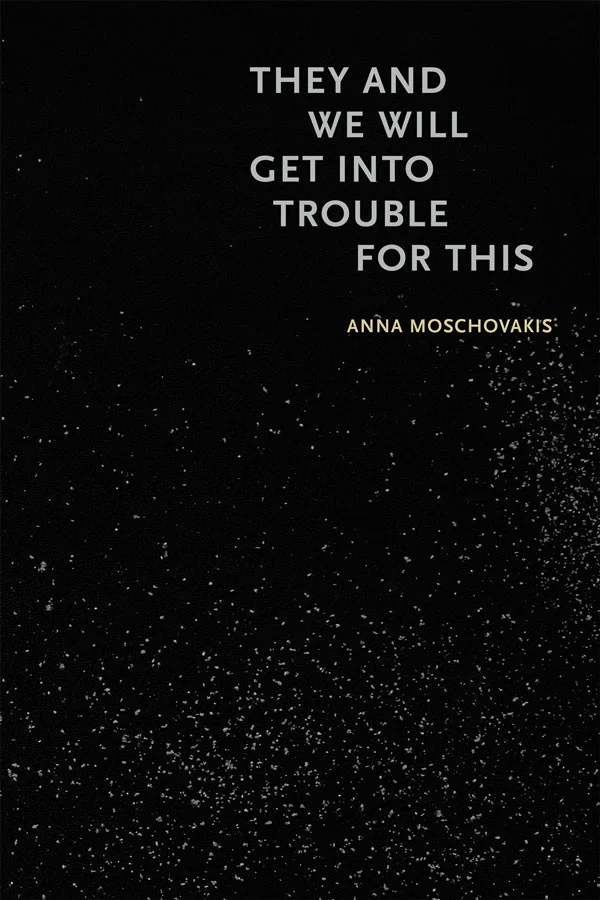
They and We Will Get Into Trouble for This
Poetry by Anna Moschovakis
March 15, 2016 • 6 x 9 • 112 Pages • 978-1-56689-420-3
Moschovakis invents new forms, insisting that we can never tire of asking “how must I live in the world.”
Anna Moschovakis measures words, crosses languages, and invents forms. In a mode of inquiry, friction, and barbed naiveté, these four long poems trouble notions of history, self-knowledge, and intimacy, insisting that “how to be” is a question we can never tire of confronting.
About the Author
Anna Moschovakis is the author of You and Three Others are Approaching a Lake, winner of the James Laughlin Award from the Academy of American Poets, and I Have Not Been Able to Get Through to Everyone, a finalist for the Norma Farber First Book Award and a selection of the Poetry Society of America’s New American Poetry Series. Her translations from the French include texts by Robert Bresson, Annie Ernaux, Samira Negrouche, Marcelle Sauvageot, Jean-Luc Nancy, and Albert Cossery. She teaches in the MFA programs at Pratt Institute and Bard College and was the 2016 Holloway Lecturer in the Practice of Poetry at UC Berkeley. Raised in Los Angeles, Moschovakis has lived in New York since 1993 and is currently based in the northern Catskills, where she is active in a nonprofit art and community space called Bushel in Delhi, New York. She is also a longtime member of the Brooklyn-based publishing collective Ugly Duckling Presse.
Thanks to a 2013 ADA Access Improvement Grant administered by VSA Minnesota for the Metropolitan Regional Arts Council, this title is also formatted for screen readers which make text accessible to the blind and visually impaired. To purchase this title for use with a screen reader please call (612) 338-0125 or email us at [email protected].
Reviews
“Deeply engaging. . . . Moschovakis sets philosophy, etymology, and memory in motion to show that ‘There are many ways to follow a thought.’” —Publishers Weekly
“Reading though the manuscript is like diving into a deep pool contained within a cavern, the resonance and echoing qualities provide such distinction, it is impossible to confuse the experience of this reading with anything else.” —New York Journal of Books
“Anna Moschovakis is a great abstract poet in the sense that she explores how formal procedures and found vocabularies and grammatical structures delimit what we can express at a given historical moment. But what makes her an indispensable writer is how she is able—and through her we are able—to experience questions of logical and linguistic relation as intensely lived, as sites not only of critical reflection, but of love. This book completes what I consider an essential poetic trilogy. It has expanded my sense of how I, you, they, we might address one another in the present tense of art.” —Ben Lerner
“They and We Will Get into Trouble for This may have its lineage in various traditions, but if we call it avant-garde or experimental, it is to say that it provides new ways of looking at what poetry can do at this very moment, broadening our perception of what was always possible. In that sense, it is a rich and momentous book, which should establish Anna Moschovakis as one of the most important poets writing today.” —Kenyon Review
“Her style is somewhat similar to Rae Armantrout’s. Both poets are infinitely curious, and not only do they approach each poem with a question, but they often end the poem with a question. There’s rarely a straight answer. . . . I enjoy and appreciate her philosophically bent poetry, her austere use of language, and the sense of violence that charges her poems.” —San Francisco Bay Guardian
“Perhaps what is needed now is what this book supplies: beautiful and fraught complexity. . . . Philosophy, anthropology, linguistics, and other realms of theory are woven throughout the book, which never creates an academic distance, but builds a path toward intimacy.” —Boston Review
“It feels smart, unsettled—at times evasive, and at others so straightforward that it hurts.” —American Poets
“The poem and the collection it calls home pulse with lines full of power . . . in forms interesting enough to be compelling but not experimental enough to be off-putting. It’s a fine line, and the distinction is vital for Moschovakis.” —Flavorwire
“Moschovakis writes with an honesty and simplicity that is at once concise and lyrical.” —Literary Hub
“Once you’ve read any Moschovakis poetry book, you will be happily fated to read (and await) each new release by one of our most ardent and original poets.” —Literary Hub
“If you’re interested in poetry that defies the boundaries of language and structure, They and We Will Get into Trouble for This is the collection for you.” —Bustle
“Moschovakis achieves perfectly the anxiety of inexactness by claiming the dilemma of language.” —Fanzine
“As a poet, one likes to think language contains the power to save us, to rescue us from our ubiquitous sense of demise. But Anna Moschovakis has gathered, in this triple-voiced chorus of flawless verse, the courage to admit the coming apocalypse.” —Red Paint Hill Poetry Journal
“As happy as the day is long I’ll get myself into the kind of trouble Moschovakis’s new book invites—the trouble linked to agitation (L. turbulus) and the confusion that comes from being one among many (L. turba, for crowd). Its parts decidedly intertextual and polyglot, think of it as a turbulence machine.” —Mónica de la Torre
“Anna Moschovakis’s writing shows us what we lose by our rend(er)ing of contemporary poetry into binary categories of ‘_____’ and ‘_____.’ Her poems traverse the boundaries of ‘lyric’ and ‘conceptual,’ national literatures, bodily conditions, time, consciousness, and language. ‘Whose I is this anyway?’ they ask with luminous poetic intelligence.” —Dorothy Wang
“Splintering along the divide of sentences and lines and the spit that holds them and us together in a most beautiful flowering pattern, this work reflects back (to me) such a complex scene of almost knowing, almost understanding, it breaks my heart. Working in Moschovakis’ day and age will keep a poet ethical and unfoolish.” —Simone White
Original: $16.95
-65%$16.95
$5.93Product Information
Product Information
Shipping & Returns
Shipping & Returns
Description
Poetry by Anna Moschovakis
March 15, 2016 • 6 x 9 • 112 Pages • 978-1-56689-420-3
Moschovakis invents new forms, insisting that we can never tire of asking “how must I live in the world.”
Anna Moschovakis measures words, crosses languages, and invents forms. In a mode of inquiry, friction, and barbed naiveté, these four long poems trouble notions of history, self-knowledge, and intimacy, insisting that “how to be” is a question we can never tire of confronting.
About the Author
Anna Moschovakis is the author of You and Three Others are Approaching a Lake, winner of the James Laughlin Award from the Academy of American Poets, and I Have Not Been Able to Get Through to Everyone, a finalist for the Norma Farber First Book Award and a selection of the Poetry Society of America’s New American Poetry Series. Her translations from the French include texts by Robert Bresson, Annie Ernaux, Samira Negrouche, Marcelle Sauvageot, Jean-Luc Nancy, and Albert Cossery. She teaches in the MFA programs at Pratt Institute and Bard College and was the 2016 Holloway Lecturer in the Practice of Poetry at UC Berkeley. Raised in Los Angeles, Moschovakis has lived in New York since 1993 and is currently based in the northern Catskills, where she is active in a nonprofit art and community space called Bushel in Delhi, New York. She is also a longtime member of the Brooklyn-based publishing collective Ugly Duckling Presse.
Thanks to a 2013 ADA Access Improvement Grant administered by VSA Minnesota for the Metropolitan Regional Arts Council, this title is also formatted for screen readers which make text accessible to the blind and visually impaired. To purchase this title for use with a screen reader please call (612) 338-0125 or email us at [email protected].
Reviews
“Deeply engaging. . . . Moschovakis sets philosophy, etymology, and memory in motion to show that ‘There are many ways to follow a thought.’” —Publishers Weekly
“Reading though the manuscript is like diving into a deep pool contained within a cavern, the resonance and echoing qualities provide such distinction, it is impossible to confuse the experience of this reading with anything else.” —New York Journal of Books
“Anna Moschovakis is a great abstract poet in the sense that she explores how formal procedures and found vocabularies and grammatical structures delimit what we can express at a given historical moment. But what makes her an indispensable writer is how she is able—and through her we are able—to experience questions of logical and linguistic relation as intensely lived, as sites not only of critical reflection, but of love. This book completes what I consider an essential poetic trilogy. It has expanded my sense of how I, you, they, we might address one another in the present tense of art.” —Ben Lerner
“They and We Will Get into Trouble for This may have its lineage in various traditions, but if we call it avant-garde or experimental, it is to say that it provides new ways of looking at what poetry can do at this very moment, broadening our perception of what was always possible. In that sense, it is a rich and momentous book, which should establish Anna Moschovakis as one of the most important poets writing today.” —Kenyon Review
“Her style is somewhat similar to Rae Armantrout’s. Both poets are infinitely curious, and not only do they approach each poem with a question, but they often end the poem with a question. There’s rarely a straight answer. . . . I enjoy and appreciate her philosophically bent poetry, her austere use of language, and the sense of violence that charges her poems.” —San Francisco Bay Guardian
“Perhaps what is needed now is what this book supplies: beautiful and fraught complexity. . . . Philosophy, anthropology, linguistics, and other realms of theory are woven throughout the book, which never creates an academic distance, but builds a path toward intimacy.” —Boston Review
“It feels smart, unsettled—at times evasive, and at others so straightforward that it hurts.” —American Poets
“The poem and the collection it calls home pulse with lines full of power . . . in forms interesting enough to be compelling but not experimental enough to be off-putting. It’s a fine line, and the distinction is vital for Moschovakis.” —Flavorwire
“Moschovakis writes with an honesty and simplicity that is at once concise and lyrical.” —Literary Hub
“Once you’ve read any Moschovakis poetry book, you will be happily fated to read (and await) each new release by one of our most ardent and original poets.” —Literary Hub
“If you’re interested in poetry that defies the boundaries of language and structure, They and We Will Get into Trouble for This is the collection for you.” —Bustle
“Moschovakis achieves perfectly the anxiety of inexactness by claiming the dilemma of language.” —Fanzine
“As a poet, one likes to think language contains the power to save us, to rescue us from our ubiquitous sense of demise. But Anna Moschovakis has gathered, in this triple-voiced chorus of flawless verse, the courage to admit the coming apocalypse.” —Red Paint Hill Poetry Journal
“As happy as the day is long I’ll get myself into the kind of trouble Moschovakis’s new book invites—the trouble linked to agitation (L. turbulus) and the confusion that comes from being one among many (L. turba, for crowd). Its parts decidedly intertextual and polyglot, think of it as a turbulence machine.” —Mónica de la Torre
“Anna Moschovakis’s writing shows us what we lose by our rend(er)ing of contemporary poetry into binary categories of ‘_____’ and ‘_____.’ Her poems traverse the boundaries of ‘lyric’ and ‘conceptual,’ national literatures, bodily conditions, time, consciousness, and language. ‘Whose I is this anyway?’ they ask with luminous poetic intelligence.” —Dorothy Wang
“Splintering along the divide of sentences and lines and the spit that holds them and us together in a most beautiful flowering pattern, this work reflects back (to me) such a complex scene of almost knowing, almost understanding, it breaks my heart. Working in Moschovakis’ day and age will keep a poet ethical and unfoolish.” —Simone White