The Paris Review, “Our Contributors' Favorite Books of 2020”
Harvard Review, “Eight Books by Latinx Poets”
Ms. Magazine, “Best Poetry of 2020”
Remezcla,“Latino and Latin American Authors to Read in 2020
Refinery29,“Best New Books”
Autostraddle, “Books Relevant to Your Queer and Feminist Interests in 2020”
Latin Post, “Must Read Books by Latin Authors in 2020”
“The circles, the titular ‘thresholes,’ mark the thresholds between fragments. . . . In Montes’s work, these labels seem to say, don’t skip the white space—the gaps between language are part of the language. . . . It’s a trick that never stops feeling like magic, the intimacy of nothing but black marks on white paper.” —Elisa Gabbert, New York Times
“I felt as though I was being beckoned into the book’s orbit. . . . [THRESHOLES], which is classified as poetry, parses grief through the language of holes—‘a not knowing,’ ‘a surge in reverse,’ ‘the white noise of the shore,’ ‘somebody (an abstraction) sitting next to your ghost.’ I can’t wait to read it again.” —Aisha Sabatini Sloan, The Paris Review
“[A] drifting, yet driven, meditation on grief and healing. . . . Fragmented and emergent, THRESHOLES draws together an expansive range of topics on death, the body, trauma, knowledge, healing, oppression, language, and art. Yet the book feels cohesive, bound together in Montes’s percipient vision. . . . THRESHOLES fearlessly explores what it means to come close to formlessness.” —Rachel Carroll, Los Angeles Review of Books
“With its aphoristic lines and longer paragraphs, [Montes] is constructing a sort of anti-monument: to events in her own life that resist description; to the past and present of the Bronx; to contemporary artists and writers and friendships; in the spirit of the artist Gordon Matta-Clark; against death but not without deep engagement with loss.” —Lucy Ives, BOMB Magazine
“A cascade of distinct, one-line stanzas that navigate the present moment, the fallibility of narrative, the violence of living, and the mystery of the body and the Other. . . .The book evoked much else in me, such as delight over the concision and clarity, wonder over the intangible concepts [Montes] makes felt, fascination at the references and artworks detailed in her research, and constant surprise at the turns the lines take.” —Tyler Barton, TriQuarterly
“Alongside [Montes], we tunnel through a series of hollow points, pressure positions, aesthetic snapshots. . . . A taxonomy of holes, but also of their edges, where they end and meet.” —Trisha Low, The Believer
“Testifies to the fierce, brave determination of one Latinx writer to write through struggle. . . . Montes graces us with a unique ability to foresee how time may empower artistic utterances through the breakage.” —Kara Laurene Pernicano, Full Stop
“Presented clearly and in a seemingly improvisational and unrestrained manner, Montes acknowledges that her journey is simultaneously created and ‘undone by [her] own animal hand.’ Her commitment to its forward movement results in a book-length epic about trauma and loss.” —Ruben Quesada, Harvard Review
“A book we need during this time. Revealing Montes’s vast intellect as she draws from subject matters such as art, dance, linguistics, and beyond, THRESHOLES moves through time and place, specifically her birthplace of the Bronx, and takes readers through the death of her dear ‘R.’ THRESHOLES is a perfect book for this moment where time is experienced differently. . . . an unleashing of our identities trapped between the past and our becoming.” —Diana Seo Hyung Lee, Degree Critical
“[Montes] returns to the expansive arts scene of the Bronx in the ‘70s and ‘80s, looks at the potential vibrant and artistic future of her neighborhood and questions her own role as a bridge between both. The book delves deep into the forces moving through a neighborhood often seen as peripheral and an artist living in it: gentrification, loss and a wild hope.” —Remezcla
“Montes is reconciling something within these pages, or with something, but she won’t spell it out for the reader—her words will make you feel it. . . . Holes stretch between past and present, between the Bronx and Minneapolis, between reader and author. Montes is making connections, reconciling, in these pages, and it’s beautiful to bear witness.” —Jessica Maria, The Book Slut
“[A] powerful, beautiful work. . . . some kind of ancient universal equation that brings Montes to a place where she can traverse time and space and other once-meaningful boundaries, all in order to tell her story. It's a story of the Bronx of the '70s and '80s, and of the body and art, of entrances and exits, of life.” —Refinery29
“Montes’s anticipated second book. . . .[an] exploration of body memory.” —Poetry
“THRESHOLES is a training manual for grief and desire, for which no remedies exist except this one: running towards what will burn you up anyway, like a star. ‘How do you come back from that for which there are no words?’ Lara Mimosa Montes asks us, producing a new form of silence that does not, as even the most provisional form of sound must, decay. Instead, in this powerful and beautiful work, absence becomes an artifact, the only thing we get to touch. ‘I was there,’ as Montes writes, ‘and yet I have no memory of that performance.’ This is a line that moved rapidly through my own organism, like pink lightning, changing and charging my own cells. It turns out that this is the only thing I want from poetry, but I didn't remember it until I read this book.” —Bhanu Kapil
“Lara Mimosa Montes is the powerhouse these troubled times need. A true heir of Marguerite Duras and Clarice Lispector, Montes writes with ferocious intellectual energy and emotional pungency, and she never takes the cautious path. Here, she has composed a felicitously broken threnody filled with optimistic openings wherein new possibilities for vision can take root. Poetry, documentary, critique, song, and passion play: these modes join hands in THRESHOLES, and the result is an inspiring demonstration of what she calls ‘the rigorous, unpredictable sanctity of study.’” —Wayne Koestenbaum
“THRESHOLES is brilliant in its associative inscription of the Bronx as a crux of art and memory and wreckage. The book resists narratives and undoes the verb’s hold on constructing histories with an acute and glistening eye as formed by community as the body itself. Lara Mimosa Montes interrupts genre/gentrification in a thrilling book that brings to bear the notion of a ‘body I can in language throw,’ a most welcome disruption to lyric autofiction modalities.” —Carmen Giménez Smith
Praise for Lara Mimosa Montes
“Lara Mimosa Montes is a startling and powerful poet, who opts for vertigo, and whose greatest virtue may be her ability to perform flamboyantly while abstaining from histrionics—to recuse herself, with the exercise of a triumphant minimalism, from her own virtuoso spotlight. Braiding together numbness and desire, she brilliantly demonstrates, in the close-miked fashion of a cabaret Maurice Blanchot, the weirdness of being a witness, a quietly divulging voice.\" —Wayne Koestenbaum
\"The strange and compelling beauty of The Somnambulist lies in its 'savvy circumlocution' of multiple stories in language that the poet herself alternately embraces and fears, loves and reviles. 'If I look for language to find you, if I let it, language finds me everywhere,' she writes, and the line is as much of a promise as a threat. The Somnambulist tells, in fragmented parts, the story of the poet's hustler uncle alongside her own story of becoming a poet. This is a new kind of writer's memoir—or true crime story, or coming-of-age narrative, or family autobiography—one that navigates the tricky territory of multiple sub-genres with extraordinary skill, sly wit, and subversive splendor.\" —Laura Sims
\"Sleepwalking backward and forward through time, Montes' language refuses poetic adornments, opting instead for a minimalist clarity that attempts to repair the obfuscation created by memory, fragmented narratives, regret, and mystifying criminal records. Rooted in the body, and aware of the stakes involved in this telling, language itself becomes figurative in the fact that it arrives to us at all.\" —Vanessa Angélica Villarreal
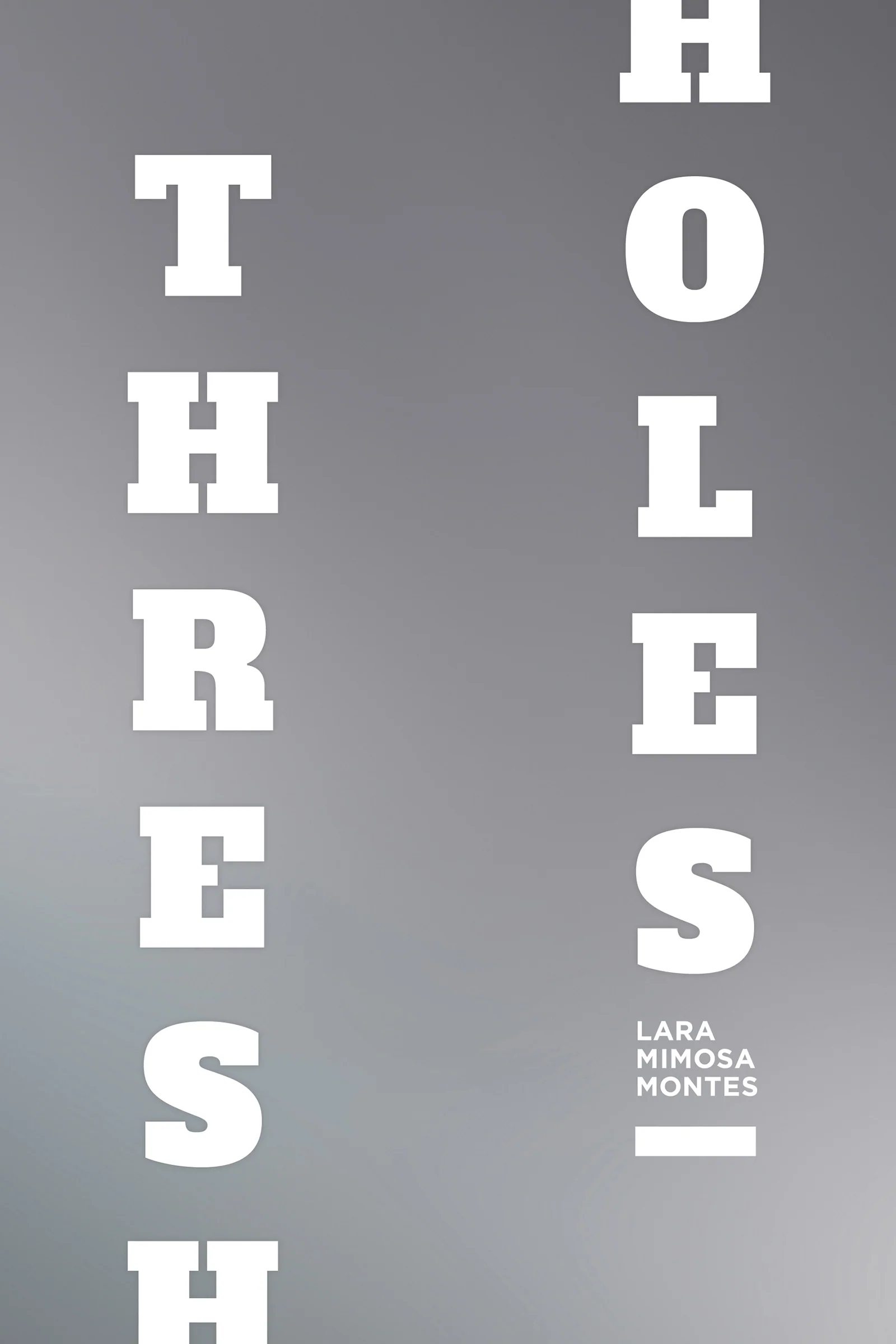
THRESHOLES
Poetry by Lara Mimosa Montes
May 12, 2020 • 6 x 9 • 104 pages • 978-1-56689-579-8
In elegiac and fervent language, Lara Mimosa Montes writes across the thresholds of fracture, trauma, violence, and identity.
THRESHOLES is both a doorway and an absence, a road map and a remembering. In this almanac of place and memory, Lara Mimosa Montes explores the passage of time, returning to the Bronx of the ’70s and ’80s and the artistry that flourished there. What is the threshold between now and then, and how can the poet be the bridge between the two? Just as artists of that time highlighted what was missing in the Bronx, this collection examines what is left open in the wake of trauma and loss.
About the Author
Lara Mimosa Montes is a writer based in Minneapolis and New York. Her poems and essays have appeared in Academy of American Poets’ Poem-A-Day, BOMB, Boston Review, Hyperallergic, Jacket2, and elsewhere. She is a 2018 McKnight Writing Fellow and CantoMundo Fellow. She holds a PhD in English from The Graduate Center, City University of New York. Currently, she works as a senior editor of Triple Canopy. She was born in the Bronx.
Praise for THRESHOLES
The Paris Review, “Our Contributors' Favorite Books of 2020”
Harvard Review, “Eight Books by Latinx Poets”
Ms. Magazine, “Best Poetry of 2020”
Remezcla,“Latino and Latin American Authors to Read in 2020
Refinery29,“Best New Books”
Autostraddle, “Books Relevant to Your Queer and Feminist Interests in 2020”
Latin Post, “Must Read Books by Latin Authors in 2020”
“The circles, the titular ‘thresholes,’ mark the thresholds between fragments. . . . In Montes’s work, these labels seem to say, don’t skip the white space—the gaps between language are part of the language. . . . It’s a trick that never stops feeling like magic, the intimacy of nothing but black marks on white paper.” —Elisa Gabbert, New York Times
“I felt as though I was being beckoned into the book’s orbit. . . . [THRESHOLES], which is classified as poetry, parses grief through the language of holes—‘a not knowing,’ ‘a surge in reverse,’ ‘the white noise of the shore,’ ‘somebody (an abstraction) sitting next to your ghost.’ I can’t wait to read it again.” —Aisha Sabatini Sloan, The Paris Review
“[A] drifting, yet driven, meditation on grief and healing. . . . Fragmented and emergent, THRESHOLES draws together an expansive range of topics on death, the body, trauma, knowledge, healing, oppression, language, and art. Yet the book feels cohesive, bound together in Montes’s percipient vision. . . . THRESHOLES fearlessly explores what it means to come close to formlessness.” —Rachel Carroll, Los Angeles Review of Books
“With its aphoristic lines and longer paragraphs, [Montes] is constructing a sort of anti-monument: to events in her own life that resist description; to the past and present of the Bronx; to contemporary artists and writers and friendships; in the spirit of the artist Gordon Matta-Clark; against death but not without deep engagement with loss.” —Lucy Ives, BOMB Magazine
“A cascade of distinct, one-line stanzas that navigate the present moment, the fallibility of narrative, the violence of living, and the mystery of the body and the Other. . . .The book evoked much else in me, such as delight over the concision and clarity, wonder over the intangible concepts [Montes] makes felt, fascination at the references and artworks detailed in her research, and constant surprise at the turns the lines take.” —Tyler Barton, TriQuarterly
“Alongside [Montes], we tunnel through a series of hollow points, pressure positions, aesthetic snapshots. . . . A taxonomy of holes, but also of their edges, where they end and meet.” —Trisha Low, The Believer
“Testifies to the fierce, brave determination of one Latinx writer to write through struggle. . . . Montes graces us with a unique ability to foresee how time may empower artistic utterances through the breakage.” —Kara Laurene Pernicano, Full Stop
“Presented clearly and in a seemingly improvisational and unrestrained manner, Montes acknowledges that her journey is simultaneously created and ‘undone by [her] own animal hand.’ Her commitment to its forward movement results in a book-length epic about trauma and loss.” —Ruben Quesada, Harvard Review
“A book we need during this time. Revealing Montes’s vast intellect as she draws from subject matters such as art, dance, linguistics, and beyond, THRESHOLES moves through time and place, specifically her birthplace of the Bronx, and takes readers through the death of her dear ‘R.’ THRESHOLES is a perfect book for this moment where time is experienced differently. . . . an unleashing of our identities trapped between the past and our becoming.” —Diana Seo Hyung Lee, Degree Critical
“[Montes] returns to the expansive arts scene of the Bronx in the ‘70s and ‘80s, looks at the potential vibrant and artistic future of her neighborhood and questions her own role as a bridge between both. The book delves deep into the forces moving through a neighborhood often seen as peripheral and an artist living in it: gentrification, loss and a wild hope.” —Remezcla
“Montes is reconciling something within these pages, or with something, but she won’t spell it out for the reader—her words will make you feel it. . . . Holes stretch between past and present, between the Bronx and Minneapolis, between reader and author. Montes is making connections, reconciling, in these pages, and it’s beautiful to bear witness.” —Jessica Maria, The Book Slut
“[A] powerful, beautiful work. . . . some kind of ancient universal equation that brings Montes to a place where she can traverse time and space and other once-meaningful boundaries, all in order to tell her story. It's a story of the Bronx of the '70s and '80s, and of the body and art, of entrances and exits, of life.” —Refinery29
“Montes’s anticipated second book. . . .[an] exploration of body memory.” —Poetry
“THRESHOLES is a training manual for grief and desire, for which no remedies exist except this one: running towards what will burn you up anyway, like a star. ‘How do you come back from that for which there are no words?’ Lara Mimosa Montes asks us, producing a new form of silence that does not, as even the most provisional form of sound must, decay. Instead, in this powerful and beautiful work, absence becomes an artifact, the only thing we get to touch. ‘I was there,’ as Montes writes, ‘and yet I have no memory of that performance.’ This is a line that moved rapidly through my own organism, like pink lightning, changing and charging my own cells. It turns out that this is the only thing I want from poetry, but I didn't remember it until I read this book.” —Bhanu Kapil
“Lara Mimosa Montes is the powerhouse these troubled times need. A true heir of Marguerite Duras and Clarice Lispector, Montes writes with ferocious intellectual energy and emotional pungency, and she never takes the cautious path. Here, she has composed a felicitously broken threnody filled with optimistic openings wherein new possibilities for vision can take root. Poetry, documentary, critique, song, and passion play: these modes join hands in THRESHOLES, and the result is an inspiring demonstration of what she calls ‘the rigorous, unpredictable sanctity of study.’” —Wayne Koestenbaum
“THRESHOLES is brilliant in its associative inscription of the Bronx as a crux of art and memory and wreckage. The book resists narratives and undoes the verb’s hold on constructing histories with an acute and glistening eye as formed by community as the body itself. Lara Mimosa Montes interrupts genre/gentrification in a thrilling book that brings to bear the notion of a ‘body I can in language throw,’ a most welcome disruption to lyric autofiction modalities.” —Carmen Giménez Smith
Praise for Lara Mimosa Montes
“Lara Mimosa Montes is a startling and powerful poet, who opts for vertigo, and whose greatest virtue may be her ability to perform flamboyantly while abstaining from histrionics—to recuse herself, with the exercise of a triumphant minimalism, from her own virtuoso spotlight. Braiding together numbness and desire, she brilliantly demonstrates, in the close-miked fashion of a cabaret Maurice Blanchot, the weirdness of being a witness, a quietly divulging voice." —Wayne Koestenbaum
"The strange and compelling beauty of The Somnambulist lies in its 'savvy circumlocution' of multiple stories in language that the poet herself alternately embraces and fears, loves and reviles. 'If I look for language to find you, if I let it, language finds me everywhere,' she writes, and the line is as much of a promise as a threat. The Somnambulist tells, in fragmented parts, the story of the poet's hustler uncle alongside her own story of becoming a poet. This is a new kind of writer's memoir—or true crime story, or coming-of-age narrative, or family autobiography—one that navigates the tricky territory of multiple sub-genres with extraordinary skill, sly wit, and subversive splendor." —Laura Sims
"Sleepwalking backward and forward through time, Montes' language refuses poetic adornments, opting instead for a minimalist clarity that attempts to repair the obfuscation created by memory, fragmented narratives, regret, and mystifying criminal records. Rooted in the body, and aware of the stakes involved in this telling, language itself becomes figurative in the fact that it arrives to us at all." —Vanessa Angélica Villarreal
Original: $16.95
-65%$16.95
$5.93Product Information
Product Information
Shipping & Returns
Shipping & Returns
Description
Poetry by Lara Mimosa Montes
May 12, 2020 • 6 x 9 • 104 pages • 978-1-56689-579-8
In elegiac and fervent language, Lara Mimosa Montes writes across the thresholds of fracture, trauma, violence, and identity.
THRESHOLES is both a doorway and an absence, a road map and a remembering. In this almanac of place and memory, Lara Mimosa Montes explores the passage of time, returning to the Bronx of the ’70s and ’80s and the artistry that flourished there. What is the threshold between now and then, and how can the poet be the bridge between the two? Just as artists of that time highlighted what was missing in the Bronx, this collection examines what is left open in the wake of trauma and loss.
About the Author
Lara Mimosa Montes is a writer based in Minneapolis and New York. Her poems and essays have appeared in Academy of American Poets’ Poem-A-Day, BOMB, Boston Review, Hyperallergic, Jacket2, and elsewhere. She is a 2018 McKnight Writing Fellow and CantoMundo Fellow. She holds a PhD in English from The Graduate Center, City University of New York. Currently, she works as a senior editor of Triple Canopy. She was born in the Bronx.
Praise for THRESHOLES
The Paris Review, “Our Contributors' Favorite Books of 2020”
Harvard Review, “Eight Books by Latinx Poets”
Ms. Magazine, “Best Poetry of 2020”
Remezcla,“Latino and Latin American Authors to Read in 2020
Refinery29,“Best New Books”
Autostraddle, “Books Relevant to Your Queer and Feminist Interests in 2020”
Latin Post, “Must Read Books by Latin Authors in 2020”
“The circles, the titular ‘thresholes,’ mark the thresholds between fragments. . . . In Montes’s work, these labels seem to say, don’t skip the white space—the gaps between language are part of the language. . . . It’s a trick that never stops feeling like magic, the intimacy of nothing but black marks on white paper.” —Elisa Gabbert, New York Times
“I felt as though I was being beckoned into the book’s orbit. . . . [THRESHOLES], which is classified as poetry, parses grief through the language of holes—‘a not knowing,’ ‘a surge in reverse,’ ‘the white noise of the shore,’ ‘somebody (an abstraction) sitting next to your ghost.’ I can’t wait to read it again.” —Aisha Sabatini Sloan, The Paris Review
“[A] drifting, yet driven, meditation on grief and healing. . . . Fragmented and emergent, THRESHOLES draws together an expansive range of topics on death, the body, trauma, knowledge, healing, oppression, language, and art. Yet the book feels cohesive, bound together in Montes’s percipient vision. . . . THRESHOLES fearlessly explores what it means to come close to formlessness.” —Rachel Carroll, Los Angeles Review of Books
“With its aphoristic lines and longer paragraphs, [Montes] is constructing a sort of anti-monument: to events in her own life that resist description; to the past and present of the Bronx; to contemporary artists and writers and friendships; in the spirit of the artist Gordon Matta-Clark; against death but not without deep engagement with loss.” —Lucy Ives, BOMB Magazine
“A cascade of distinct, one-line stanzas that navigate the present moment, the fallibility of narrative, the violence of living, and the mystery of the body and the Other. . . .The book evoked much else in me, such as delight over the concision and clarity, wonder over the intangible concepts [Montes] makes felt, fascination at the references and artworks detailed in her research, and constant surprise at the turns the lines take.” —Tyler Barton, TriQuarterly
“Alongside [Montes], we tunnel through a series of hollow points, pressure positions, aesthetic snapshots. . . . A taxonomy of holes, but also of their edges, where they end and meet.” —Trisha Low, The Believer
“Testifies to the fierce, brave determination of one Latinx writer to write through struggle. . . . Montes graces us with a unique ability to foresee how time may empower artistic utterances through the breakage.” —Kara Laurene Pernicano, Full Stop
“Presented clearly and in a seemingly improvisational and unrestrained manner, Montes acknowledges that her journey is simultaneously created and ‘undone by [her] own animal hand.’ Her commitment to its forward movement results in a book-length epic about trauma and loss.” —Ruben Quesada, Harvard Review
“A book we need during this time. Revealing Montes’s vast intellect as she draws from subject matters such as art, dance, linguistics, and beyond, THRESHOLES moves through time and place, specifically her birthplace of the Bronx, and takes readers through the death of her dear ‘R.’ THRESHOLES is a perfect book for this moment where time is experienced differently. . . . an unleashing of our identities trapped between the past and our becoming.” —Diana Seo Hyung Lee, Degree Critical
“[Montes] returns to the expansive arts scene of the Bronx in the ‘70s and ‘80s, looks at the potential vibrant and artistic future of her neighborhood and questions her own role as a bridge between both. The book delves deep into the forces moving through a neighborhood often seen as peripheral and an artist living in it: gentrification, loss and a wild hope.” —Remezcla
“Montes is reconciling something within these pages, or with something, but she won’t spell it out for the reader—her words will make you feel it. . . . Holes stretch between past and present, between the Bronx and Minneapolis, between reader and author. Montes is making connections, reconciling, in these pages, and it’s beautiful to bear witness.” —Jessica Maria, The Book Slut
“[A] powerful, beautiful work. . . . some kind of ancient universal equation that brings Montes to a place where she can traverse time and space and other once-meaningful boundaries, all in order to tell her story. It's a story of the Bronx of the '70s and '80s, and of the body and art, of entrances and exits, of life.” —Refinery29
“Montes’s anticipated second book. . . .[an] exploration of body memory.” —Poetry
“THRESHOLES is a training manual for grief and desire, for which no remedies exist except this one: running towards what will burn you up anyway, like a star. ‘How do you come back from that for which there are no words?’ Lara Mimosa Montes asks us, producing a new form of silence that does not, as even the most provisional form of sound must, decay. Instead, in this powerful and beautiful work, absence becomes an artifact, the only thing we get to touch. ‘I was there,’ as Montes writes, ‘and yet I have no memory of that performance.’ This is a line that moved rapidly through my own organism, like pink lightning, changing and charging my own cells. It turns out that this is the only thing I want from poetry, but I didn't remember it until I read this book.” —Bhanu Kapil
“Lara Mimosa Montes is the powerhouse these troubled times need. A true heir of Marguerite Duras and Clarice Lispector, Montes writes with ferocious intellectual energy and emotional pungency, and she never takes the cautious path. Here, she has composed a felicitously broken threnody filled with optimistic openings wherein new possibilities for vision can take root. Poetry, documentary, critique, song, and passion play: these modes join hands in THRESHOLES, and the result is an inspiring demonstration of what she calls ‘the rigorous, unpredictable sanctity of study.’” —Wayne Koestenbaum
“THRESHOLES is brilliant in its associative inscription of the Bronx as a crux of art and memory and wreckage. The book resists narratives and undoes the verb’s hold on constructing histories with an acute and glistening eye as formed by community as the body itself. Lara Mimosa Montes interrupts genre/gentrification in a thrilling book that brings to bear the notion of a ‘body I can in language throw,’ a most welcome disruption to lyric autofiction modalities.” —Carmen Giménez Smith
Praise for Lara Mimosa Montes
“Lara Mimosa Montes is a startling and powerful poet, who opts for vertigo, and whose greatest virtue may be her ability to perform flamboyantly while abstaining from histrionics—to recuse herself, with the exercise of a triumphant minimalism, from her own virtuoso spotlight. Braiding together numbness and desire, she brilliantly demonstrates, in the close-miked fashion of a cabaret Maurice Blanchot, the weirdness of being a witness, a quietly divulging voice." —Wayne Koestenbaum
"The strange and compelling beauty of The Somnambulist lies in its 'savvy circumlocution' of multiple stories in language that the poet herself alternately embraces and fears, loves and reviles. 'If I look for language to find you, if I let it, language finds me everywhere,' she writes, and the line is as much of a promise as a threat. The Somnambulist tells, in fragmented parts, the story of the poet's hustler uncle alongside her own story of becoming a poet. This is a new kind of writer's memoir—or true crime story, or coming-of-age narrative, or family autobiography—one that navigates the tricky territory of multiple sub-genres with extraordinary skill, sly wit, and subversive splendor." —Laura Sims
"Sleepwalking backward and forward through time, Montes' language refuses poetic adornments, opting instead for a minimalist clarity that attempts to repair the obfuscation created by memory, fragmented narratives, regret, and mystifying criminal records. Rooted in the body, and aware of the stakes involved in this telling, language itself becomes figurative in the fact that it arrives to us at all." —Vanessa Angélica Villarreal