Chicago Review of Books, “Must-Read Books for March”
“Borzutzky handles history as liquid, the past a wave forever crashing into the present. . . . an urgently contemporary project, rejecting the pretense of retrospective distance in order to mourn from within chaos.” —Hannah Aizenman, The New Yorker
“A panoramic and formally various investigation of the evils of capitalism, imperialism, and white supremacy. . . . Borzutzky’s arresting writing sings and stuns as it addresses difficult, painful truths.” —Publishers Weekly, starred review
“The poet’s voice has echoes of Waldman and Olson. The poems are at times conversational and incantatory. . . . It’s essentially a way of working through the violence that’s persistent today, while still trying to acknowledge a specific terrible act of violence. . . . critical and ambitious, most damning in its understatement and reflection.” —Joseph Houlihan, Chicago Review of Books
“This is a broken god of a book. . . . Borzutzky dares to write—to confront—the unspeakable: the atrocities of capital. In his nightmarish sixth collection of poetry, Borzutzky’s poems continue to murmur the ghost languages and unimaginable cruelties of our world: its surveillance tactics, its tactical warfare, its caged babies, its corrupt bankers, its private sectors, its privatized air, its foreclosed mouths. These are not just poems of compelling witness, but unimaginable, unforgettable songs of grief.” —Paul Cunningham, Action Books
“Stunning. . . . Global capitalist ironies become punchlines but also give way to protests, from Chile to Chicago and beyond.” —Urayoán Noel, The Latinx Project
“Borzutzky, the 2016 National Book Award for Poetry winner for his collection The Performance of Becoming Human, writes in a bare and immediate style free of artifice. The imagery is clear and direct. . . . The simple—but not simplistic—writing, pulls you in.” —David Rullo, Pittsburgh Jewish Chronicle
“Sprawling in its rage, from the concentration camps at the border to police violence to the scourge of mass shootings, this collection uses language to identify the unspeakable.” —Chicago Review of Books
“These poems apply a clarity of conscience and language to the surreal nightmare born of white supremacy and zero-sum-game capitalism. Borzutzky—like Reznikoff and Rukeyser, and Chilean poet Raúl Zurita, whom he has translated—reminds us that poetry is and has long been a tool of reckoning and refusal, a way of singing for what has been stolen, slaughtered, stifled. These are the songs we must learn to sing.” —Tracy K. Smith
“Written After a Massacre in the Year 2018 is a montage for the systemic torque of our bodies. With stunning alacrity, Daniel Borzutzky emboldens a list of images into reality, as a broken witness—phenomenology of the murmuring poet’s ‘guilt of this innocent lung.’ Given rage to clean away the moral fiber of a culture led astray, we venture into the understructure of massacre with a book as a torch, providing humanity its navigation. Among these pages, emotional and spiritual selves gather to find cadence in perspective. ‘We break we are broken we are,’ transformation meets self-creation, daring subject to engage and render. Fractures of society are given multiple angles, to form our own entry points—each perception its own formation of equanimity. Line by line, we repeat the prayers that might heal those we love, ourselves included. Borzutzky offers us a testament to the written breath—to hear poetry’s fault line, running through each of us.” —Edwin Torres, author of Xoeteox: the infinite word object
“I can't do anything but bow. This is lacerating work.” —Achy Obejas
Praise for Daniel Borzutzky
Winner of the 2016 National Book Award
Finalist for the 2019 Griffin International Poetry Prize
“Borzutzky’s intelligence and learning are formidable.” —Los Angeles Times
“Violent, perverse, tender.” —Eileen Myles, Poetry Foundation
“According to Borzutzky, we are all responsible for the current state of the union.” —Craig Morgan Teicher, NPR
“Through repetition and obsessive accumulation, every phrase leaps off the page, begging to be spoken aloud, or shouted. The work is as personally conflicted as Berryman’s, as stealthy as Celan’s, and as openly political as Ginsberg’s.” —National Book Award citation
“This is one of contemporary poetry’s most cogent documents of humanity and suffering in the 21st century.” —Publishers Weekly
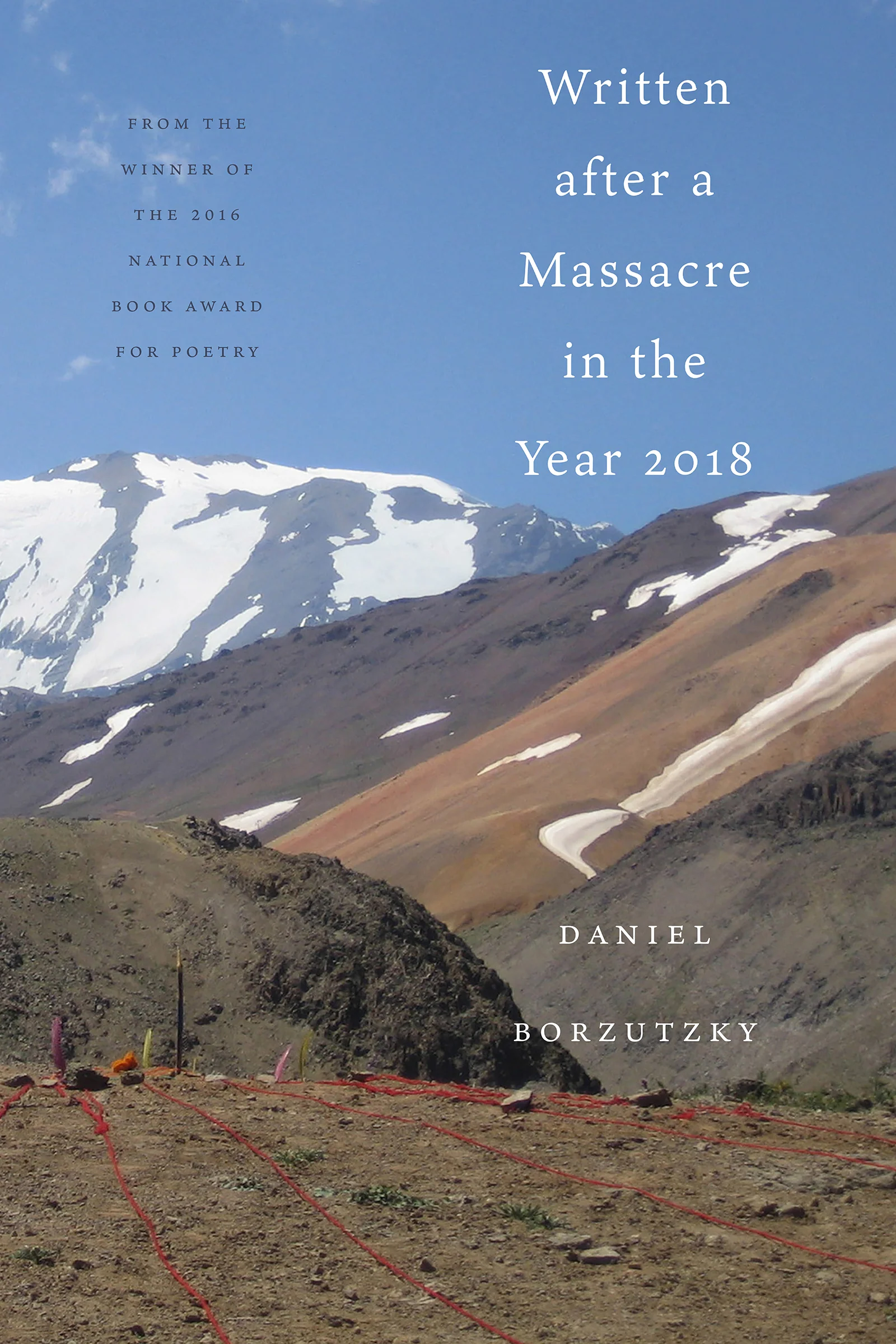
Written After a Massacre in the Year 2018
Poetry by Daniel Borzutzky
Hardcover edition: March 2, 2021 • 6 x 9 • 120 pages • 978-1-56689-599-6
Paperback edition: March 8, 2022 • 6 x 9 • 120 pages • 978-1-56689-624-5
National Book Award winner Daniel Borzutzky pens an incandescent indictment of capitalism’s moral decay.
In Written After a Massacre in the Year 2018, Daniel Borzutzky rages against the military industrial complex that profits from violence, against the unjust policing of certain bodies, against xenophobia passing for immigration policy, against hate spreading like a virus. He grieves for children in cages and those slain in the Tree of Life synagogue shooting in Pittsburgh. But pulsing amid Borzutzky’s outrage over our era’s tragedies is a longing for something better: for generosity to triumph over stinginess and for peace to transform injustice. Borzutzky’s strident language juxtaposes the horror of consumer-culture violence with its absurdity, and he masterfully shifts between shock and heartbreak over the course of the collection. Bleak but not hopeless, Written After a Massacre in the Year 2018 is an unflinching poetic reckoning with the twenty-first century.
About the Author
Daniel Borzutzky is the author of several poetry collections, including The Book of Interfering Bodies; In the Murmurs of the Rotten Carcass Economy; The Performance of Becoming Human, winner of the 2016 National Book Award; and Lake Michigan, a finalist for the 2019 Griffin International Poetry Prize. His translation of Galo Ghigliotto’s Valdivia received the National Translation Award. He has also translated books by Chilean poets Raúl Zurita and Jaime Luis Huenún. He teaches at the University of Illinois at Chicago.
Praise for Written After a Massacre in the Year 2018
Chicago Review of Books, “Must-Read Books for March”
“Borzutzky handles history as liquid, the past a wave forever crashing into the present. . . . an urgently contemporary project, rejecting the pretense of retrospective distance in order to mourn from within chaos.” —Hannah Aizenman, The New Yorker
“A panoramic and formally various investigation of the evils of capitalism, imperialism, and white supremacy. . . . Borzutzky’s arresting writing sings and stuns as it addresses difficult, painful truths.” —Publishers Weekly, starred review
“The poet’s voice has echoes of Waldman and Olson. The poems are at times conversational and incantatory. . . . It’s essentially a way of working through the violence that’s persistent today, while still trying to acknowledge a specific terrible act of violence. . . . critical and ambitious, most damning in its understatement and reflection.” —Joseph Houlihan, Chicago Review of Books
“This is a broken god of a book. . . . Borzutzky dares to write—to confront—the unspeakable: the atrocities of capital. In his nightmarish sixth collection of poetry, Borzutzky’s poems continue to murmur the ghost languages and unimaginable cruelties of our world: its surveillance tactics, its tactical warfare, its caged babies, its corrupt bankers, its private sectors, its privatized air, its foreclosed mouths. These are not just poems of compelling witness, but unimaginable, unforgettable songs of grief.” —Paul Cunningham, Action Books
“Stunning. . . . Global capitalist ironies become punchlines but also give way to protests, from Chile to Chicago and beyond.” —Urayoán Noel, The Latinx Project
“Borzutzky, the 2016 National Book Award for Poetry winner for his collection The Performance of Becoming Human, writes in a bare and immediate style free of artifice. The imagery is clear and direct. . . . The simple—but not simplistic—writing, pulls you in.” —David Rullo, Pittsburgh Jewish Chronicle
“Sprawling in its rage, from the concentration camps at the border to police violence to the scourge of mass shootings, this collection uses language to identify the unspeakable.” —Chicago Review of Books
“These poems apply a clarity of conscience and language to the surreal nightmare born of white supremacy and zero-sum-game capitalism. Borzutzky—like Reznikoff and Rukeyser, and Chilean poet Raúl Zurita, whom he has translated—reminds us that poetry is and has long been a tool of reckoning and refusal, a way of singing for what has been stolen, slaughtered, stifled. These are the songs we must learn to sing.” —Tracy K. Smith
“Written After a Massacre in the Year 2018 is a montage for the systemic torque of our bodies. With stunning alacrity, Daniel Borzutzky emboldens a list of images into reality, as a broken witness—phenomenology of the murmuring poet’s ‘guilt of this innocent lung.’ Given rage to clean away the moral fiber of a culture led astray, we venture into the understructure of massacre with a book as a torch, providing humanity its navigation. Among these pages, emotional and spiritual selves gather to find cadence in perspective. ‘We break we are broken we are,’ transformation meets self-creation, daring subject to engage and render. Fractures of society are given multiple angles, to form our own entry points—each perception its own formation of equanimity. Line by line, we repeat the prayers that might heal those we love, ourselves included. Borzutzky offers us a testament to the written breath—to hear poetry’s fault line, running through each of us.” —Edwin Torres, author of Xoeteox: the infinite word object
“I can't do anything but bow. This is lacerating work.” —Achy Obejas
Praise for Daniel Borzutzky
Winner of the 2016 National Book Award
Finalist for the 2019 Griffin International Poetry Prize
“Borzutzky’s intelligence and learning are formidable.” —Los Angeles Times
“Violent, perverse, tender.” —Eileen Myles, Poetry Foundation
“According to Borzutzky, we are all responsible for the current state of the union.” —Craig Morgan Teicher, NPR
“Through repetition and obsessive accumulation, every phrase leaps off the page, begging to be spoken aloud, or shouted. The work is as personally conflicted as Berryman’s, as stealthy as Celan’s, and as openly political as Ginsberg’s.” —National Book Award citation
“This is one of contemporary poetry’s most cogent documents of humanity and suffering in the 21st century.” —Publishers Weekly
Product Information
Product Information
Shipping & Returns
Shipping & Returns
Description
Poetry by Daniel Borzutzky
Hardcover edition: March 2, 2021 • 6 x 9 • 120 pages • 978-1-56689-599-6
Paperback edition: March 8, 2022 • 6 x 9 • 120 pages • 978-1-56689-624-5
National Book Award winner Daniel Borzutzky pens an incandescent indictment of capitalism’s moral decay.
In Written After a Massacre in the Year 2018, Daniel Borzutzky rages against the military industrial complex that profits from violence, against the unjust policing of certain bodies, against xenophobia passing for immigration policy, against hate spreading like a virus. He grieves for children in cages and those slain in the Tree of Life synagogue shooting in Pittsburgh. But pulsing amid Borzutzky’s outrage over our era’s tragedies is a longing for something better: for generosity to triumph over stinginess and for peace to transform injustice. Borzutzky’s strident language juxtaposes the horror of consumer-culture violence with its absurdity, and he masterfully shifts between shock and heartbreak over the course of the collection. Bleak but not hopeless, Written After a Massacre in the Year 2018 is an unflinching poetic reckoning with the twenty-first century.
About the Author
Daniel Borzutzky is the author of several poetry collections, including The Book of Interfering Bodies; In the Murmurs of the Rotten Carcass Economy; The Performance of Becoming Human, winner of the 2016 National Book Award; and Lake Michigan, a finalist for the 2019 Griffin International Poetry Prize. His translation of Galo Ghigliotto’s Valdivia received the National Translation Award. He has also translated books by Chilean poets Raúl Zurita and Jaime Luis Huenún. He teaches at the University of Illinois at Chicago.
Praise for Written After a Massacre in the Year 2018
Chicago Review of Books, “Must-Read Books for March”
“Borzutzky handles history as liquid, the past a wave forever crashing into the present. . . . an urgently contemporary project, rejecting the pretense of retrospective distance in order to mourn from within chaos.” —Hannah Aizenman, The New Yorker
“A panoramic and formally various investigation of the evils of capitalism, imperialism, and white supremacy. . . . Borzutzky’s arresting writing sings and stuns as it addresses difficult, painful truths.” —Publishers Weekly, starred review
“The poet’s voice has echoes of Waldman and Olson. The poems are at times conversational and incantatory. . . . It’s essentially a way of working through the violence that’s persistent today, while still trying to acknowledge a specific terrible act of violence. . . . critical and ambitious, most damning in its understatement and reflection.” —Joseph Houlihan, Chicago Review of Books
“This is a broken god of a book. . . . Borzutzky dares to write—to confront—the unspeakable: the atrocities of capital. In his nightmarish sixth collection of poetry, Borzutzky’s poems continue to murmur the ghost languages and unimaginable cruelties of our world: its surveillance tactics, its tactical warfare, its caged babies, its corrupt bankers, its private sectors, its privatized air, its foreclosed mouths. These are not just poems of compelling witness, but unimaginable, unforgettable songs of grief.” —Paul Cunningham, Action Books
“Stunning. . . . Global capitalist ironies become punchlines but also give way to protests, from Chile to Chicago and beyond.” —Urayoán Noel, The Latinx Project
“Borzutzky, the 2016 National Book Award for Poetry winner for his collection The Performance of Becoming Human, writes in a bare and immediate style free of artifice. The imagery is clear and direct. . . . The simple—but not simplistic—writing, pulls you in.” —David Rullo, Pittsburgh Jewish Chronicle
“Sprawling in its rage, from the concentration camps at the border to police violence to the scourge of mass shootings, this collection uses language to identify the unspeakable.” —Chicago Review of Books
“These poems apply a clarity of conscience and language to the surreal nightmare born of white supremacy and zero-sum-game capitalism. Borzutzky—like Reznikoff and Rukeyser, and Chilean poet Raúl Zurita, whom he has translated—reminds us that poetry is and has long been a tool of reckoning and refusal, a way of singing for what has been stolen, slaughtered, stifled. These are the songs we must learn to sing.” —Tracy K. Smith
“Written After a Massacre in the Year 2018 is a montage for the systemic torque of our bodies. With stunning alacrity, Daniel Borzutzky emboldens a list of images into reality, as a broken witness—phenomenology of the murmuring poet’s ‘guilt of this innocent lung.’ Given rage to clean away the moral fiber of a culture led astray, we venture into the understructure of massacre with a book as a torch, providing humanity its navigation. Among these pages, emotional and spiritual selves gather to find cadence in perspective. ‘We break we are broken we are,’ transformation meets self-creation, daring subject to engage and render. Fractures of society are given multiple angles, to form our own entry points—each perception its own formation of equanimity. Line by line, we repeat the prayers that might heal those we love, ourselves included. Borzutzky offers us a testament to the written breath—to hear poetry’s fault line, running through each of us.” —Edwin Torres, author of Xoeteox: the infinite word object
“I can't do anything but bow. This is lacerating work.” —Achy Obejas
Praise for Daniel Borzutzky
Winner of the 2016 National Book Award
Finalist for the 2019 Griffin International Poetry Prize
“Borzutzky’s intelligence and learning are formidable.” —Los Angeles Times
“Violent, perverse, tender.” —Eileen Myles, Poetry Foundation
“According to Borzutzky, we are all responsible for the current state of the union.” —Craig Morgan Teicher, NPR
“Through repetition and obsessive accumulation, every phrase leaps off the page, begging to be spoken aloud, or shouted. The work is as personally conflicted as Berryman’s, as stealthy as Celan’s, and as openly political as Ginsberg’s.” —National Book Award citation
“This is one of contemporary poetry’s most cogent documents of humanity and suffering in the 21st century.” —Publishers Weekly