Finalist for the 2013 James Tait Black Prize in fiction
Runner-Up for the 2013 Sami Rohr Prize for Jewish Literature
Winner of the 2012 Believer Book Award
Finalist for the 2011 Los Angeles Times Book Prize (Art Seidenbaum Award for First Fiction)
Finalist for the New York Public Library’s 2012 Young Lions Fiction Award
Wall Street Journal’s Top 10 Fiction of 2011”
New Yorker’s “Best of the Year in Culture 2011”
Newsweek/Daily Beast’s “Best of 2011”
Boston Globe’s “Best of 2011”
The Guardian’s “Best Books of 2011”
Shelf Unbound’s “Top Ten of 2011”
New Stateman’s “Best Books of 2011”
Huffington Post’s “Yet Another Year-End List”
Work in Progress’s “FSG’s Favorite Book of 2012”
Literary Hub, “50 Best Contemporary Novels”
“Ben Lerner’s remarkable first novel . . . is a bildungsroman and meditation and slacker tale fused by a precise, reflective and darkly comic voice. It is also a revealing study of what it's like to be a young American abroad. . . . Lerner is concerned with ineffability, but Adam Gordon (and the author) fight back with more than words. . . . The ultimate product of Gordon’s success is the novel itself.” —New York Times Book Review
“One of the funniest (and truest) novels I know of by a writer of his generation. . . . A dazzlingly good novel.” —New York Review of Books
“A subtle, sinuous, and very funny first novel . . . . Leaving the Atocha Station has a beguiling mixture of lightness and weight. There are wonderful sentences and jokes on almost every page. Lerner is attempting to capture something that most conventional novels, with their cumbersome caravans of plot and scene and ‘conflict,’ fail to do: the drift of thought, the unmomentous passage of undramatic life.” —New Yorker
“Flip, hip, smart, and very funny. . . . Reading it was unlike any other novel-reading experience I’ve had for a long time.” —Maureen Corrigan, NPR’s “Fresh Air with Terry Gross”
“[Leaving the Atocha Station is] hilarious and cracklingly intelligent, fully alive and original in every sentence, and abuzz with the feel of our late-late-modern moment.” —Jonathan Franzen in the Guardian’s Books of the Year 2011
“A remarkable first novel. . . . Intensely and unusually brilliant.” —The Guardian
“Utterly charming. Lerner’s self-hating, lying, overmedicated, brilliant fool of a hero is a memorable character, and his voice speaks with a music distinctly and hilariously all his own.” —Paul Auster
“Leaving the Atocha Station is a marvelous novel, not least because of the magical way that it reverses the postmodernist spell, transmuting a fraudulent figure into a fully dimensional and compelling character.” —Wall Street Journal
“One of the strengths of Leaving the Atocha Station is how it absorbs these radical impulses without compromising narrative shape and speed. . . . More important, however, this blending—of perception and politics—comes right out of how Lerner sees the world in real life.” —Electric Literature
“Lerner’s prose, at once precise and swerving, propels the book in lieu of a plot and creates an experience of something [main character Adam] Gordon criticizes more heavily plotted books of failing to capture: ‘the texture of time as it passed, life’s white machine.’” —Daily Beast
“A noteworthy debut . . . . Lerner has fun with the interplay between the unreliable spoken word and subtleties in speech and body language, capturing the struggle of a young artist unsure of the meaning or value of his art. . . . Lerner succeeds in drawing out the problems inherent in art, expectation, and communication.” —Publishers Weekly
“Ben Lerner’s first novel, coming on the heels of three outstanding poetry collections, is a darkly hilarious examination of just how self-conscious, miserable, and absurd one man can be. . . . Lerner’s writing is beautiful, funny, and revelatory.” —Deb Olin Unferth, Bookforum
“ Leaving the Atocha Station is as much an apologia for poetry as it is a novel. Lerner’s ability to accomplish both projects at once is a marvel. His sense of narrative forward motion and his penchant for rumination are kept in constant competition with one another, so that neither is allowed to keep the upper hand for long. Leaving the Atocha Station is a novel for poets, liars, and equivocators—that is, for aspects of us all. It is also a poem, dedicated to the gulf between self and self–ego and alter ego, ‘true me’ and ‘false me,’ present self and outgrown past.” —Open Letters Monthly
“The first novel from Ben Lerner, a finalist for the National Book Award in poetry, explores with humor and depth what everyone assumes is OK to overlook. . . . Ben Lerner’s phrases meander, unconcerned tourists, taking exotic day trips to surprising clauses before returning to their familiar hostels of subject and predicate. . . . An honest, exciting account of what it’s like to be a fairly regular guy in fairly regular circumstances . . . [and] somehow it’s more incredible, and more modern a dilemma, than the explosives.” —Star Tribune
“Leaving the Atocha Station is the kind of book that feels lived rather than composed—a post-MFA The Catcher in the Rye for professional adolescents. When I finished reading the novel, I wanted to know what Gordon was up to and had to resist the urge to look for him on Facebook and Twitter, which is a shame. I could have given his résumé a boost with an endorsement on LinkedIn.” —San Diego CityBeat
“I admire Ben’s poetry, but I love to death his new book, Leaving the Atocha Station. Ben Lerner’s novel . . . ‘chronicles the endemic disease of our time: the difficulty of feeling. . .’ A significant book.” —Los Angeles Review of Books
“In his adroitly interiorized first novel . . . Lerner makes this tale of a nervous young artist abroad profoundly evocative by using his protagonist’s difficulties with Spanish, fear of creativity, and mental instability to cleverly, seductively, and hilariously investigate the nature of language and storytelling, veracity and fraud. As Adam’s private fears are dwarfed by terrorist train attacks, Lerner casts light on how we must constantly rework the narrative of our lives to survive and flourish.” —Booklist
“Leaving the Atocha Station is, among other things, a character-driven ‘page-turner’ and a concisely definitive study of the ‘actual’ versus the ‘virtual’ as applied to relationships, language, poetry, experience. It’s funny and affecting and as meticulous and ‘knowing’ in its execution of itself, I feel, as Ben’s poetry collections are.” —Believer
“What is the average person’s role in history? How can we live with our own fraudulence? Why should we make art, and what kind of art can we make now? To all these questions Atocha Station is an answer.” —Vulture
“Lerner, himself an Ivy League poet and National Book Award finalist who once spent time in Madrid on a prestigious fellowship, wrestles well with absence as an event. . . . The combination of tension and languor, grounded by sensual details, recalls Javier Marías.” —Time Out New York
“[Leaving the Atocha Station] is remarkable for its ability to be simultaneously warm, ruminative, heart-breaking, and funny.” —Shelf Unbound
“Perhaps it’s because there’s so much skepticism surrounding the novel-by-poet that, when it’s successful, it’s such a cause for celebration. Some prime examples of monumental novels by poets and about poets (but not just for poets) are Boris Pasternak’s Doctor Zhivago, Roberto Bolaño’s The Savage Detectives, and Rainer Maria Rilke’s The Notebooks of Malte Laurids Brigge. Now, let us celebrate another of their rank: Ben Lerner’s Leaving the Atocha Station.” —Jewish Daily Forward
“An extraordinary novel about the intersections of art and reality in contemporary life.” —John Ashbery
“Acclaimed poet Ben Lerner’s first novel is a fascinating and often brilliant investigation of the distance (or the communication) between experience and art. . . . Rendering its subject from just about every angle, Leaving the Atocha Station becomes something close to highly self-aware, to something poetic.” —Zyzzyva
“Last night I started Ben Lerner’s novel Leaving the Atocha Station. By page three it was clear I was either staying up all night or putting the novel away until the weekend. I’m still angry with myself for having slept.” —Stacy Schiff
“Impenetrable Screen is at times quite poignant, and Atocha Station is canny and wickedly funny throughout. . . . These works too argue for themselves as achievements, talismanic keys attaining some degree of access to ‘life’s white machine’ and ‘desire’s buzz.’” —Full Stop
“The writing—fluid, sharp, and fast—pulls you along, rarely stumbling. Lerner understands human interaction with unusual clarity and for the egotistical Adam, every conversation is a sparring match. . . . The effect is striking and, unexpectedly comforting.” —Iberosphere
“Linguistically, Leaving the Atocha Station is one of the most remarkable books I have read this year. Lerner is a poet, but this isn't a ‘poetic novel,’ by which I mean the kind of work where mellifluous description acts as a kind of literary toupee. Lerner’s poetry manifests itself in elegantly stilted grammar, in contradiction and self-cancellation, is painfully self-aware self-mirroring and especially in misunderstanding . . . The camber of Adam’s thoughts is conveyed with astonishing grace.” —Scotsman
“I did love this debut novel by a young poet . . . which takes place at the time of the 2004 Madrid subway bombings and channels W.G. Sebald in a way that’s far more interesting, for my money, than another Sebaldian homage published the same year.” —Publishers Weekly
“I was both amused and appalled by the anti-hero of Ben Lerner’s Leaving the Atocha Station.” —The Guardian
“In his first novel, Leaving the Atocha Station, Lerner makes a kind of refined comedy out of his grad student narrator’s gnawing sense of his own inauthenticity.” —New Statesman
“The sharpest and funniest novel I read this year.” —Daily Mail
“I really liked Ben Lerner’s Leaving the Atocha Station. . . . It is incredibly smart. It’s terrifying how smart this author is.” —Miami Herald
“The prose is mesmerizing. . . . A fairly astonishing large achievement of poetic voice and diction.” —Circular Breathing
“An impressively verisimilar account of ennui and alienation in . . . our post-9/11 world.” —Bookriot
“Leaving the Atocha Station gets to the heart of this fact of our existence. It captures the complex relationship we have with art, with faith, with love, and with life, and it does so with wit, honesty and grace.” —HuffPost
“Leaving the Atocha Station, an American-abroad novel by the poet Ben Lerner, reaches 'for what cannot be disclosed or confessed in narrative.” —New York Times
“The two achievements that push Leaving the Atocha Station into must-read territory are its antihero narrator and the almost kinetic nature of its prose. . . . The author fills the pages with an electric, commanding prose that turns into everything the reader needs.” —Verbicide
“‘In my continued, mostly futile, campaign to offer various children, nieces and nephews an alternative to vampires and wizards,’ he wrote, ‘I’ll be giving . . . Ben Lerner’s smart, ruminating novel, Leaving the Atocha Station.’” —New York Times
“That monster of overprivilege and overeducation ends up being genuinely sympathetic, and that a book that has serious questions to ask about the place of art in our virtually anesthetized world is consistently laugh-out-loud funny, are testaments to Ben Lerner’s dazzling prose, which switches effortlessly from deadpan to ironic to salty to tragic and back again.” —The Millions, “A Year in Reading: Paul Murray”
“I loved Ben Lerner’s Leaving the Atocha Station. It fits into the category I like to call ‘the perfect little novel.’” —BuzzFeed, “The Best Books We Read in 2012”
“Lerner is a multi-form talent who crosses genres, modes, and media to represent a leading edge of contemporary writing.” —Contemporary Literature
“In Leaving the Atocha Station the light is at first humor, of which self-deprecation and compulsive lying are the materials. . . . Lerner suggests that hope lies in the excision of self-consciousness, a less partial view of oneself.” —Los Angeles Review of Books
“Indeed, we’ve often found ourselves at a loss to explain why this book is so wonderful. . . . Shields gets it: the book ‘chronicles the endemic disease of our time: the difficulty of feeling.’” —Flavorwire
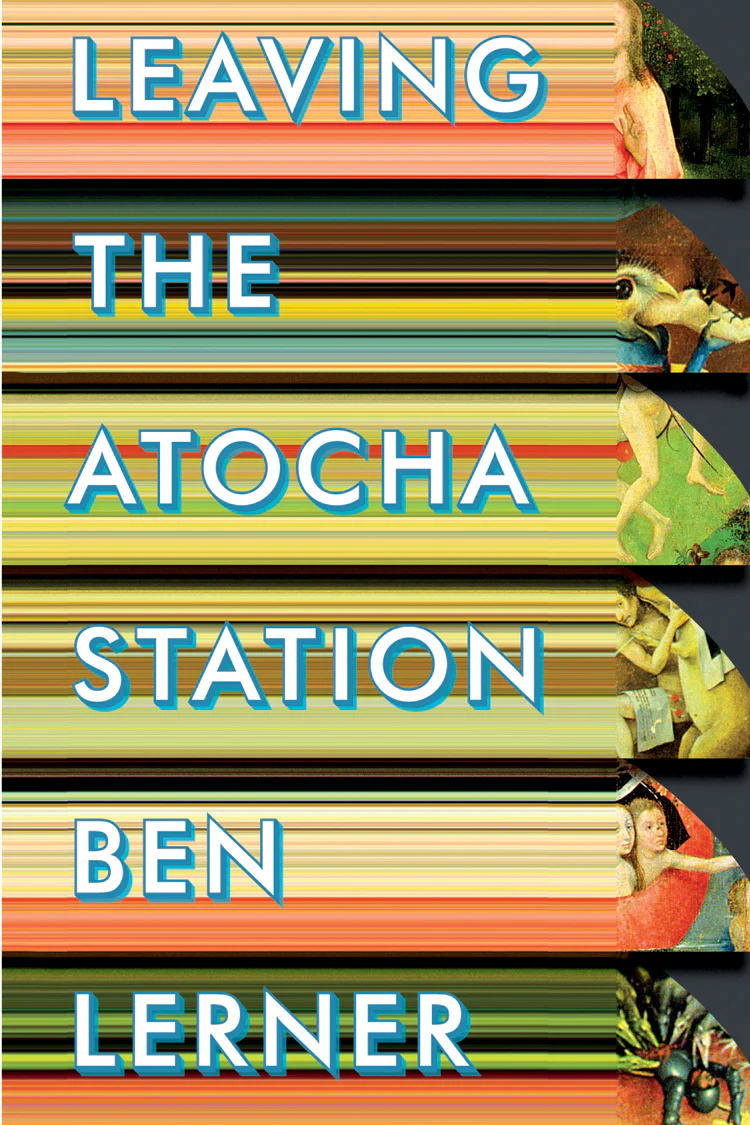
Leaving the Atocha Station
A novel by Ben Lerner
August 23, 2011 • 6 x 9 • 186 pages • 978-1-56689-274-2
From a National Book Award finalist, this hilarious and profound first novel captures the experience of the young American abroad while exploring the possibilities of art and authenticity in our time.
Adam Gordon is a brilliant, if highly unreliable, young American poet on a prestigious fellowship in Madrid, struggling to establish his sense of self and his relationship to art. Instead of following the dictates of his fellowship, Adam’s “research” becomes a meditation on the possibility of the genuine in the arts and beyond: are his relationships with the people he meets in Spain as fraudulent as he fears his poems are? Is poetry an essential art form, or merely a screen for the reader’s projections? A witness to the 2004 Madrid train bombings and their aftermath, does he participate in historic events or merely watch them pass him by?
In prose that veers between the comic and tragic, the self-contemptuous and the inspired, Leaving the Atocha Station is a portrait of the artist as a young man in an age of Google searches, pharmaceuticals, and spectacle.
About the Author
Ben Lerner is the author of three books of poetry The Lichtenberg Figures, Angle of Yaw, and Mean Free Path. Lerner has been a finalist for the National Book Award and the Northern California Book Award, a Fulbright Scholar in Spain, and the recipient of a 2010-2011 Howard Foundation Fellowship. In 2011 he became the first American to win the Preis der Stadt Münster für Internationale Poesie. He teaches in the writing program at Brooklyn College.
His debut novel Leaving the Atocha Station was named one of the best books of 2011 by the Wall Street Journal, the New Yorker, the Guardian, the Boston Globe, New York Magazine, and many others, and is a finalist for the Los Angeles Times Book Prize and the New York Public Library’s 2012 Young Lions Fiction Award.
Thanks to a 2013 ADA Access Improvement Grant administered by VSA Minnesota for the Metropolitan Regional Arts Council, this title is also formatted for screen readers which make text accessible to the blind and visually impaired. To purchase this title for use with a screen reader please call (612) 338-0125 or email us at info@coffeehousepress.org.
Reviews
Finalist for the 2013 James Tait Black Prize in fiction
Runner-Up for the 2013 Sami Rohr Prize for Jewish Literature
Winner of the 2012 Believer Book Award
Finalist for the 2011 Los Angeles Times Book Prize (Art Seidenbaum Award for First Fiction)
Finalist for the New York Public Library’s 2012 Young Lions Fiction Award
Wall Street Journal’s Top 10 Fiction of 2011”
New Yorker’s “Best of the Year in Culture 2011”
Newsweek/Daily Beast’s “Best of 2011”
Boston Globe’s “Best of 2011”
The Guardian’s “Best Books of 2011”
Shelf Unbound’s “Top Ten of 2011”
New Stateman’s “Best Books of 2011”
Huffington Post’s “Yet Another Year-End List”
Work in Progress’s “FSG’s Favorite Book of 2012”
Literary Hub, “50 Best Contemporary Novels”
“Ben Lerner’s remarkable first novel . . . is a bildungsroman and meditation and slacker tale fused by a precise, reflective and darkly comic voice. It is also a revealing study of what it's like to be a young American abroad. . . . Lerner is concerned with ineffability, but Adam Gordon (and the author) fight back with more than words. . . . The ultimate product of Gordon’s success is the novel itself.” —New York Times Book Review
“One of the funniest (and truest) novels I know of by a writer of his generation. . . . A dazzlingly good novel.” —New York Review of Books
“A subtle, sinuous, and very funny first novel . . . . Leaving the Atocha Station has a beguiling mixture of lightness and weight. There are wonderful sentences and jokes on almost every page. Lerner is attempting to capture something that most conventional novels, with their cumbersome caravans of plot and scene and ‘conflict,’ fail to do: the drift of thought, the unmomentous passage of undramatic life.” —New Yorker
“Flip, hip, smart, and very funny. . . . Reading it was unlike any other novel-reading experience I’ve had for a long time.” —Maureen Corrigan, NPR’s “Fresh Air with Terry Gross”
“[Leaving the Atocha Station is] hilarious and cracklingly intelligent, fully alive and original in every sentence, and abuzz with the feel of our late-late-modern moment.” —Jonathan Franzen in the Guardian’s Books of the Year 2011
“A remarkable first novel. . . . Intensely and unusually brilliant.” —The Guardian
“Utterly charming. Lerner’s self-hating, lying, overmedicated, brilliant fool of a hero is a memorable character, and his voice speaks with a music distinctly and hilariously all his own.” —Paul Auster
“Leaving the Atocha Station is a marvelous novel, not least because of the magical way that it reverses the postmodernist spell, transmuting a fraudulent figure into a fully dimensional and compelling character.” —Wall Street Journal
“One of the strengths of Leaving the Atocha Station is how it absorbs these radical impulses without compromising narrative shape and speed. . . . More important, however, this blending—of perception and politics—comes right out of how Lerner sees the world in real life.” —Electric Literature
“Lerner’s prose, at once precise and swerving, propels the book in lieu of a plot and creates an experience of something [main character Adam] Gordon criticizes more heavily plotted books of failing to capture: ‘the texture of time as it passed, life’s white machine.’” —Daily Beast
“A noteworthy debut . . . . Lerner has fun with the interplay between the unreliable spoken word and subtleties in speech and body language, capturing the struggle of a young artist unsure of the meaning or value of his art. . . . Lerner succeeds in drawing out the problems inherent in art, expectation, and communication.” —Publishers Weekly
“Ben Lerner’s first novel, coming on the heels of three outstanding poetry collections, is a darkly hilarious examination of just how self-conscious, miserable, and absurd one man can be. . . . Lerner’s writing is beautiful, funny, and revelatory.” —Deb Olin Unferth, Bookforum
“ Leaving the Atocha Station is as much an apologia for poetry as it is a novel. Lerner’s ability to accomplish both projects at once is a marvel. His sense of narrative forward motion and his penchant for rumination are kept in constant competition with one another, so that neither is allowed to keep the upper hand for long. Leaving the Atocha Station is a novel for poets, liars, and equivocators—that is, for aspects of us all. It is also a poem, dedicated to the gulf between self and self–ego and alter ego, ‘true me’ and ‘false me,’ present self and outgrown past.” —Open Letters Monthly
“The first novel from Ben Lerner, a finalist for the National Book Award in poetry, explores with humor and depth what everyone assumes is OK to overlook. . . . Ben Lerner’s phrases meander, unconcerned tourists, taking exotic day trips to surprising clauses before returning to their familiar hostels of subject and predicate. . . . An honest, exciting account of what it’s like to be a fairly regular guy in fairly regular circumstances . . . [and] somehow it’s more incredible, and more modern a dilemma, than the explosives.” —Star Tribune
“Leaving the Atocha Station is the kind of book that feels lived rather than composed—a post-MFA The Catcher in the Rye for professional adolescents. When I finished reading the novel, I wanted to know what Gordon was up to and had to resist the urge to look for him on Facebook and Twitter, which is a shame. I could have given his résumé a boost with an endorsement on LinkedIn.” —San Diego CityBeat
“I admire Ben’s poetry, but I love to death his new book, Leaving the Atocha Station. Ben Lerner’s novel . . . ‘chronicles the endemic disease of our time: the difficulty of feeling. . .’ A significant book.” —Los Angeles Review of Books
“In his adroitly interiorized first novel . . . Lerner makes this tale of a nervous young artist abroad profoundly evocative by using his protagonist’s difficulties with Spanish, fear of creativity, and mental instability to cleverly, seductively, and hilariously investigate the nature of language and storytelling, veracity and fraud. As Adam’s private fears are dwarfed by terrorist train attacks, Lerner casts light on how we must constantly rework the narrative of our lives to survive and flourish.” —Booklist
“Leaving the Atocha Station is, among other things, a character-driven ‘page-turner’ and a concisely definitive study of the ‘actual’ versus the ‘virtual’ as applied to relationships, language, poetry, experience. It’s funny and affecting and as meticulous and ‘knowing’ in its execution of itself, I feel, as Ben’s poetry collections are.” —Believer
“What is the average person’s role in history? How can we live with our own fraudulence? Why should we make art, and what kind of art can we make now? To all these questions Atocha Station is an answer.” —Vulture
“Lerner, himself an Ivy League poet and National Book Award finalist who once spent time in Madrid on a prestigious fellowship, wrestles well with absence as an event. . . . The combination of tension and languor, grounded by sensual details, recalls Javier Marías.” —Time Out New York
“[Leaving the Atocha Station] is remarkable for its ability to be simultaneously warm, ruminative, heart-breaking, and funny.” —Shelf Unbound
“Perhaps it’s because there’s so much skepticism surrounding the novel-by-poet that, when it’s successful, it’s such a cause for celebration. Some prime examples of monumental novels by poets and about poets (but not just for poets) are Boris Pasternak’s Doctor Zhivago, Roberto Bolaño’s The Savage Detectives, and Rainer Maria Rilke’s The Notebooks of Malte Laurids Brigge. Now, let us celebrate another of their rank: Ben Lerner’s Leaving the Atocha Station.” —Jewish Daily Forward
“An extraordinary novel about the intersections of art and reality in contemporary life.” —John Ashbery
“Acclaimed poet Ben Lerner’s first novel is a fascinating and often brilliant investigation of the distance (or the communication) between experience and art. . . . Rendering its subject from just about every angle, Leaving the Atocha Station becomes something close to highly self-aware, to something poetic.” —Zyzzyva
“Last night I started Ben Lerner’s novel Leaving the Atocha Station. By page three it was clear I was either staying up all night or putting the novel away until the weekend. I’m still angry with myself for having slept.” —Stacy Schiff
“Impenetrable Screen is at times quite poignant, and Atocha Station is canny and wickedly funny throughout. . . . These works too argue for themselves as achievements, talismanic keys attaining some degree of access to ‘life’s white machine’ and ‘desire’s buzz.’” —Full Stop
“The writing—fluid, sharp, and fast—pulls you along, rarely stumbling. Lerner understands human interaction with unusual clarity and for the egotistical Adam, every conversation is a sparring match. . . . The effect is striking and, unexpectedly comforting.” —Iberosphere
“Linguistically, Leaving the Atocha Station is one of the most remarkable books I have read this year. Lerner is a poet, but this isn't a ‘poetic novel,’ by which I mean the kind of work where mellifluous description acts as a kind of literary toupee. Lerner’s poetry manifests itself in elegantly stilted grammar, in contradiction and self-cancellation, is painfully self-aware self-mirroring and especially in misunderstanding . . . The camber of Adam’s thoughts is conveyed with astonishing grace.” —Scotsman
“I did love this debut novel by a young poet . . . which takes place at the time of the 2004 Madrid subway bombings and channels W.G. Sebald in a way that’s far more interesting, for my money, than another Sebaldian homage published the same year.” —Publishers Weekly
“I was both amused and appalled by the anti-hero of Ben Lerner’s Leaving the Atocha Station.” —The Guardian
“In his first novel, Leaving the Atocha Station, Lerner makes a kind of refined comedy out of his grad student narrator’s gnawing sense of his own inauthenticity.” —New Statesman
“The sharpest and funniest novel I read this year.” —Daily Mail
“I really liked Ben Lerner’s Leaving the Atocha Station. . . . It is incredibly smart. It’s terrifying how smart this author is.” —Miami Herald
“The prose is mesmerizing. . . . A fairly astonishing large achievement of poetic voice and diction.” —Circular Breathing
“An impressively verisimilar account of ennui and alienation in . . . our post-9/11 world.” —Bookriot
“Leaving the Atocha Station gets to the heart of this fact of our existence. It captures the complex relationship we have with art, with faith, with love, and with life, and it does so with wit, honesty and grace.” —HuffPost
“Leaving the Atocha Station, an American-abroad novel by the poet Ben Lerner, reaches 'for what cannot be disclosed or confessed in narrative.” —New York Times
“The two achievements that push Leaving the Atocha Station into must-read territory are its antihero narrator and the almost kinetic nature of its prose. . . . The author fills the pages with an electric, commanding prose that turns into everything the reader needs.” —Verbicide
“‘In my continued, mostly futile, campaign to offer various children, nieces and nephews an alternative to vampires and wizards,’ he wrote, ‘I’ll be giving . . . Ben Lerner’s smart, ruminating novel, Leaving the Atocha Station.’” —New York Times
“That monster of overprivilege and overeducation ends up being genuinely sympathetic, and that a book that has serious questions to ask about the place of art in our virtually anesthetized world is consistently laugh-out-loud funny, are testaments to Ben Lerner’s dazzling prose, which switches effortlessly from deadpan to ironic to salty to tragic and back again.” —The Millions, “A Year in Reading: Paul Murray”
“I loved Ben Lerner’s Leaving the Atocha Station. It fits into the category I like to call ‘the perfect little novel.’” —BuzzFeed, “The Best Books We Read in 2012”
“Lerner is a multi-form talent who crosses genres, modes, and media to represent a leading edge of contemporary writing.” —Contemporary Literature
“In Leaving the Atocha Station the light is at first humor, of which self-deprecation and compulsive lying are the materials. . . . Lerner suggests that hope lies in the excision of self-consciousness, a less partial view of oneself.” —Los Angeles Review of Books
“Indeed, we’ve often found ourselves at a loss to explain why this book is so wonderful. . . . Shields gets it: the book ‘chronicles the endemic disease of our time: the difficulty of feeling.’” —Flavorwire
Original: $18.00
-65%$18.00
$6.30Product Information
Product Information
Shipping & Returns
Shipping & Returns
Description
A novel by Ben Lerner
August 23, 2011 • 6 x 9 • 186 pages • 978-1-56689-274-2
From a National Book Award finalist, this hilarious and profound first novel captures the experience of the young American abroad while exploring the possibilities of art and authenticity in our time.
Adam Gordon is a brilliant, if highly unreliable, young American poet on a prestigious fellowship in Madrid, struggling to establish his sense of self and his relationship to art. Instead of following the dictates of his fellowship, Adam’s “research” becomes a meditation on the possibility of the genuine in the arts and beyond: are his relationships with the people he meets in Spain as fraudulent as he fears his poems are? Is poetry an essential art form, or merely a screen for the reader’s projections? A witness to the 2004 Madrid train bombings and their aftermath, does he participate in historic events or merely watch them pass him by?
In prose that veers between the comic and tragic, the self-contemptuous and the inspired, Leaving the Atocha Station is a portrait of the artist as a young man in an age of Google searches, pharmaceuticals, and spectacle.
About the Author
Ben Lerner is the author of three books of poetry The Lichtenberg Figures, Angle of Yaw, and Mean Free Path. Lerner has been a finalist for the National Book Award and the Northern California Book Award, a Fulbright Scholar in Spain, and the recipient of a 2010-2011 Howard Foundation Fellowship. In 2011 he became the first American to win the Preis der Stadt Münster für Internationale Poesie. He teaches in the writing program at Brooklyn College.
His debut novel Leaving the Atocha Station was named one of the best books of 2011 by the Wall Street Journal, the New Yorker, the Guardian, the Boston Globe, New York Magazine, and many others, and is a finalist for the Los Angeles Times Book Prize and the New York Public Library’s 2012 Young Lions Fiction Award.
Thanks to a 2013 ADA Access Improvement Grant administered by VSA Minnesota for the Metropolitan Regional Arts Council, this title is also formatted for screen readers which make text accessible to the blind and visually impaired. To purchase this title for use with a screen reader please call (612) 338-0125 or email us at info@coffeehousepress.org.
Reviews
Finalist for the 2013 James Tait Black Prize in fiction
Runner-Up for the 2013 Sami Rohr Prize for Jewish Literature
Winner of the 2012 Believer Book Award
Finalist for the 2011 Los Angeles Times Book Prize (Art Seidenbaum Award for First Fiction)
Finalist for the New York Public Library’s 2012 Young Lions Fiction Award
Wall Street Journal’s Top 10 Fiction of 2011”
New Yorker’s “Best of the Year in Culture 2011”
Newsweek/Daily Beast’s “Best of 2011”
Boston Globe’s “Best of 2011”
The Guardian’s “Best Books of 2011”
Shelf Unbound’s “Top Ten of 2011”
New Stateman’s “Best Books of 2011”
Huffington Post’s “Yet Another Year-End List”
Work in Progress’s “FSG’s Favorite Book of 2012”
Literary Hub, “50 Best Contemporary Novels”
“Ben Lerner’s remarkable first novel . . . is a bildungsroman and meditation and slacker tale fused by a precise, reflective and darkly comic voice. It is also a revealing study of what it's like to be a young American abroad. . . . Lerner is concerned with ineffability, but Adam Gordon (and the author) fight back with more than words. . . . The ultimate product of Gordon’s success is the novel itself.” —New York Times Book Review
“One of the funniest (and truest) novels I know of by a writer of his generation. . . . A dazzlingly good novel.” —New York Review of Books
“A subtle, sinuous, and very funny first novel . . . . Leaving the Atocha Station has a beguiling mixture of lightness and weight. There are wonderful sentences and jokes on almost every page. Lerner is attempting to capture something that most conventional novels, with their cumbersome caravans of plot and scene and ‘conflict,’ fail to do: the drift of thought, the unmomentous passage of undramatic life.” —New Yorker
“Flip, hip, smart, and very funny. . . . Reading it was unlike any other novel-reading experience I’ve had for a long time.” —Maureen Corrigan, NPR’s “Fresh Air with Terry Gross”
“[Leaving the Atocha Station is] hilarious and cracklingly intelligent, fully alive and original in every sentence, and abuzz with the feel of our late-late-modern moment.” —Jonathan Franzen in the Guardian’s Books of the Year 2011
“A remarkable first novel. . . . Intensely and unusually brilliant.” —The Guardian
“Utterly charming. Lerner’s self-hating, lying, overmedicated, brilliant fool of a hero is a memorable character, and his voice speaks with a music distinctly and hilariously all his own.” —Paul Auster
“Leaving the Atocha Station is a marvelous novel, not least because of the magical way that it reverses the postmodernist spell, transmuting a fraudulent figure into a fully dimensional and compelling character.” —Wall Street Journal
“One of the strengths of Leaving the Atocha Station is how it absorbs these radical impulses without compromising narrative shape and speed. . . . More important, however, this blending—of perception and politics—comes right out of how Lerner sees the world in real life.” —Electric Literature
“Lerner’s prose, at once precise and swerving, propels the book in lieu of a plot and creates an experience of something [main character Adam] Gordon criticizes more heavily plotted books of failing to capture: ‘the texture of time as it passed, life’s white machine.’” —Daily Beast
“A noteworthy debut . . . . Lerner has fun with the interplay between the unreliable spoken word and subtleties in speech and body language, capturing the struggle of a young artist unsure of the meaning or value of his art. . . . Lerner succeeds in drawing out the problems inherent in art, expectation, and communication.” —Publishers Weekly
“Ben Lerner’s first novel, coming on the heels of three outstanding poetry collections, is a darkly hilarious examination of just how self-conscious, miserable, and absurd one man can be. . . . Lerner’s writing is beautiful, funny, and revelatory.” —Deb Olin Unferth, Bookforum
“ Leaving the Atocha Station is as much an apologia for poetry as it is a novel. Lerner’s ability to accomplish both projects at once is a marvel. His sense of narrative forward motion and his penchant for rumination are kept in constant competition with one another, so that neither is allowed to keep the upper hand for long. Leaving the Atocha Station is a novel for poets, liars, and equivocators—that is, for aspects of us all. It is also a poem, dedicated to the gulf between self and self–ego and alter ego, ‘true me’ and ‘false me,’ present self and outgrown past.” —Open Letters Monthly
“The first novel from Ben Lerner, a finalist for the National Book Award in poetry, explores with humor and depth what everyone assumes is OK to overlook. . . . Ben Lerner’s phrases meander, unconcerned tourists, taking exotic day trips to surprising clauses before returning to their familiar hostels of subject and predicate. . . . An honest, exciting account of what it’s like to be a fairly regular guy in fairly regular circumstances . . . [and] somehow it’s more incredible, and more modern a dilemma, than the explosives.” —Star Tribune
“Leaving the Atocha Station is the kind of book that feels lived rather than composed—a post-MFA The Catcher in the Rye for professional adolescents. When I finished reading the novel, I wanted to know what Gordon was up to and had to resist the urge to look for him on Facebook and Twitter, which is a shame. I could have given his résumé a boost with an endorsement on LinkedIn.” —San Diego CityBeat
“I admire Ben’s poetry, but I love to death his new book, Leaving the Atocha Station. Ben Lerner’s novel . . . ‘chronicles the endemic disease of our time: the difficulty of feeling. . .’ A significant book.” —Los Angeles Review of Books
“In his adroitly interiorized first novel . . . Lerner makes this tale of a nervous young artist abroad profoundly evocative by using his protagonist’s difficulties with Spanish, fear of creativity, and mental instability to cleverly, seductively, and hilariously investigate the nature of language and storytelling, veracity and fraud. As Adam’s private fears are dwarfed by terrorist train attacks, Lerner casts light on how we must constantly rework the narrative of our lives to survive and flourish.” —Booklist
“Leaving the Atocha Station is, among other things, a character-driven ‘page-turner’ and a concisely definitive study of the ‘actual’ versus the ‘virtual’ as applied to relationships, language, poetry, experience. It’s funny and affecting and as meticulous and ‘knowing’ in its execution of itself, I feel, as Ben’s poetry collections are.” —Believer
“What is the average person’s role in history? How can we live with our own fraudulence? Why should we make art, and what kind of art can we make now? To all these questions Atocha Station is an answer.” —Vulture
“Lerner, himself an Ivy League poet and National Book Award finalist who once spent time in Madrid on a prestigious fellowship, wrestles well with absence as an event. . . . The combination of tension and languor, grounded by sensual details, recalls Javier Marías.” —Time Out New York
“[Leaving the Atocha Station] is remarkable for its ability to be simultaneously warm, ruminative, heart-breaking, and funny.” —Shelf Unbound
“Perhaps it’s because there’s so much skepticism surrounding the novel-by-poet that, when it’s successful, it’s such a cause for celebration. Some prime examples of monumental novels by poets and about poets (but not just for poets) are Boris Pasternak’s Doctor Zhivago, Roberto Bolaño’s The Savage Detectives, and Rainer Maria Rilke’s The Notebooks of Malte Laurids Brigge. Now, let us celebrate another of their rank: Ben Lerner’s Leaving the Atocha Station.” —Jewish Daily Forward
“An extraordinary novel about the intersections of art and reality in contemporary life.” —John Ashbery
“Acclaimed poet Ben Lerner’s first novel is a fascinating and often brilliant investigation of the distance (or the communication) between experience and art. . . . Rendering its subject from just about every angle, Leaving the Atocha Station becomes something close to highly self-aware, to something poetic.” —Zyzzyva
“Last night I started Ben Lerner’s novel Leaving the Atocha Station. By page three it was clear I was either staying up all night or putting the novel away until the weekend. I’m still angry with myself for having slept.” —Stacy Schiff
“Impenetrable Screen is at times quite poignant, and Atocha Station is canny and wickedly funny throughout. . . . These works too argue for themselves as achievements, talismanic keys attaining some degree of access to ‘life’s white machine’ and ‘desire’s buzz.’” —Full Stop
“The writing—fluid, sharp, and fast—pulls you along, rarely stumbling. Lerner understands human interaction with unusual clarity and for the egotistical Adam, every conversation is a sparring match. . . . The effect is striking and, unexpectedly comforting.” —Iberosphere
“Linguistically, Leaving the Atocha Station is one of the most remarkable books I have read this year. Lerner is a poet, but this isn't a ‘poetic novel,’ by which I mean the kind of work where mellifluous description acts as a kind of literary toupee. Lerner’s poetry manifests itself in elegantly stilted grammar, in contradiction and self-cancellation, is painfully self-aware self-mirroring and especially in misunderstanding . . . The camber of Adam’s thoughts is conveyed with astonishing grace.” —Scotsman
“I did love this debut novel by a young poet . . . which takes place at the time of the 2004 Madrid subway bombings and channels W.G. Sebald in a way that’s far more interesting, for my money, than another Sebaldian homage published the same year.” —Publishers Weekly
“I was both amused and appalled by the anti-hero of Ben Lerner’s Leaving the Atocha Station.” —The Guardian
“In his first novel, Leaving the Atocha Station, Lerner makes a kind of refined comedy out of his grad student narrator’s gnawing sense of his own inauthenticity.” —New Statesman
“The sharpest and funniest novel I read this year.” —Daily Mail
“I really liked Ben Lerner’s Leaving the Atocha Station. . . . It is incredibly smart. It’s terrifying how smart this author is.” —Miami Herald
“The prose is mesmerizing. . . . A fairly astonishing large achievement of poetic voice and diction.” —Circular Breathing
“An impressively verisimilar account of ennui and alienation in . . . our post-9/11 world.” —Bookriot
“Leaving the Atocha Station gets to the heart of this fact of our existence. It captures the complex relationship we have with art, with faith, with love, and with life, and it does so with wit, honesty and grace.” —HuffPost
“Leaving the Atocha Station, an American-abroad novel by the poet Ben Lerner, reaches 'for what cannot be disclosed or confessed in narrative.” —New York Times
“The two achievements that push Leaving the Atocha Station into must-read territory are its antihero narrator and the almost kinetic nature of its prose. . . . The author fills the pages with an electric, commanding prose that turns into everything the reader needs.” —Verbicide
“‘In my continued, mostly futile, campaign to offer various children, nieces and nephews an alternative to vampires and wizards,’ he wrote, ‘I’ll be giving . . . Ben Lerner’s smart, ruminating novel, Leaving the Atocha Station.’” —New York Times
“That monster of overprivilege and overeducation ends up being genuinely sympathetic, and that a book that has serious questions to ask about the place of art in our virtually anesthetized world is consistently laugh-out-loud funny, are testaments to Ben Lerner’s dazzling prose, which switches effortlessly from deadpan to ironic to salty to tragic and back again.” —The Millions, “A Year in Reading: Paul Murray”
“I loved Ben Lerner’s Leaving the Atocha Station. It fits into the category I like to call ‘the perfect little novel.’” —BuzzFeed, “The Best Books We Read in 2012”
“Lerner is a multi-form talent who crosses genres, modes, and media to represent a leading edge of contemporary writing.” —Contemporary Literature
“In Leaving the Atocha Station the light is at first humor, of which self-deprecation and compulsive lying are the materials. . . . Lerner suggests that hope lies in the excision of self-consciousness, a less partial view of oneself.” —Los Angeles Review of Books
“Indeed, we’ve often found ourselves at a loss to explain why this book is so wonderful. . . . Shields gets it: the book ‘chronicles the endemic disease of our time: the difficulty of feeling.’” —Flavorwire