Longlisted for the 2023 National Book Award for Translated Literature
\nVulture, “Books We Can’t Wait to Read in 2023”
\n
“Cárdenas generates queasy intrigue from something as strange as the birth of a devil child and as mundane as a text message that has been read but not replied to. . . . Briskly paced, thoughtful, and truly weird: a whodunit that takes on the very idea of blame.” —Kirkus, starred review
“A dizzying and beguiling yarn. . . . A crime story, but one without clear answers or culprits. . . . Cárdenas describes the sweltering heat in beautifully strange terms, adding to the sense of small-town oppression, where self-deprecating jokes are ‘a kind of determinist doctrine.’ South American fiction fans will love this.” —Publishers Weekly
\"Catastrophe and grace intertwine throughout The Devil of the Provinces, as do the horror and beauty of what remains hidden. The result, in the hands of Juan Cárdenas, is hypnotic, disturbing, memorable.” —Rodrigo Hasbún
“A supernatural thriller, a murder mystery, and a rumination on personal and environmental catastrophe—The Devil of the Provinces is none of these things and all of these things. With skillful economy, Juan Cárdenas crafts a story where everyone is complicit, even the reader. A brilliant, ambitious novel that searches for meaning in the shadows of a dangerous and ambiguous world.” —Mark Haber
Praise for Ornamental
Finalist for the 2021 PEN Translation Award
“With pitch-black comedy, Ornamental, nimbly translated by Lizzie Davis, channels the ways that egomaniacs in science and art—in any field—rise to the top, up the pyramid of capitalism. . . . The rhythm of Cárdenas’s writing compels and reassures, as if driven by the very humanity the lab has helped suppress.” —Nathan Scott McNamara, The New York Times
“[A] work of subtlety and restraint. . . . What makes Ornamental so deeply affecting, however, is not that its pages come together to form a beautiful work of exterior art—though [they] do—but its ability to cast unease on our interior worlds. . . . Brilliantly executed and cleverly translated, Ornamental leaves us with a fresh understanding of the creation of art and the nature of meaning-making.” —Dashiel Carrera, Los Angeles Review of Books
“In his thrilling novel Ornamental, Colombian art critic, translator, curator, and renowned author Juan Cárdenas masterfully tells the tale of the junction of an experimenting doctor, his wife, and his subsidized voluntary narcotic patient. . . . Expertly translated by seasoned editor Lizzie Davis.” —Ellie Simon, World Literature Today
“In spare and economical prose, Cárdenas sketches a highly stratified world, where drugs link high society and neighborhoods that are ‘a single crush of old houses and ruins’. . . . The overall effect offers both thrills and chills.” —Publishers Weekly
“[An] absurdist critique of class inequality. . . . Cárdenas also dabbles in art criticism and curation and uses that knowledge to acidic effect in a social drama that borders on the phantasmagorical. . . . With captivating moments.” —Kirkus
“This is the first of Cárdenas’s novels to be translated into English, with hopefully more to come, as he’s a supremely talented and original writer. Ornamental is a strange, dystopian tale about medical trials, in which a doctor studies women addicted to a mysterious recreational drug. Drugs will sadly always be associated with Colombia, but Cárdenas’s surreal examination of addiction and compulsion is a unique and necessary contribution to the conversation.” —Julianne Pachico, The Guardian
“[A]n exhilarating, slippery narrative where the reader knows much truth can be found, if only they can figure out how to decipher it. . . . Cárdenas’s prose is economical yet lyrical; many of his images are veritable objets d’art. . . . Lizzie Davis has done a spectacular job rendering Cárdenas’s novel in English.” —Gillian Esquivia-Cohen, Kenyon Review
“A pointed critique of late capitalism incarnated in today’s manipulative pharmaceutical industry, of rapid modernization in postcolonial contexts, and of facile arts. [Ornamental] showcases the impact of economic exploitation on the human body and desire, and probes the complicity of arts, architecture, philosophy, and language in capitalism’s crooked dynamics. I read translated literature to connect with my linguistic others, to get out of my skin, and see the world through the eyes of those I may never meet otherwise. Cárdenas’s novel and Davis’s translation did just that for me. Davis has masterfully rewritten Cárdenas’s novel in English.” —Sevinç Türkkan, Hopscotch Translation
“Cardenas’s narrative style hangs on outlines and sketches that give the short novel an allegorical heft surprising for its slimness. . . . It’s in the unexpected reversal of focus, from the researcher to number 4, from the moneyed to the impoverished, that Ornamental commits its boldest act and reminds us of the people sacrificed and ignored by the progress of science.” —Sebastian Sarti, Cleveland Review of Books
“This blow-me-over novel, set in a post-narco-baroque Colombia that could be anywhere, begins with a medical study of women committed to ingesting, in exchange for payment, an experimental and addictive recreational drug. Their dreams go strange, serving as a kind of litmus which registers lurid abscesses in a class-and-youth-obsessed society and in what we mistook to be the women’s ordinary lives. Soon, prophetic graffiti appears on walls around the city. Juan Cárdenas is masterful in his rendering of dreamy dreams, in his evocation of workplace psychology, in his urge to keep shifting the structure of his narrative even while he consistently delivers a prose so energetic, restless, and particular that its astonishing poetic qualities—someone ‘threatening pain with extortion,’ someone ‘signing imagined telegrams of dried monkey meat,’ the night recovering, at last, ‘its vulgarity’—don’t give us any pause. And translator Lizzie Davis is the next generation’s Natasha Wimmer, one of our most rewarding and savvy translators from the Spanish.” —Forrest Gander
\"In this disquieting dystopia, impeccably translated by Lizzie Davis, the prose of Juan Cárdenas surpasses the beauty promised by the sinister drug of happiness. A very subtle, smart book indeed.” —Alia Trabucco Zerán
“Cárdenas understands the great possibilities available to literary minimalism, taking advantage of them linguistically as well as politically, in careful strokes of theme and plot. A stunning novel about the entitlement of both the pharmaceutical industry and the art world, but also about desire, addiction, excess, and a security team made of spider monkeys. Perhaps the most damning fictional portrait of late capitalism I have ever read, at once absurd and startlingly relevant, Ornamental is a subtle and beautifully written nightmare.” —Brian Evenson
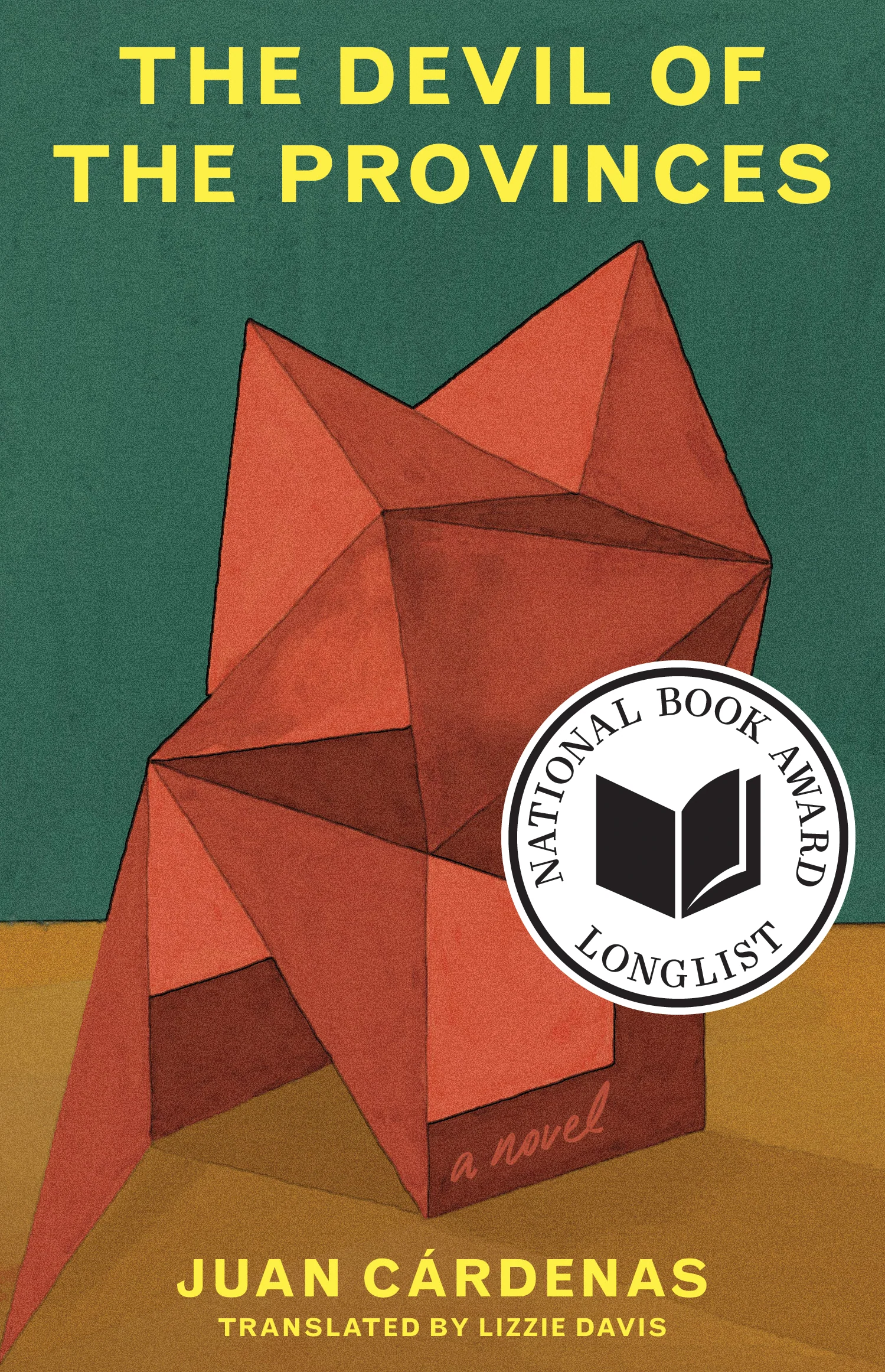
The Devil of the Provinces
A novel by Juan Cárdenas, trans. by Lizzie Davis
September 12, 2023 • 5 x 7.75 • 176 pages • 978-1-56689-678-8
After a series of failures, a biologist returns to his hometown to live with his grieving mother. But in this gripping crime novel that upends the genre’s conventions, strange events unravel what he thought he knew of his past, his present, and himself.
When a biologist returns to Colombia after fifteen years abroad, he quickly becomes entangled in the trappings of his past and his increasingly bizarre present: the unsolved murder of his brother, a boarding school where girls give birth to strange creatures, a chance encounter with his irrevocably changed first love. A brush with a well-connected acquaintance leads to a biotechnology job offer, and he’s gradually drawn into a web of conspiracy. Ultimately, he may be destined to remain in the city he’d hoped never to see again—in The Devil of the Provinces, nothing is as it seems.
About the Author
Juan Cárdenas (1978) is a Colombian art critic, curator, translator, and author of seven works of fiction, most recently the story collection Volver a comer del árbol de la ciencia and the novel Elástico de sombra. He has translated the works of such writers as William Faulkner, Thomas Wolfe, Gordon Lish, David Ohle, J. M. Machado de Assis, and Eça de Queirós. In 2014, his novel Los estratos received the Otras Voces Otros Ámbitos Prize. In 2017, he was named one of the thirty-nine best Latin American writers under the age of thirty-nine by the Hay Festival in Bogotá. Cárdenas currently coordinates the masters program in creative writing at the Caro y Cuervo Institute in Bogotá, where he works as a professor and researcher.
About the Translator
Lizzie Davis is a translator and a writer. Her recent projects include Juan Cárdenas’s Ornamental (a finalist for the 2021 PEN Translation Prize); Elena Medel’s The Wonders, cotranslated with Thomas Bunstead; and work by Valeria Luiselli, Pilar Fraile Amador, and Aura García-Junco.
Praise for The Devil of the Provinces
Longlisted for the 2023 National Book Award for Translated Literature
Vulture, “Books We Can’t Wait to Read in 2023”
“Cárdenas generates queasy intrigue from something as strange as the birth of a devil child and as mundane as a text message that has been read but not replied to. . . . Briskly paced, thoughtful, and truly weird: a whodunit that takes on the very idea of blame.” —Kirkus, starred review
“A dizzying and beguiling yarn. . . . A crime story, but one without clear answers or culprits. . . . Cárdenas describes the sweltering heat in beautifully strange terms, adding to the sense of small-town oppression, where self-deprecating jokes are ‘a kind of determinist doctrine.’ South American fiction fans will love this.” —Publishers Weekly
"Catastrophe and grace intertwine throughout The Devil of the Provinces, as do the horror and beauty of what remains hidden. The result, in the hands of Juan Cárdenas, is hypnotic, disturbing, memorable.” —Rodrigo Hasbún
“A supernatural thriller, a murder mystery, and a rumination on personal and environmental catastrophe—The Devil of the Provinces is none of these things and all of these things. With skillful economy, Juan Cárdenas crafts a story where everyone is complicit, even the reader. A brilliant, ambitious novel that searches for meaning in the shadows of a dangerous and ambiguous world.” —Mark Haber
Praise for Ornamental
Finalist for the 2021 PEN Translation Award
“With pitch-black comedy, Ornamental, nimbly translated by Lizzie Davis, channels the ways that egomaniacs in science and art—in any field—rise to the top, up the pyramid of capitalism. . . . The rhythm of Cárdenas’s writing compels and reassures, as if driven by the very humanity the lab has helped suppress.” —Nathan Scott McNamara, The New York Times
“[A] work of subtlety and restraint. . . . What makes Ornamental so deeply affecting, however, is not that its pages come together to form a beautiful work of exterior art—though [they] do—but its ability to cast unease on our interior worlds. . . . Brilliantly executed and cleverly translated, Ornamental leaves us with a fresh understanding of the creation of art and the nature of meaning-making.” —Dashiel Carrera, Los Angeles Review of Books
“In his thrilling novel Ornamental, Colombian art critic, translator, curator, and renowned author Juan Cárdenas masterfully tells the tale of the junction of an experimenting doctor, his wife, and his subsidized voluntary narcotic patient. . . . Expertly translated by seasoned editor Lizzie Davis.” —Ellie Simon, World Literature Today
“In spare and economical prose, Cárdenas sketches a highly stratified world, where drugs link high society and neighborhoods that are ‘a single crush of old houses and ruins’. . . . The overall effect offers both thrills and chills.” —Publishers Weekly
“[An] absurdist critique of class inequality. . . . Cárdenas also dabbles in art criticism and curation and uses that knowledge to acidic effect in a social drama that borders on the phantasmagorical. . . . With captivating moments.” —Kirkus
“This is the first of Cárdenas’s novels to be translated into English, with hopefully more to come, as he’s a supremely talented and original writer. Ornamental is a strange, dystopian tale about medical trials, in which a doctor studies women addicted to a mysterious recreational drug. Drugs will sadly always be associated with Colombia, but Cárdenas’s surreal examination of addiction and compulsion is a unique and necessary contribution to the conversation.” —Julianne Pachico, The Guardian
“[A]n exhilarating, slippery narrative where the reader knows much truth can be found, if only they can figure out how to decipher it. . . . Cárdenas’s prose is economical yet lyrical; many of his images are veritable objets d’art. . . . Lizzie Davis has done a spectacular job rendering Cárdenas’s novel in English.” —Gillian Esquivia-Cohen, Kenyon Review
“A pointed critique of late capitalism incarnated in today’s manipulative pharmaceutical industry, of rapid modernization in postcolonial contexts, and of facile arts. [Ornamental] showcases the impact of economic exploitation on the human body and desire, and probes the complicity of arts, architecture, philosophy, and language in capitalism’s crooked dynamics. I read translated literature to connect with my linguistic others, to get out of my skin, and see the world through the eyes of those I may never meet otherwise. Cárdenas’s novel and Davis’s translation did just that for me. Davis has masterfully rewritten Cárdenas’s novel in English.” —Sevinç Türkkan, Hopscotch Translation
“Cardenas’s narrative style hangs on outlines and sketches that give the short novel an allegorical heft surprising for its slimness. . . . It’s in the unexpected reversal of focus, from the researcher to number 4, from the moneyed to the impoverished, that Ornamental commits its boldest act and reminds us of the people sacrificed and ignored by the progress of science.” —Sebastian Sarti, Cleveland Review of Books
“This blow-me-over novel, set in a post-narco-baroque Colombia that could be anywhere, begins with a medical study of women committed to ingesting, in exchange for payment, an experimental and addictive recreational drug. Their dreams go strange, serving as a kind of litmus which registers lurid abscesses in a class-and-youth-obsessed society and in what we mistook to be the women’s ordinary lives. Soon, prophetic graffiti appears on walls around the city. Juan Cárdenas is masterful in his rendering of dreamy dreams, in his evocation of workplace psychology, in his urge to keep shifting the structure of his narrative even while he consistently delivers a prose so energetic, restless, and particular that its astonishing poetic qualities—someone ‘threatening pain with extortion,’ someone ‘signing imagined telegrams of dried monkey meat,’ the night recovering, at last, ‘its vulgarity’—don’t give us any pause. And translator Lizzie Davis is the next generation’s Natasha Wimmer, one of our most rewarding and savvy translators from the Spanish.” —Forrest Gander
"In this disquieting dystopia, impeccably translated by Lizzie Davis, the prose of Juan Cárdenas surpasses the beauty promised by the sinister drug of happiness. A very subtle, smart book indeed.” —Alia Trabucco Zerán
“Cárdenas understands the great possibilities available to literary minimalism, taking advantage of them linguistically as well as politically, in careful strokes of theme and plot. A stunning novel about the entitlement of both the pharmaceutical industry and the art world, but also about desire, addiction, excess, and a security team made of spider monkeys. Perhaps the most damning fictional portrait of late capitalism I have ever read, at once absurd and startlingly relevant, Ornamental is a subtle and beautifully written nightmare.” —Brian Evenson
Original: $17.95
-65%$17.95
$6.28Product Information
Product Information
Shipping & Returns
Shipping & Returns
Description
A novel by Juan Cárdenas, trans. by Lizzie Davis
September 12, 2023 • 5 x 7.75 • 176 pages • 978-1-56689-678-8
After a series of failures, a biologist returns to his hometown to live with his grieving mother. But in this gripping crime novel that upends the genre’s conventions, strange events unravel what he thought he knew of his past, his present, and himself.
When a biologist returns to Colombia after fifteen years abroad, he quickly becomes entangled in the trappings of his past and his increasingly bizarre present: the unsolved murder of his brother, a boarding school where girls give birth to strange creatures, a chance encounter with his irrevocably changed first love. A brush with a well-connected acquaintance leads to a biotechnology job offer, and he’s gradually drawn into a web of conspiracy. Ultimately, he may be destined to remain in the city he’d hoped never to see again—in The Devil of the Provinces, nothing is as it seems.
About the Author
Juan Cárdenas (1978) is a Colombian art critic, curator, translator, and author of seven works of fiction, most recently the story collection Volver a comer del árbol de la ciencia and the novel Elástico de sombra. He has translated the works of such writers as William Faulkner, Thomas Wolfe, Gordon Lish, David Ohle, J. M. Machado de Assis, and Eça de Queirós. In 2014, his novel Los estratos received the Otras Voces Otros Ámbitos Prize. In 2017, he was named one of the thirty-nine best Latin American writers under the age of thirty-nine by the Hay Festival in Bogotá. Cárdenas currently coordinates the masters program in creative writing at the Caro y Cuervo Institute in Bogotá, where he works as a professor and researcher.
About the Translator
Lizzie Davis is a translator and a writer. Her recent projects include Juan Cárdenas’s Ornamental (a finalist for the 2021 PEN Translation Prize); Elena Medel’s The Wonders, cotranslated with Thomas Bunstead; and work by Valeria Luiselli, Pilar Fraile Amador, and Aura García-Junco.
Praise for The Devil of the Provinces
Longlisted for the 2023 National Book Award for Translated Literature
Vulture, “Books We Can’t Wait to Read in 2023”
“Cárdenas generates queasy intrigue from something as strange as the birth of a devil child and as mundane as a text message that has been read but not replied to. . . . Briskly paced, thoughtful, and truly weird: a whodunit that takes on the very idea of blame.” —Kirkus, starred review
“A dizzying and beguiling yarn. . . . A crime story, but one without clear answers or culprits. . . . Cárdenas describes the sweltering heat in beautifully strange terms, adding to the sense of small-town oppression, where self-deprecating jokes are ‘a kind of determinist doctrine.’ South American fiction fans will love this.” —Publishers Weekly
"Catastrophe and grace intertwine throughout The Devil of the Provinces, as do the horror and beauty of what remains hidden. The result, in the hands of Juan Cárdenas, is hypnotic, disturbing, memorable.” —Rodrigo Hasbún
“A supernatural thriller, a murder mystery, and a rumination on personal and environmental catastrophe—The Devil of the Provinces is none of these things and all of these things. With skillful economy, Juan Cárdenas crafts a story where everyone is complicit, even the reader. A brilliant, ambitious novel that searches for meaning in the shadows of a dangerous and ambiguous world.” —Mark Haber
Praise for Ornamental
Finalist for the 2021 PEN Translation Award
“With pitch-black comedy, Ornamental, nimbly translated by Lizzie Davis, channels the ways that egomaniacs in science and art—in any field—rise to the top, up the pyramid of capitalism. . . . The rhythm of Cárdenas’s writing compels and reassures, as if driven by the very humanity the lab has helped suppress.” —Nathan Scott McNamara, The New York Times
“[A] work of subtlety and restraint. . . . What makes Ornamental so deeply affecting, however, is not that its pages come together to form a beautiful work of exterior art—though [they] do—but its ability to cast unease on our interior worlds. . . . Brilliantly executed and cleverly translated, Ornamental leaves us with a fresh understanding of the creation of art and the nature of meaning-making.” —Dashiel Carrera, Los Angeles Review of Books
“In his thrilling novel Ornamental, Colombian art critic, translator, curator, and renowned author Juan Cárdenas masterfully tells the tale of the junction of an experimenting doctor, his wife, and his subsidized voluntary narcotic patient. . . . Expertly translated by seasoned editor Lizzie Davis.” —Ellie Simon, World Literature Today
“In spare and economical prose, Cárdenas sketches a highly stratified world, where drugs link high society and neighborhoods that are ‘a single crush of old houses and ruins’. . . . The overall effect offers both thrills and chills.” —Publishers Weekly
“[An] absurdist critique of class inequality. . . . Cárdenas also dabbles in art criticism and curation and uses that knowledge to acidic effect in a social drama that borders on the phantasmagorical. . . . With captivating moments.” —Kirkus
“This is the first of Cárdenas’s novels to be translated into English, with hopefully more to come, as he’s a supremely talented and original writer. Ornamental is a strange, dystopian tale about medical trials, in which a doctor studies women addicted to a mysterious recreational drug. Drugs will sadly always be associated with Colombia, but Cárdenas’s surreal examination of addiction and compulsion is a unique and necessary contribution to the conversation.” —Julianne Pachico, The Guardian
“[A]n exhilarating, slippery narrative where the reader knows much truth can be found, if only they can figure out how to decipher it. . . . Cárdenas’s prose is economical yet lyrical; many of his images are veritable objets d’art. . . . Lizzie Davis has done a spectacular job rendering Cárdenas’s novel in English.” —Gillian Esquivia-Cohen, Kenyon Review
“A pointed critique of late capitalism incarnated in today’s manipulative pharmaceutical industry, of rapid modernization in postcolonial contexts, and of facile arts. [Ornamental] showcases the impact of economic exploitation on the human body and desire, and probes the complicity of arts, architecture, philosophy, and language in capitalism’s crooked dynamics. I read translated literature to connect with my linguistic others, to get out of my skin, and see the world through the eyes of those I may never meet otherwise. Cárdenas’s novel and Davis’s translation did just that for me. Davis has masterfully rewritten Cárdenas’s novel in English.” —Sevinç Türkkan, Hopscotch Translation
“Cardenas’s narrative style hangs on outlines and sketches that give the short novel an allegorical heft surprising for its slimness. . . . It’s in the unexpected reversal of focus, from the researcher to number 4, from the moneyed to the impoverished, that Ornamental commits its boldest act and reminds us of the people sacrificed and ignored by the progress of science.” —Sebastian Sarti, Cleveland Review of Books
“This blow-me-over novel, set in a post-narco-baroque Colombia that could be anywhere, begins with a medical study of women committed to ingesting, in exchange for payment, an experimental and addictive recreational drug. Their dreams go strange, serving as a kind of litmus which registers lurid abscesses in a class-and-youth-obsessed society and in what we mistook to be the women’s ordinary lives. Soon, prophetic graffiti appears on walls around the city. Juan Cárdenas is masterful in his rendering of dreamy dreams, in his evocation of workplace psychology, in his urge to keep shifting the structure of his narrative even while he consistently delivers a prose so energetic, restless, and particular that its astonishing poetic qualities—someone ‘threatening pain with extortion,’ someone ‘signing imagined telegrams of dried monkey meat,’ the night recovering, at last, ‘its vulgarity’—don’t give us any pause. And translator Lizzie Davis is the next generation’s Natasha Wimmer, one of our most rewarding and savvy translators from the Spanish.” —Forrest Gander
"In this disquieting dystopia, impeccably translated by Lizzie Davis, the prose of Juan Cárdenas surpasses the beauty promised by the sinister drug of happiness. A very subtle, smart book indeed.” —Alia Trabucco Zerán
“Cárdenas understands the great possibilities available to literary minimalism, taking advantage of them linguistically as well as politically, in careful strokes of theme and plot. A stunning novel about the entitlement of both the pharmaceutical industry and the art world, but also about desire, addiction, excess, and a security team made of spider monkeys. Perhaps the most damning fictional portrait of late capitalism I have ever read, at once absurd and startlingly relevant, Ornamental is a subtle and beautifully written nightmare.” —Brian Evenson